
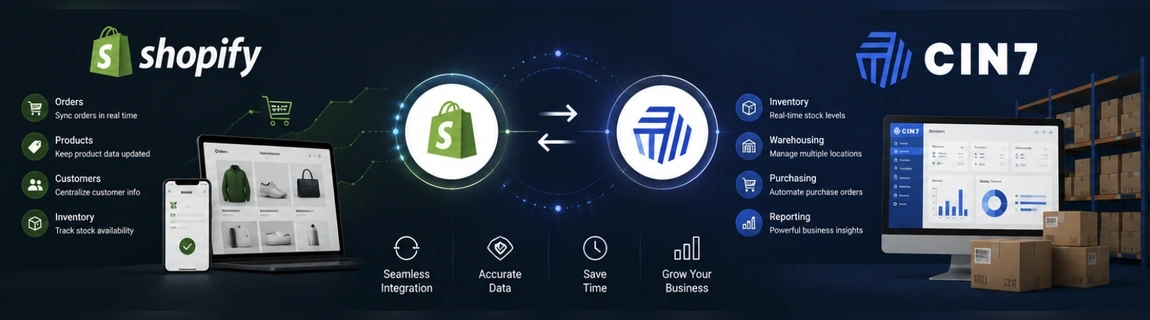
Whether you’re using Cin7 Core or Cin7 Omni, integrating Cin7 with Shopify can significantly improve inventory accuracy, streamline order management and create a scalable foundation for your eCommerce business.
However, a successful integration involves much more than simply connecting two platforms.
The most successful implementations begin with a clear understanding of which system owns what, how information should flow between platforms, and how the integration will support future growth, including B2B, multi-store operations and additional sales channels.
At OSE, we’ve seen businesses save hundreds of hours of manual administration through well-designed integrations. We’ve also seen integrations create ongoing operational issues because critical architectural decisions weren’t made at the beginning.
This guide explores the key considerations when integrating Cin7 with Shopify, common implementation pitfalls, and best practices for building a solution that scales.
Understanding Cin7 Core and Cin7 Omni
Cin7 now offers two primary inventory and operations platforms.
Cin7 Core
Cin7 Core is commonly used by wholesalers, distributors, manufacturers and growing retailers that require:
- Inventory management
- Purchasing
- Manufacturing
- Warehouse management
- Accounting integrations
- Multi-channel inventory
Each Shopify store is connected independently, with configurable settings controlling how products, orders and stock synchronise. Multiple Shopify stores can be connected to a single Cin7 Core account, subject to available integration licences. (Cin7 Core)
Cin7 Omni
Cin7 Omni is designed for retailers managing multiple sales channels, stores and warehouses.
Its Shopify integration supports synchronisation of:
- Products
- Inventory
- Orders
- Customers
- Pricing
- Transaction status
It also supports multiple Shopify stores, with each integration configured independently. Current limitations include incomplete support for some Shopify Markets functionality and certain third-party Shopify applications. (Cin7 Omni Help Center)
Although the products are different, the architectural decisions required for a successful Shopify integration are remarkably similar.
Define Your Source of Truth First
This is arguably the most important decision you’ll make.
Before connecting Shopify to Cin7, determine which platform owns each type of information.
A typical architecture might look like this:
| Data | Recommended Source |
|---|---|
| Inventory | Cin7 |
| Purchase Orders | Cin7 |
| Suppliers | Cin7 |
| Cost Price | Cin7 |
| Customer Orders | Shopify → Cin7 |
| Marketing Content | Shopify |
| SEO | Shopify |
| Landing Pages | Shopify |
| Blog Content | Shopify |
Problems arise when businesses attempt to manage the same information in both platforms.
For example:
- Editing product descriptions in Shopify while updating them in Cin7.
- Maintaining pricing rules in multiple systems.
- Creating products independently in both platforms.
Clear ownership reduces conflicts and simplifies ongoing maintenance.
Product Data Is More Important Than the Integration
Many businesses assume integration is the difficult part.
In reality, product data usually determines whether the project succeeds.
Before synchronising products, review:
- Product names
- SKUs
- Variant structure
- Product images
- Categories
- Attributes
- Units of measure
- Barcode consistency
Poor product data leads to:
- Duplicate products
- Failed mappings
- Broken collections
- Poor customer search
- Incorrect filtering
The integration simply exposes existing data quality problems.
Plan Your SKU Strategy
SKU consistency is critical.
Changing SKUs after integration is significantly more complicated than establishing a clean structure beforehand.
Questions worth asking include:
- Are SKUs unique?
- Will variants share logical naming?
- Are discontinued products archived consistently?
- Are supplier SKUs different from customer-facing SKUs?
A clean SKU strategy makes future integrations considerably easier.
Decide How Products Will Be Created
One question every implementation should answer is:
Where are new products created?
Some businesses:
- Create products in Cin7.
- Push them to Shopify.
- Enrich them inside Shopify.
Others:
- Build products inside Shopify first.
- Import into Cin7.
Neither approach is universally correct.
The important point is consistency.
Cin7 provides controls to determine which system takes precedence when product information differs, helping avoid conflicting updates.
Inventory Synchronisation
Inventory accuracy is usually the primary reason businesses adopt Cin7.
Best practice is to allow Cin7 to become the inventory source of truth.
As orders are processed, stock movements occur in Cin7 before updated quantities are synchronised back to Shopify. Cin7 Core, for example, pushes stock levels from Core to Shopify rather than importing Shopify inventory quantities into Core. (Cin7 Core)
Before going live, consider:
- Multiple warehouses
- Buffer inventory
- Safety stock
- Stock reservations
- Backorders
- Bundles
- Kits
- Manufacturing components
These decisions affect customer experience long after launch.
Order Flow Matters
One of Shopify’s strengths is its checkout experience.
One of Cin7’s strengths is operational management.
A typical flow is:
- Customer places an order in Shopify.
- Order downloads into Cin7.
- Inventory is allocated.
- Picking and packing occur.
- Shipment is completed.
- Fulfilment status updates Shopify.
However, businesses should determine:
- When orders should synchronise.
- Whether draft orders are included.
- How cancelled orders behave.
- How refunds are processed.
- How partial shipments are handled.
Cin7 Core offers configurable order capture points (such as when orders are created, paid or fulfilled) to support different operational workflows. (Cin7 Core)
Pricing Strategy
Pricing is often more complicated than expected.
Questions include:
- Which platform owns retail pricing?
- Are customer-specific prices required?
- Are wholesale prices different?
- Are promotions managed in Shopify?
- How should trade pricing work?
For B2B businesses, Shopify often manages the customer experience while Cin7 provides the operational pricing framework.
Planning this early prevents unnecessary customisation.
Planning for B2B
Many businesses implementing Cin7 eventually want to support wholesale customers.
A modern B2B portal typically requires:
- Customer-specific pricing
- Net payment terms
- Company accounts
- Multiple users
- Approval workflows
- Order history
- Re-order functionality
- Quote requests
While Cin7 manages products, inventory and operational processes, Shopify provides a far richer customer-facing buying experience for B2B organisations.
Designing the integration with future B2B requirements in mind avoids expensive redevelopment later.
Multi-Store Considerations
Many growing businesses operate multiple Shopify stores.
Examples include:
- Separate B2B and B2C stores.
- Australian and international stores.
- Multi-brand businesses.
- Franchise networks.
Both Cin7 Core and Cin7 Omni support multiple Shopify store connections, but each store requires its own integration configuration and careful mapping of products, locations and workflows.
Planning this architecture upfront is far easier than restructuring later.
Common Integration Mistakes
Some of the most common issues we encounter include:
Treating Shopify as an ERP
Shopify is an exceptional commerce platform.
It is not designed to replace inventory management or operational systems.
Treating Cin7 as a CMS
Cin7 manages operational data.
Shopify remains the better platform for merchandising, content, SEO and customer experience.
Ignoring Product Data
The integration cannot fix inconsistent product information.
Clean data should always come first.
No Source of Truth
If both systems attempt to control the same information, conflicts are inevitable.
Underestimating Growth
Businesses often design for today’s requirements rather than tomorrow’s.
Future considerations include:
- Additional Shopify stores
- B2B commerce
- International expansion
- New warehouses
- Marketplaces
- Manufacturing
- Additional ERP integration
Building flexibility into the initial architecture usually reduces future project costs.
When the Native Integration Is Enough
For many businesses, the native Cin7 integration provides everything required.
This is particularly true when:
- Standard inventory synchronisation is sufficient.
- Products follow standard Shopify structures.
- Order workflows are straightforward.
- Single-store operations are involved.
When Customisation May Be Required
As operations become more sophisticated, additional development may be appropriate.
Examples include:
- Advanced B2B pricing
- Custom approval workflows
- Complex fulfilment logic
- Marketplace integrations
- Third-party logistics providers
- PIM integration
- Customer-specific catalogues
- Custom API workflows
The goal should always be to maximise native capability before introducing unnecessary complexity.
Final Thoughts
Integrating Cin7 with Shopify is about much more than synchronising products and inventory.
A successful implementation establishes a scalable operating model that supports sales, warehousing, purchasing, fulfilment and customer experience across your business.
Whether you’re implementing Cin7 Core or Cin7 Omni, the most important decisions are rarely technical. They involve defining ownership of your data, designing efficient operational workflows and ensuring your integration can support future growth.
Taking the time to plan these decisions before implementation will typically result in a more reliable integration, a better customer experience and significantly lower ongoing maintenance costs.