
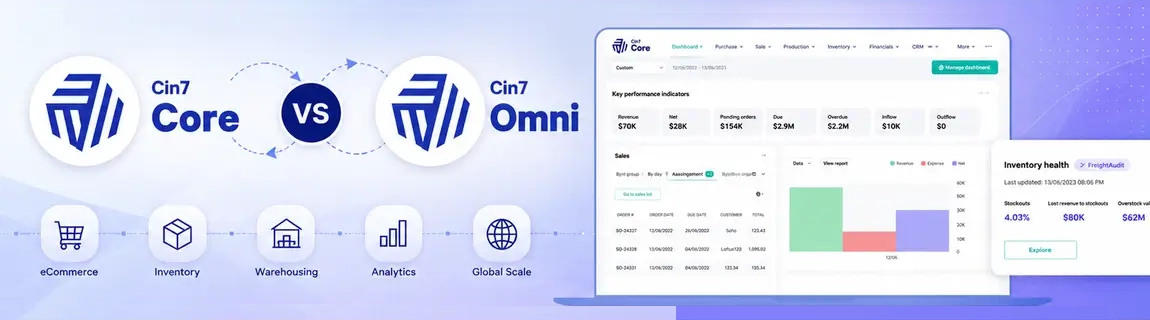
Following Cin7’s acquisition of DEAR Systems, many retailers and wholesalers have found themselves asking a simple question:
Should we choose Cin7 Core or Cin7 Omni?
At first glance, the answer isn’t obvious. Both products sit under the Cin7 umbrella. Both support inventory management. Both integrate with eCommerce platforms. Yet they were built for very different types of businesses.
Choosing the wrong platform can result in unnecessary complexity, operational inefficiencies and costly migration projects down the track. This guide compares Cin7 Core vs Cin7 Omni, helping eCommerce businesses understand which solution is likely to suit them best.
Understanding the Difference
The easiest way to think about the two products is this:
Cin7 Core
Previously known as DEAR Systems, Cin7 Core evolved from an inventory and back-office platform designed primarily for wholesalers, distributors and growing brands.
It focuses heavily on:
- Inventory management
- Purchasing
- Manufacturing
- Warehouse operations
- Accounting integrations
- Multi-channel order management
Cin7 Omni
Cin7 Omni was built with retail complexity in mind.
It combines inventory management with:
- Point of Sale (POS)
- Omnichannel retail
- Franchise operations
- Store replenishment
- Marketplace management
- Physical retail environments
Cin7 Core vs Cin7 Omni at a Glance
| Feature | Cin7 Core | Cin7 Omni |
|---|---|---|
| Former product | DEAR Systems | Original Cin7 |
| Best suited to | Brands, wholesalers, distributors | Omnichannel retailers |
| Physical stores | Limited | Strong |
| POS capability | Basic | Advanced |
| Manufacturing | Strong | Moderate |
| Warehouse operations | Strong | Strong |
| Franchise support | Limited | Excellent |
| Marketplace integrations | Good | Excellent |
| B2B operations | Strong | Moderate |
| Accounting integrations | Extensive | Extensive |
| Inventory complexity | Moderate to high | High |
| Typical business model | Wholesale-led | Retail-led |
Which Businesses Suit Cin7 Core?
Cin7 Core is often the best fit for organisations that primarily sell products rather than operate complex retail environments.
Typical examples include:
Wholesale Businesses
Businesses selling to retailers, resellers or trade customers often benefit from Core’s strengths.
Examples include:
- Food and beverage distributors
- Health and wellness brands
- Importers
- Product wholesalers
Growing DTC Brands
Businesses that started on Shopify and have outgrown spreadsheets frequently choose Core.
Common indicators include:
- Increasing order volumes
- Multiple sales channels
- Expanding product ranges
- More sophisticated purchasing requirements
Businesses with Light Manufacturing
Core supports organisations that:
- Assemble products
- Manufacture in-house
- Track bills of materials
- Require production workflows
Retailers Without Extensive Store Networks
If most revenue comes through eCommerce and operational complexity sits behind the scenes, Core can often provide sufficient capability without introducing unnecessary overhead.
Which Businesses Suit Cin7 Omni?
Cin7 Omni becomes more attractive as physical retail complexity increases.
Omnichannel Retailers
Retailers operating both online and offline channels often require functionality designed specifically for stores.
Examples include:
- Fashion retailers
- Footwear retailers
- Homewares businesses
- Specialty retail chains
Franchise Networks
Omni provides stronger support for businesses managing:
- Multiple stores
- Franchise groups
- Central purchasing
- Store replenishment
Businesses with Complex POS Requirements
Retailers needing integrated point-of-sale functionality may find Omni a more natural fit.
This can include:
- In-store transactions
- Click and collect
- Returns management
- Unified customer experiences
Businesses Focused on Store Operations
Where store performance drives operational decisions, Omni often delivers greater visibility and control.
How Do They Integrate with Shopify?
Both products offer Shopify integrations, but the emphasis differs.
Cin7 Core and Shopify
Typically suited to:
- Shopifyfirst businesses.
- Online-led brands.
- Wholesalers expanding into DTC.
- Businesses seeking operational maturity.
Common integrations include:
- Product synchronisation
- Inventory updates
- Order exports
- Customer synchronisation
- Accounting connectivity
Cin7 Omni and Shopify
Typically suited to:
- Established retailers.
- Businesses with physical stores.
- Franchise environments.
- Omnichannel operations.
Common integrations include:
- Inventory synchronisation
- Click and collect
- Store fulfilment
- Unified stock visibility
- POS workflows
What About Adobe Commerce?
Adobe Commerce is frequently selected by organisations with more sophisticated requirements.
Cin7 Core and Adobe Commerce
A good fit where businesses require:
- B2B functionality
- Customer-specific pricing
- ERP-style inventory control
- Wholesale ordering experiences
Cin7 Omni and Adobe Commerce
More suitable where organisations require:
- Omnichannel fulfilment
- Retail-first operations
- Multiple stores
- Store inventory visibility
Common Mistakes Businesses Make
Choosing a platform based solely on current requirements can create challenges later.
Common mistakes include:
Selecting Core Without Considering Future Retail Expansion
If significant store growth is planned, Omni may offer a stronger long-term fit.
Choosing Omni When Retail Complexity Doesn’t Exist
Businesses can introduce unnecessary cost and complexity if they adopt capabilities they don’t actually need.
Focusing Only on Features
Features matter.
However, businesses should also evaluate:
- Operational workflows
- Future growth plans
- Internal capability
- Integration requirements
- Customer experience objectives
Underestimating Integrations
The software itself is only one part of the equation.
Businesses should carefully assess how their inventory platform connects with:
- Shopify
- Adobe Commerce
- Accounting systems
- Shipping providers
- Marketplaces
- Warehouse technologies
So, Which One Is Right for You?
As a general guide:
Choose Cin7 Core if:
- Most revenue comes through eCommerce.
- You’re a wholesaler or distributor.
- You manufacture or assemble products.
- You require strong inventory and purchasing capabilities.
- Physical retail is limited.
Choose Cin7 Omni if:
- You operate physical stores.
- You run franchise environments.
- POS is critical.
- Omnichannel retail is central to your strategy.
- Store operations drive complexity.
Frequently Asked Questions
Yes. DEAR Systems was rebranded as Cin7 Core following Cin7’s acquisition.
Neither is universally better. The right choice depends on your business model, operational complexity and future growth plans.
Neither is universally better. The right choice depends on your business model, operational complexity and future growth plans.
Yes. Cin7 Omni integrates with Shopify and is particularly well suited to retailers operating physical stores.
Cin7 Core is generally the stronger option for wholesalers and distributors.
Cin7 Omni is typically better suited to businesses operating physical retail networks.
Choosing between Cin7 Core and Cin7 Omni isn’t about selecting the product with the longest feature list. It’s about understanding how your business operates today and where it’s heading tomorrow.
For online-first businesses, wholesalers and growing brands, Cin7 Core often provides the flexibility and inventory capability required to scale efficiently.
For retailers balancing eCommerce, physical stores and omnichannel experiences, Cin7 Omni frequently offers a stronger operational fit.
The best technology decisions are rarely driven by software alone. They come from aligning systems, integrations and customer experiences with the realities of how your business actually works.