Your Product Data Is More Important Than Your eCommerce Platform
When businesses begin planning an eCommerce project, most of the discussion centres around selecting the right platform.
Should you choose Shopify or Adobe Commerce? Should you implement a new ERP integration? Should you invest in a Product Information Management (PIM) system?
While these are all important decisions, one factor has a greater influence on the long-term success of your online store than almost anything else: your product data.
We’ve seen organisations invest hundreds of thousands of dollars into new eCommerce platforms, only to discover their existing product catalogue wasn’t designed for online selling. Missing attributes, inconsistent imagery, poorly structured categories and incomplete product descriptions quickly become obstacles that impact customer experience, search visibility and ongoing operational efficiency.
The reality is simple. Your eCommerce platform is only as good as the product data that powers it.
What Is eCommerce Product Data?
Product data is far more than a product name, SKU and price.
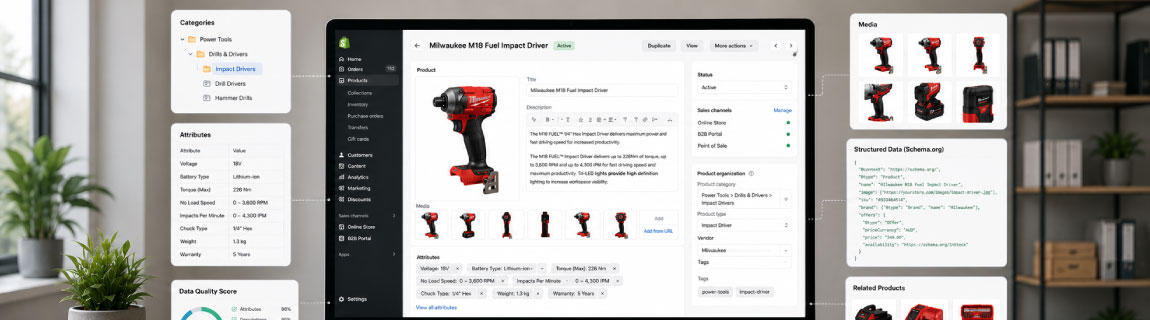
A modern eCommerce catalogue should include:
- Product names
- Detailed descriptions
- Technical specifications
- Product attributes
- Categories
- Product imagery
- Videos
- Downloads and manuals
- Related products
- Cross-sell and upsell relationships
- SEO metadata
- Structured data
- Inventory levels and availability
- Pricing
- Brand information
Together, these elements create a product experience that helps customers discover, evaluate and purchase your products with confidence.
ERP Data Is Not the Same as eCommerce Data
One of the biggest misconceptions in digital commerce is that an ERP contains everything required for an online store.
An ERP is designed to run a business.
It manages inventory, purchasing, warehousing, manufacturing, finance and logistics.
An eCommerce platform is designed to sell products.
Customers expect rich product information, intuitive navigation, advanced filtering, high-quality imagery and detailed specifications. These requirements rarely exist within an ERP because they provide little operational value to warehouse staff or finance teams.
Preparing your catalogue for eCommerce often involves enriching, restructuring and supplementing the information stored within your ERP rather than simply synchronising it. With this in mind, many ERP systems such as Microsoft Dynamics, Infor M3 and Pronto Xi require additional data enrichment before products are ready for online selling.
Designing Categories for Customers, Not Warehouses
Category structures within ERP systems are often created for operational efficiency.
For example:
- Hardware
- Fasteners
- Industrial Components
- Warehouse Bin Locations
While this structure may work internally, customers browse products differently.
A customer shopping online may expect categories such as:
- DIY
- Automotive
- Marine
- Construction
- Home Improvement
Many products also belong in multiple categories simultaneously.
Rather than forcing customers into a single navigation path, modern eCommerce platforms allow products to appear wherever they are relevant. Careful category mapping between your ERP and eCommerce platform creates a significantly better browsing experience without disrupting operational processes.
Product Attributes Drive Discovery
Attributes are one of the most valuable components of an eCommerce catalogue.
Examples include:
- Colour
- Size
- Material
- Voltage
- Capacity
- Thread size
- Compatibility
- Brand
- Country of origin
- Industry application
These structured fields power:
- Product filters
- Site search
- Faceted navigation
- AI-powered search
- Product recommendations
- Marketplace integrations
- Reporting
Without consistent product attributes, customers struggle to find products quickly, increasing frustration and reducing conversion rates.
Rich Product Content Improves Conversion
A manufacturer description copied directly from a supplier catalogue is rarely enough to convert online shoppers.
Strong product pages should include:
- Unique product descriptions
- Key benefits
- Technical specifications
- Feature summaries
- Installation instructions
- Warranty information
- Frequently asked questions
- Downloadable documentation
- Compatibility information
Rich content helps customers make informed purchasing decisions while also improving search engine optimisation.
Artificial intelligence can assist with content enrichment, but it should be used to enhance accurate product information rather than generate content without a reliable data foundation.
Product Imagery Deserves a Strategy
Images often have the greatest influence on purchasing decisions.
Unfortunately, many catalogues contain inconsistent imagery collected over many years.
An effective image strategy should consider:
Consistent Image Dimensions
Maintaining consistent aspect ratios creates a professional shopping experience and prevents product listing pages from appearing uneven.
Appropriate File Sizes
Large images slow page performance, while images compressed too aggressively reduce perceived quality.
Images should be optimised to balance performance and visual clarity.
Modern Image Formats
Where appropriate, consider formats such as:
- WebP
- AVIF
- JPEG
- PNG (only where transparency is required)
Choosing the correct format reduces page weight while maintaining image quality.
Meaningful File Names
Instead of filenames such as:
IMG_4827.jpg
Use descriptive filenames such as:
milwaukee-m18-fuel-impact-driver.jpg
Logical filenames assist with image management and provide additional context for search engines.
Alt Text
Every important product image should include descriptive alternative text that accurately describes the product.
This improves accessibility while providing additional information to search engines.
Build a Consistent Digital Asset Library
Product imagery is only one part of a digital catalogue.
Businesses should also manage:
- Safety Data Sheets
- Installation guides
- Product manuals
- Certificates
- Warranty documents
- Assembly instructions
- Exploded diagrams
- Product videos
Applying consistent naming conventions and version control makes these assets significantly easier to manage over time.
Structured Data Helps Search Engines Understand Your Products
Search engines no longer rely solely on visible page content.
Structured data provides additional context about products using recognised standards such as Schema.org.
Common structured data schemas for eCommerce includes:
- Product
- Offer
- Brand
- Review
- AggregateRating
- Breadcrumb
- Organization
- FAQ
- ImageObject
Correct implementation improves the likelihood of rich search results while helping search engines and AI-powered search experiences better understand your catalogue. We recommending reading up on Google’s Introduction to structured data which gives some pretty clear indication as to which structured data schemas will help your brand boost their visbility online.
Product Relationships Increase Average Order Value
Modern eCommerce catalogues should define relationships between products.
These may include:
- Accessories
- Replacement parts
- Compatible products
- Alternative products
- Upgrades
- Cross-sells
- Upsells
Maintaining these relationships within your product data allows recommendations to be generated consistently across your website and other sales channels. This strategy is particularly important as this gives a great deal of clarity as to the relationships between products and content on your website.
When Should You Consider a PIM?
As product catalogues grow, maintaining information directly within an ERP often becomes increasingly difficult.
A Product Information Management (PIM) platform provides a central location for enriching, governing and distributing product information across multiple channels.
For organisations managing thousands of products, multiple brands or multiple websites, a PIM can simplify catalogue management while improving data quality.
Product Data Requires Ongoing Governance
Creating a high-quality catalogue is not a one-off project.
Businesses should establish clear ownership for:
- Product creation
- Content approval
- Image management
- Attribute standards
- Category governance
- SEO optimisation
- Data quality reviews
Strong governance ensures product information remains accurate as new products are introduced and existing products evolve.
The Commercial Value of Better Product Data
Well-structured product data delivers measurable commercial benefits across your organisation.
Businesses typically experience:
- Improved conversion rates
- Better customer experience
- Faster product discovery
- Stronger organic search visibility
- Improved AI search performance
- More effective product recommendations
- Simpler ERP and marketplace integrations
- Reduced manual administration
- Faster product launches
- Greater consistency across every sales channel
Rather than viewing product information as an administrative task, successful organisations treat it as a strategic business asset.
Conclusion
The success of an eCommerce platform depends on far more than the technology it runs on.
Whether you’re implementing Shopify, Adobe Commerce or another enterprise platform, investing in high-quality product data creates a stronger foundation for every aspect of digital commerce.
Well-structured categories, comprehensive product attributes, rich content, optimised imagery, structured data and clear governance all contribute to a better customer experience and a more efficient business.
If you’re planning an eCommerce project, preparing your product catalogue before development begins is one of the highest-value investments you can make. A modern platform can only perform as well as the product data it receives, making product quality a competitive advantage that continues to deliver value long after your website goes live.