
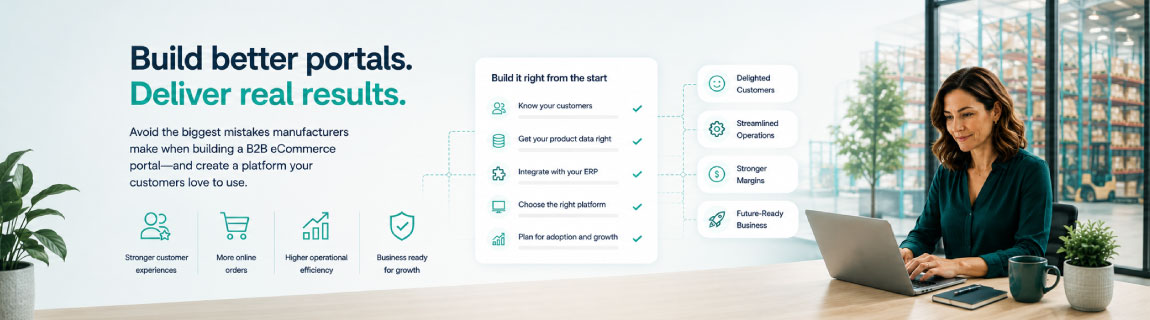
For many manufacturers, investing in a B2B eCommerce portal represents one of the most significant digital transformation projects they’ll undertake.
Done well, a modern B2B portal can streamline operations, improve customer satisfaction, reduce administrative costs and enable sustainable business growth. Customers gain the ability to place orders online 24/7, view customer-specific pricing, check stock availability and access technical product information without needing to contact a sales representative.
Yet despite these benefits, many B2B commerce projects fail to achieve their full potential.
The reason is rarely the technology itself.
Instead, problems usually begin much earlier, during planning, platform selection and project scoping.
Over the years we’ve worked with manufacturers, wholesalers and distributors across Australia, we’ve seen the same mistakes repeated time and again.
Avoiding them can significantly improve both the success of your project and the long-term return on your investment.
Mistake 1: Treating B2B Like B2C
One of the most common misconceptions is assuming a B2B portal is simply a retail website with customer login functionality.
In reality, B2B commerce introduces an entirely different set of requirements.
Manufacturers typically need to support:
- Customer-specific pricing.
- Contract pricing.
- Multiple buyers within a single organisation.
- Approval workflows.
- Credit limits.
- Customer-specific product catalogues.
- Quote requests.
- Bulk ordering.
- Repeat ordering.
- Multiple delivery locations.
- Complex tax requirements.
Designing a B2B portal using B2C thinking almost always creates frustration for both customers and internal teams.
Mistake 2: Choosing a Platform Before Understanding the Business
Many projects begin with the question:
Which eCommerce platform should we choose?
In reality, this should be one of the last questions asked.
The first questions should be:
- What business problems are we trying to solve?
- How do our customers buy?
- How complex are our pricing structures?
- What systems need to integrate?
- What does success look like three years from now?
Only once these questions have been answered should platform selection begin.
A common mistake is selecting whichever platform is currently attracting the most attention in the market.
Every major platform has strengths.
Some excel in B2C retail.
Others provide exceptional flexibility for complex B2B requirements.
Some are easier to implement.
Others offer deeper customisation.
The right platform depends on your business model, customer expectations, operational complexity and long-term strategy, not current market trends.
Mistake 3: Underestimating ERP Integration
For manufacturers, the ERP remains the heart of the business.
Your eCommerce platform is only as effective as the information flowing into it.
Successful integrations typically include:
- Customer pricing.
- Inventory.
- Product data.
- Sales orders.
- Shipment tracking.
- Customer accounts.
- Credit information.
- Order history.
- Invoices.
Attempting to shortcut ERP integration often results in duplicate processes, inconsistent information and poor customer experiences.
Mistake 4: Assuming ERP Product Data Is Ready for eCommerce
ERP systems were designed to run businesses.
They were not designed to sell products online.
Many ERP catalogues contain:
- Internal product names.
- Limited descriptions.
- Missing imagery.
- Minimal attributes.
- Inconsistent categories.
Modern B2B commerce requires far richer information.
Technical specifications.
Documents.
Compatibility.
Installation guides.
Videos.
FAQs.
Industry certifications.
The businesses investing in eCommerce-ready product data consistently outperform those relying solely on ERP records.
Mistake 5: Forgetting About Customer Adoption
Building the portal is only half the project.
Customers actually using it is the other half.
Many organisations launch excellent systems but continue receiving orders by phone and email because they never encourage behavioural change.
Successful adoption often includes:
- Customer training.
- Sales team support.
- Incentives for online ordering.
- Clear communication.
- Simple onboarding.
- Ongoing optimisation.
Technology alone rarely changes customer behaviour.
Mistake 6: Designing Around Internal Departments Instead of Customers
Many navigation structures mirror internal departments.
Or ERP categories.
Customers don’t think this way.
They search by:
- Application.
- Industry.
- Product type.
- Brand.
- Compatibility.
- Problem they’re trying to solve.
The most successful B2B portals organise products around customer buying behaviour rather than internal business structures.
Mistake 7: Ignoring Search
Many B2B catalogues contain tens or even hundreds of thousands of products.
Customers should not need to browse through multiple category levels to locate a product.
Modern B2B search should support:
- Part numbers.
- Customer part numbers.
- Natural language.
- Synonyms.
- Product attributes.
- Technical filters.
- AI-assisted recommendations.
Search is often the single most important feature in a large B2B catalogue.
Mistake 8: Not Planning for Future Growth
Many organisations scope projects around today’s requirements.
Instead, ask:
What will our business look like in five years?
Will you expand internationally?
Add new brands?
Acquire businesses?
Launch direct-to-consumer channels?
Introduce customer portals for different markets?
A scalable architecture avoids expensive rebuilds later.
Mistake 9: Trying to Replicate Every Existing Manual Process
Digital transformation is an opportunity to improve processes.
Not simply digitise inefficiencies.
Ask:
Does this approval process still make sense?
Could AI help?
Can customers self-serve?
Can pricing be automated?
Can repeat orders be simplified?
Every project should improve the business, not preserve unnecessary complexity.
Mistake 10: Choosing an Implementation Partner on Price Alone
Perhaps the most expensive mistake is selecting a delivery partner purely because their proposal has the lowest upfront investment.
B2B commerce projects involve:
- Complex integrations.
- Business process redesign.
- Product data.
- Customer experience.
- Long-term support.
The quality of implementation often determines how easy the platform will be to maintain over the next five to ten years.
Well-structured solutions typically reduce future maintenance costs dramatically, simplify upgrades and provide greater flexibility as your business evolves.
The cheapest implementation is often the most expensive over the life of the platform. When undertaking a B2B portal build, remember this is likely the most influential factor when it comes to overall sales-channel TCO.
A Successful B2B Portal Is More Than Just Software
The most successful B2B commerce projects don’t begin with technology.
They begin with understanding customers, business processes and long-term strategy.
Only then do they move into platform selection, integrations and implementation.
Manufacturers who invest time in planning, product data, ERP integration and customer experience consistently achieve stronger adoption, greater operational efficiencies and a higher return on investment.
Final Thoughts
Building a successful B2B eCommerce portal isn’t simply about selecting a modern platform or integrating with your ERP. It’s about creating a digital experience that genuinely improves the way your customers buy from you while making your business more efficient to operate.
The most successful manufacturers approach B2B commerce as a long-term business transformation rather than an IT project. They invest time in understanding their customers, improving product data, simplifying business processes and selecting technology that aligns with both their current requirements and future growth plans.
It’s also important to remember that a B2B portal is never truly “finished”. Customer expectations continue to evolve, new technologies emerge, and businesses change over time. The organisations achieving the greatest return on investment are those that continuously refine their portal, introduce new self-service capabilities, improve search and product discovery, and use customer feedback to shape future enhancements.
Perhaps the biggest takeaway is this: while technology plays an important role, it is rarely the deciding factor in the success of a B2B commerce project.
Projects succeed because they begin with a clear understanding of business objectives, are built around customer needs rather than internal processes, and are supported by high-quality implementation and ongoing optimisation.
Manufacturers that avoid the common mistakes outlined in this article are far more likely to deliver a portal that not only reduces operational costs and improves customer satisfaction, but also becomes a genuine competitive advantage. In an increasingly digital marketplace, a well-executed B2B eCommerce portal is no longer just another sales channel. It is becoming one of the most important investments a manufacturer can make to support future growth.