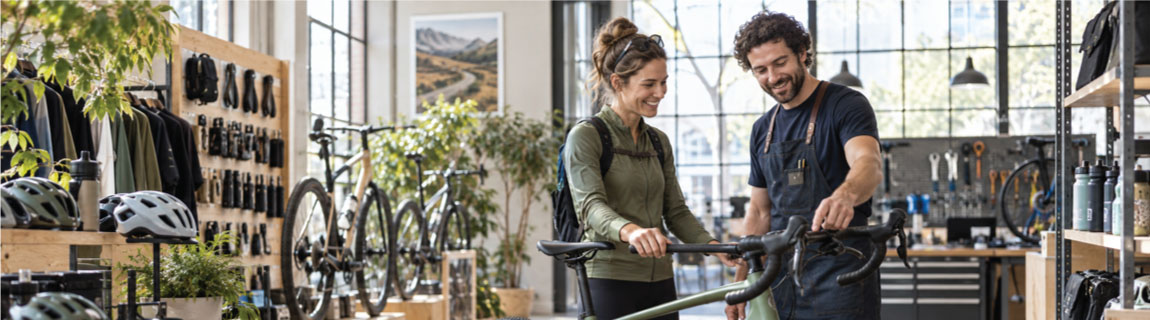

A customer buys a pair of leggings online and chooses to collect them from your store. When they arrive, their order is ready. A team member offers a fitting room, helps them confirm the size and shows them a matching top. They leave with an outfit, confidence in their purchase and a reason to return.
That’s the commercial opportunity behind click & collect.
The original online order is only one part of the journey. Collection creates an opportunity to provide useful service, introduce relevant products and build a relationship with someone who has already chosen your brand.
Capturing that opportunity takes coordination. Your website, inventory, store team and customer communications all need to support the same experience.
Here’s how to make click & collect a stronger contributor to omnichannel revenue.
1. Make collection visible before checkout
Customers may choose a retailer because they can get a product locally, avoid delivery costs or collect it around their schedule. Give them that information while they’re deciding what to buy.
Show collection availability on product pages, with details for the selected variant and location. “Available for collection” is a starting point. “Available at Fortitude Valley—usually ready within four business hours” gives customers something they can plan around.
Only display timeframes your team can reliably meet.
Keep collection visible alongside delivery at checkout, and make it easy to switch between them. Baymard’s usability research has found that shoppers can miss alternative fulfilment options or struggle to distinguish store pickup from ship-to-store services. Clear labels and accessible choices matter.
If an item needs transferring from another location, explain the additional wait. A product available for collection today is a different proposition from one arriving next week.
2. Make inventory accuracy part of the sales experience
A collection promise depends on having the right product, in the right location, ready for the customer.
If someone purchases the final unit online while another shopper buys it in-store, your team needs a clear way to resolve the conflict. Without reliable stock updates and order reservation, click & collect can create cancellations and wasted journeys.
Review how your operation handles:
- Inventory updates between your ecommerce platform and point-of-sale system.
- Stock reservation after an online purchase.
- Low-stock items, damaged goods and display stock.
- Orders requiring transfers between locations.
- Exceptions when staff cannot locate an item.
Assign ownership for checking incoming orders and physically confirming stock. Send the ready-for-collection notification once the item has been picked and set aside.
The immediate objective is simple: when you tell a customer their order is ready, it should be ready.
3. Use collection messages to remove uncertainty
Your confirmation email should explain what happens next. Your ready-for-collection message should explain what to do now.
Keep that distinction obvious so customers don’t travel to the store too early.
A useful collection notification includes the store address, opening hours, collection point, order reference, what the customer needs to bring and how long you’ll hold the order. Include parking or access instructions where they make the visit easier.
Make the essentials easy to read on a phone.
You can also introduce a relevant service:
“Want to check the fit before you leave? Our team can help you try on your order when you collect.”
Keep promotional content secondary to collection instructions. The message’s first job is to help the customer complete their visit successfully.
4. Design a fast handover with an opportunity to browse
Make the collection point easy to find. Customers should not need to queue at several counters or explain their order to multiple staff members.
A clearly signed desk, organised storage and a straightforward order lookup process can help staff serve customers efficiently.
Around that experience, create opportunities for discovery. Place a small, relevant selection of products near the collection area and keep displays easy to browse.
For an activewear retailer, that might mean socks, caps or matching pieces from a featured collection. A homewares store could present candles beside candleholders. An electronics retailer could offer.
Preserve a quick route for customers who simply want to collect and leave. Additional purchases should come from relevance and good service.
5. Train staff to make one useful recommendation
Store teams need enough product and order context to help naturally.
A generic “Anything else today?” gives customers little reason to engage. A specific question can uncover a need:
“Would you like to check the fit before you head off?”
Or:
“Do you already have the adapter this needs?”
Build a short set of prompts around your most common collection categories. Focus on fit, compatibility, intended use and genuinely useful complementary products.
Give staff permission to accept a quick “No, thanks” and complete the handover immediately.
Recognise the operational work too. Picking orders, maintaining accuracy and meeting collection promises all contribute to the customer experience. Sales incentives should support those responsibilities.
6. Test additional value before offering blanket discounts
A pickup-only discount may encourage another purchase, but it also reduces the margin on products a customer might have bought at full price.
Start by testing service and relevance: a fitting session, product demonstration, complementary-product display or carefully chosen bundle.
If you test an incentive, define the conditions and commercial objective. For example, a qualifying bundle might aim to increase attachment of a useful accessory while preserving a minimum contribution margin.
Compare the result with similar collection visits that did not receive the offer. Look at additional sales, discounts, product costs and returns.
A higher basket value is useful when the economics improve with it.
7. Make exchanges and order changes straightforward
Collection is an opportunity to resolve uncertainty while the customer is already in front of your team.
For products where it makes sense, offer a chance to check size, colour or suitability before leaving. Staff should understand how to handle an exchange, price difference or refund across online and store systems.
Explain relevant conditions clearly, including any restrictions on sale items.
If an item is unsuitable, helping the customer find the right alternative can preserve the sale. A straightforward refund process can also protect the relationship when an alternative does not work.
Record the reason for the change. Repeated sizing or product-description issues can inform improvements to your website.
8. Connect online and store reporting
Click & collect spans several events: an online purchase, store fulfilment, collection and possibly a separate in-store transaction.
Connect those events where your systems support it. That might involve linking an additional point-of-sale purchase to the collection order or using a consistent customer record.
Shopify’s current click & collect guidance includes pickup workflows and performance measurement, illustrating the need to manage the service across both ecommerce and store operations.
Keep the accounting clear. Count the original purchase once. Record any additional purchase separately, and give the collecting store operational credit without duplicating revenue.
Avoid making account creation or marketing sign-up a condition of collection. The reporting process should remain simple for the customer and staff.
9. Measure additional revenue and the cost of delivering it
Pickup order volume tells you how much customers use the service. It does not tell you whether the service is creating profitable growth.
Use a balanced scorecard:
| Metric | What it helps you understand |
|---|---|
| Collection orders ready within the promised timeframe | Whether you’re delivering a reliable service |
| Customer wait time at collection | How easy the handover is |
| Stock-related cancellation rate | Whether availability is trustworthy |
| Additional-purchase rate | How often collection visits include another purchase |
| Average additional purchase value | How much those purchases contribute |
| Contribution after fulfilment costs | Whether the economics are attractive |
| Repeat purchase rate across channels | Whether customers return after collection |
Define your measures consistently. For example:
Additional-purchase rate = collection visits with a linked additional purchase ÷ completed collection visits
Imagine 1,000 completed collection visits, with 180 linked additional purchases averaging $35. That represents $6,300 in associated additional sales.
It does not prove that all $6,300 was caused by click & collect. Some customers may have made those purchases anyway. To assess incremental impact, test changes across comparable stores or periods and account for differences in traffic, promotions and product mix.
Include picking labour, storage, transfers, payment fees and returns when evaluating contribution. Collection may avoid some delivery costs, but it still requires resources.
10. Improve one part of the journey at a time
Begin with a complete test order. Assess product-page availability, checkout selection, notifications, readiness, signage and handover.
Fix reliability problems first. Then test one commercial improvement, such as a relevant display near collection or a staff prompt offering a fit check.
Set a primary success measure and monitor the customer experience alongside it. A recommendation that increases additional purchases but creates longer queues may need changing.
Once you find an approach that works, document it clearly enough for another store or team member to repeat.
The next time someone collects an online order, give them an accurate promise, an easy handover and useful help. Those are practical foundations for earning an additional purchase today—and another visit later.
Turn Every Collection Into a Revenue Opportunity
Click and collect should be treated as more than a fulfilment option. When it is designed properly, it brings high-intent customers into stores, reduces delivery friction and creates valuable opportunities for additional purchases, stronger loyalty and better customer service.
The retailers achieving the best results connect accurate local inventory, a simple checkout, clear collection communications and a well-planned in-store experience. They also measure what happens after the online order, including collection speed, additional store purchases, repeat orders and customer lifetime value.
The opportunity is significant, but success depends on the technology and operational processes beneath the experience. With the right commerce platform, integrations and store strategy, click and collect can become one of the most commercially valuable connections between your online and physical retail channels.