
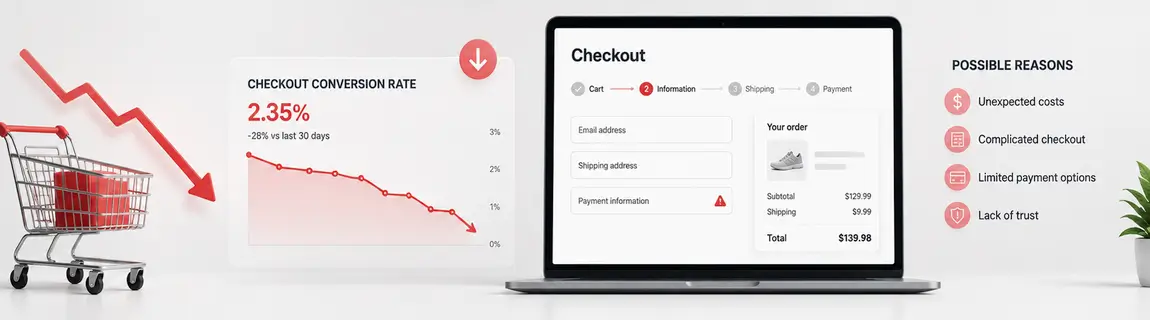
Your checkout conversion rate was 62% last month. This month it’s 48%.
Traffic hasn’t changed significantly. Marketing spend is consistent. Product pricing appears stable. Yet fewer customers are completing their purchases.
Sound familiar?
A sudden drop in checkout conversion is one of the most concerning issues an eCommerce business can experience. Even a small decline can have a significant impact on monthly revenue.
For example, if 10,000 customers begin checkout each month, reducing checkout conversion from 60% to 50% results in 1,000 fewer completed orders. Depending on your average order value, that can represent hundreds of thousands of dollars in lost revenue annually.
The good news is that checkout conversion issues are rarely random.
In almost every case, there is an underlying cause that can be identified through a structured investigation.
This guide outlines the areas we recommend reviewing when checkout conversion suddenly declines.
Before You Start: Confirm It’s a Real Problem
The first step is ensuring the decline is genuine.
Review:
- Date range comparisons
- Year-on-year performance
- Device mix
- Traffic sources
- Campaign changes
- Major promotions
- Seasonal fluctuations
A one-week decline during a public holiday or immediately after a large sale may not indicate a long-term issue.
Look for sustained trends rather than isolated anomalies.
1. Did Anything Change?
Start with the obvious.
Many checkout issues appear immediately after a seemingly unrelated change.
Review recent changes including:
- Theme updates
- Checkout customisations
- Shopify Checkout Extensibility updates
- Adobe Commerce releases
- Payment gateway changes
- Shipping configuration
- Tax settings
- Third-party applications
- ERP integrations
- Inventory synchronisation
- Promotional rules
Even a minor adjustment can unintentionally introduce friction into the checkout process.
Create a timeline of changes against your conversion data.
Often, the answer becomes immediately obvious.
2. Has Traffic Quality Changed?
Not every conversion issue is a checkout issue.
If marketing begins attracting lower-intent visitors, checkout completion naturally declines.
Compare:
- Organic search
- Paid search
- Social campaigns
- Email marketing
- Direct traffic
- Referral traffic
Look for channels with unusually high checkout abandonment.
If one campaign is responsible, the problem may have started well before the customer reached checkout.
3. Has Mobile Performance Declined?
For many retailers, mobile now generates the majority of checkout sessions.
Yet it often converts significantly lower than desktop.
Review:
- Mobile checkout conversion
- Desktop checkout conversion
- Tablet performance
- Operating systems
- Browser versions
If desktop remains stable while mobile falls, the issue is often related to usability rather than pricing or products.
Common examples include:
- Buttons below the fold
- Difficult form fields
- Keyboard issues
- Slow page rendering
- Poor autofill support
4. Are Payment Methods Failing?
Payment issues frequently go unnoticed.
Customers rarely contact a retailer to report that their payment failed.
Instead, they simply abandon their purchase.
Investigate:
- Payment gateway logs
- Card decline rates
- 3D Secure failures
- Apple Pay
- Google Pay
- PayPal
- Buy Now Pay Later providers
- Fraud detection rules
Even a small increase in payment failures can dramatically affect conversion.
5. Have Shipping Costs or Delivery Estimates Changed?
Unexpected shipping costs remain one of the largest causes of checkout abandonment.
Review:
- Shipping charges
- Delivery estimates
- Shipping rule changes
- Free shipping thresholds
- Regional pricing
- International shipping
Customers often tolerate higher product prices more readily than unexpected shipping costs introduced at the final step.
6. Is Inventory Causing Friction?
Inventory issues don’t always prevent checkout.
They often reduce customer confidence.
Examples include:
- Products becoming unavailable during checkout
- Backorders appearing unexpectedly
- Split shipments
- Low stock warnings
- Inventory synchronisation delays
If your ERP updates inventory every few minutes rather than in real time, customers may encounter frustrating inconsistencies.
7. Has Checkout Become Slower?
Performance matters.
Customers become increasingly impatient during checkout because they are moments away from completing their purchase.
Review:
- Page load time
- Server response
- Third-party scripts
- Payment gateway latency
- Shipping rate calculations
- ERP pricing lookups
Many enterprise websites experience slower checkout performance after additional integrations are introduced.
Every API request adds time.
8. Are Discount Codes Creating Problems?
Promotions are designed to increase revenue.
Ironically, they can also reduce conversion.
Examples include:
- Expired coupons
- Invalid discount messages
- Stacking conflicts
- Gift card issues
- Loyalty redemption failures
Customers encountering unexpected errors frequently abandon rather than retry.
9. Has Customer Trust Been Reduced?
Trust is particularly important during checkout.
Customers are about to provide payment information.
Anything that creates uncertainty increases abandonment.
Review:
- Security messaging
- Payment logos
- Delivery information
- Returns policy
- Contact details
- Error messages
- Checkout branding
Even small design changes can influence customer confidence.
10. Are Checkout Errors Being Logged?
Most businesses only monitor revenue.
Few actively monitor checkout errors.
Check:
- JavaScript errors
- Browser console logs
- Payment gateway errors
- API failures
- Validation errors
- Session timeouts
Technical issues affecting only a small percentage of users can still have a meaningful financial impact.
11. Has One Browser or Device Stopped Working?
Sometimes checkout appears healthy overall.
The problem only affects one browser.
Review conversion by:
- Chrome
- Safari
- Edge
- Firefox
Also compare:
- iPhone
- Android
- Windows
- macOS
A browser-specific issue introduced during a recent update can reduce conversion almost overnight.
12. Has Customer Behaviour Changed?
Not every decline originates from your website.
External factors may influence buying behaviour.
Examples include:
- Cost of living pressures
- Competitor promotions
- Seasonal demand
- Product availability
- Industry changes
Understanding the broader market helps determine whether the issue is operational or commercial.
Build a Checkout Investigation Checklist
Rather than jumping straight into redesigning your checkout, work through a structured diagnostic process.
A practical investigation should cover:
- Recent platform changes
- Marketing changes
- Device performance
- Browser performance
- Payment methods
- Shipping configuration
- Inventory accuracy
- Performance metrics
- Error logs
- Customer feedback
Working methodically often identifies the cause much faster than making multiple changes simultaneously.
Don’t Assume the Platform Is the Problem
When checkout conversion drops, organisations often conclude they need a new platform.
In reality, platforms are rarely the primary cause.
We’ve seen conversion declines caused by:
- Payment provider configuration
- Shipping logic
- Third-party apps
- Product availability
- Promotional rules
- Performance degradation
- Analytics implementation errors
Migrating platforms without identifying the underlying issue simply transfers the problem to new software.
Final Thoughts
A declining checkout conversion rate should never be ignored.
Even a relatively small reduction can have a substantial impact on annual revenue.
The most successful eCommerce teams don’t guess why conversion has fallen. They investigate systematically, eliminate potential causes one by one, and use data to identify the true source of friction.
Whether you’re running Shopify, Adobe Commerce or another enterprise platform, the goal isn’t simply to increase checkout conversion. It’s to understand why customers are abandoning the process and remove the obstacles preventing them from completing their purchase.
By approaching checkout optimisation as a diagnostic exercise rather than a redesign project, you’ll often uncover improvements that deliver measurable revenue growth without changing your platform at all.