
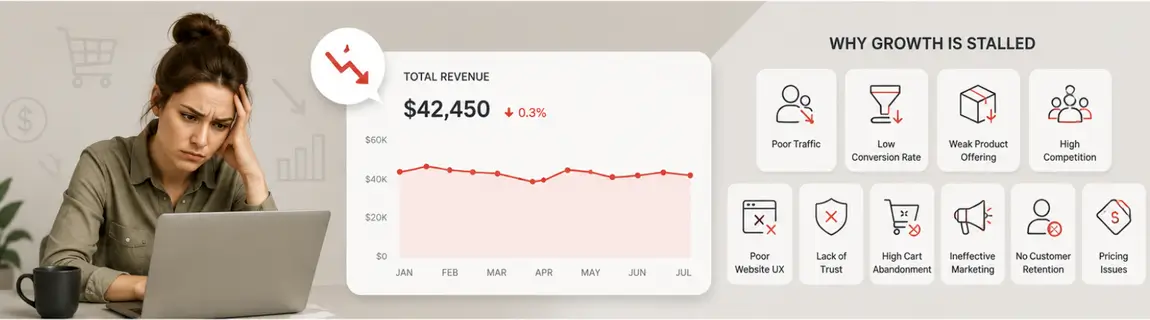
If your online revenue has plateaued, you’re not alone.
Many retailers and manufacturers experience periods where online sales simply stop growing. Traffic may still be coming to the site. Orders are still being placed. Marketing spend continues. Yet month after month, revenue barely moves.
The immediate reaction is often to increase advertising budgets, redesign the website, or even consider replacing the eCommerce platform entirely.
In reality, those are rarely the root cause.
After working with enterprise retailers, manufacturers and B2B organisations across Australia, we’ve found that flat revenue is usually the result of several smaller issues compounding over time. The good news is that identifying these bottlenecks often presents significant opportunities for growth without dramatically increasing your marketing spend.
This guide explores the most common reasons online revenue stagnates and where organisations should focus their efforts before investing in a complete digital transformation.
1. You’re Attracting Visitors, But Not Buyers
A healthy increase in website traffic doesn’t necessarily translate into increased revenue.
Many businesses celebrate growing visitor numbers while overlooking a decline in conversion quality.
Ask yourself:
- Has organic traffic increased while enquiries remain flat?
- Are paid campaigns attracting visitors with low purchase intent?
- Has AI search changed the type of traffic reaching your website?
- Are visitors landing on pages that don’t match their expectations?
Search engines have evolved considerably. Success is no longer simply about ranking highly for broad keywords. Today’s customers expect highly relevant landing pages that immediately answer their questions and guide them towards a purchase.
Rather than focusing purely on traffic volume, organisations should analyse:
- Conversion rate by traffic source
- Revenue by landing page
- Bounce rates
- Time on page
- Assisted conversions
Often, improving traffic quality delivers better results than simply increasing visitor numbers.
2. Customers Can’t Find What They’re Looking For
This is one of the most common issues we encounter.
Businesses invest heavily in acquiring visitors, only to lose them because products are difficult to discover.
Typical causes include:
- Poor search functionality
- Confusing navigation
- Excessive category depth
- Missing filters
- Inconsistent product attributes
- Weak product naming conventions
Large catalogues become particularly challenging as they grow.
A retailer with 20,000 products cannot rely on navigation alone. Customers increasingly expect intelligent search, predictive suggestions, faceted filtering and product recommendations that quickly narrow their options.
If customers cannot find products within seconds, many simply leave.
3. Product Data Has Become a Competitive Weakness
Many organisations underestimate the impact of product data.
Poor product information doesn’t just affect SEO.
It influences nearly every aspect of an eCommerce experience.
Examples include:
- Internal search
- Category pages
- Filters
- Product recommendations
- AI search
- Merchant Centre feeds
- Product comparison
- Customer confidence
Common issues include:
- Missing specifications
- Poor product descriptions
- Inconsistent attributes
- Duplicate information
- Limited imagery
- Missing compatibility information
For manufacturers and wholesalers, product data is often inherited directly from an ERP system. While suitable for internal operations, ERP data rarely provides the level of detail customers expect online.
Investing in product data frequently delivers improvements across conversion, search visibility and customer satisfaction simultaneously.
4. Your Website Mirrors Your ERP Instead of Your Customers
This is particularly common in B2B environments.
Many websites are unintentionally designed around ERP structures rather than customer buying behaviour.
Examples include:
- ERP category structures
- Internal product codes
- Technical product names
- Complex pricing rules
- Stock visibility limitations
Your ERP exists to manage business operations.
Your website exists to help customers buy.
Those are very different objectives.
Successful eCommerce businesses separate operational systems from customer experience, allowing merchandising, navigation and content to reflect how customers actually shop.
5. Your Mobile Experience Is Costing You Sales
Mobile traffic now represents the majority of visits for many retailers.
Unfortunately, many enterprise websites were originally designed around desktop users.
Areas worth reviewing include:
- Navigation complexity
- Filter usability
- Search placement
- Page load speed
- Checkout flow
- Form completion
- Product image quality
Even small improvements to mobile usability can have a meaningful impact on conversion rates.
6. Customers Don’t Yet Trust Your Business
Buying online always involves an element of risk.
Customers are constantly asking themselves:
“Can I trust this company?”
Trust is built through dozens of small signals, including:
- High-quality photography
- Detailed specifications
- Customer reviews
- Delivery information
- Returns policies
- Clear contact details
- Professional design
- Secure checkout
Weak product pages create uncertainty.
Strong product pages reduce perceived risk and increase confidence.
Often, improving trust signals delivers stronger returns than redesigning the entire website.
7. Existing Customers Aren’t Coming Back
Many businesses spend heavily acquiring new customers while neglecting those they’ve already won.
Returning customers typically:
- Convert at higher rates
- Spend more per order
- Require lower acquisition costs
- Purchase more frequently
If repeat purchase rates remain low, consider:
- Email automation
- Loyalty programs
- Personalised recommendations
- Replenishment reminders
- Customer segmentation
- Trade account engagement
- Post-purchase education
Increasing customer lifetime value is often faster and more cost-effective than constantly chasing new visitors.
8. You’re Measuring Revenue Instead of Performance
Revenue is an outcome.
It isn’t the metric that tells you what needs improvement.
Instead, organisations should monitor indicators such as:
- Conversion rate
- Average order value
- Add-to-cart rate
- Search success rate
- Product page engagement
- Returning customer rate
- Checkout completion
- Revenue per visitor
When these metrics improve consistently, revenue usually follows.
9. Your Competitors Haven’t Stood Still
The eCommerce market changes rapidly.
Leading retailers continuously improve:
- Product content
- Search
- Navigation
- Merchandising
- Personalisation
- AI capabilities
- Checkout
- Customer service
Many organisations launch a website and expect it to perform for years with only minor updates.
The highest-performing businesses treat optimisation as an ongoing process rather than a one-time project.
Small improvements made every month compound into significant competitive advantages over time.
10. You’re Solving the Wrong Problem
Perhaps the biggest mistake organisations make is assuming their platform is responsible for flat revenue.
Sometimes it is.
Often it isn’t.
We’ve seen businesses migrate platforms only to discover that:
- Product data remained poor.
- Search still underperformed.
- Navigation stayed confusing.
- ERP integrations continued to frustrate users.
- Customer experience barely changed.
Changing technology without addressing underlying business problems rarely produces transformational growth.
Before investing in a replatform, organisations should objectively assess whether the real issues lie in data, customer experience, merchandising, integrations, marketing or internal processes.
A successful eCommerce strategy addresses these fundamentals first.
Where Should You Start?
If online revenue has plateaued, resist the temptation to look for a single silver bullet.
Instead, conduct a structured review across your digital ecosystem.
Ask questions such as:
- Can customers quickly find products?
- Is our product data complete and accurate?
- Does our website reflect customer buying behaviour?
- Are we retaining existing customers effectively?
- Are we measuring the right performance indicators?
- Is our technology enabling growth or creating friction?
In many cases, improving these areas unlocks significant revenue growth without dramatically increasing advertising budgets or replacing core systems.
Final Thoughts
Flat online revenue is rarely caused by one major issue.
More often, it’s the accumulation of dozens of smaller friction points across product data, customer experience, search, integrations, merchandising and ongoing optimisation.
The businesses that consistently outperform their competitors don’t simply spend more on marketing. They remove friction from every stage of the customer journey and continually refine their digital experience.
Whether you’re operating on Shopify, Adobe Commerce, BigCommerce or another enterprise platform, sustainable growth comes from understanding the real constraints on your business and addressing them systematically.
If your online revenue has plateaued, it may be time to stop asking “How do we get more traffic?” and start asking “What is preventing today’s visitors from becoming tomorrow’s customers?”
The answer to that question is often where the greatest opportunity lies.