
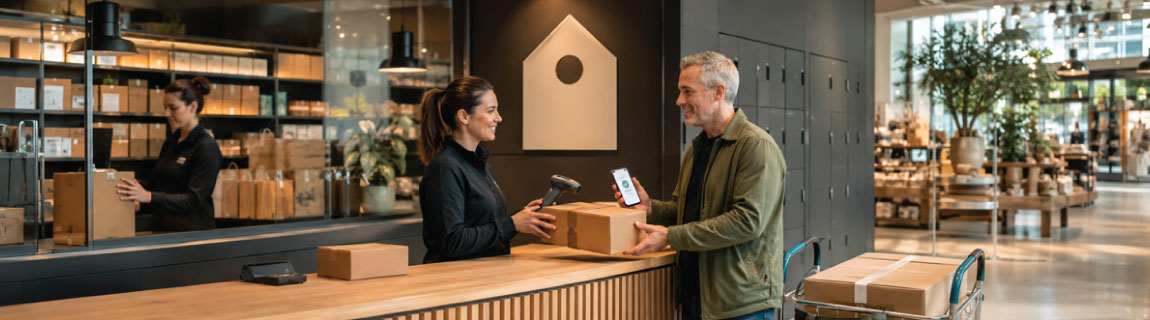
Click and collect has evolved from a convenient delivery alternative into an important part of the omnichannel customer experience.
For shoppers, it offers the speed of online purchasing without the cost or uncertainty of home delivery. For retailers, it can convert store inventory into an ecommerce advantage, reduce fulfilment costs and bring digitally acquired customers into physical locations.
But simply offering click and collect is not enough.
A customer may have completed the transaction online, but their opinion of the experience is often determined at the store. Confusing availability information, premature collection notifications, poor signage and long waits can undermine all the work invested in the digital journey.
A winning click-and-collect experience must connect inventory, ecommerce, store operations and customer communication from beginning to end.
Start with accurate product availability
The experience begins before the customer adds anything to their basket.
Shoppers need to know whether a product is available for collection, where it can be collected and when it will be ready. If this information changes during checkout—or proves inaccurate after the order is placed—confidence quickly disappears.
Retailers should provide:
- Store-level inventory availability
- A clear distinction between “in stock” and “available to collect”
- Realistic preparation times
- Nearby alternative locations
- Visibility of limited or low stock
- Collection options before checkout
Inventory accuracy is fundamental. A store may technically have an item in stock, but it could already be reserved, damaged, misplaced or unavailable to the team preparing online orders.
Retailers should measure how frequently accepted orders cannot be fulfilled from the nominated location. These exceptions reveal where inventory data and physical store processes are no longer aligned.
Make store selection effortless
Choosing a collection location should be straightforward, especially on mobile.
Customers should be able to search by postcode, suburb or current location and compare stores using meaningful information. Distance alone may not determine the best option.
Useful store information includes:
- Distance and travel time
- Opening and collection hours
- Estimated readiness
- Parking availability
- Accessibility
- Collection method
- Current product availability
The selected store should remain visible throughout checkout. This reduces the risk of customers unintentionally choosing the wrong location or assuming their usual store has been selected.
Retailers should also make it easy to change locations before completing the order. Forcing the shopper to restart the journey creates unnecessary abandonment.
Set accurate expectations at checkout
Click and collect should not be presented as a vague promise.
Before customers place an order, they should understand:
- When the order is likely to be ready
- How they will be notified
- Where they need to go
- What identification or confirmation is required
- How long the order will be held
- What happens if another person collects it
- Whether collection is available outside normal store hours
Specific expectations create confidence. “Usually ready within two hours” is more useful than “collect soon,” provided the retailer can consistently meet that commitment.
The estimated collection time should reflect the realities of each location, including staffing, order volume and trading conditions. A universal promise may be simple to advertise but difficult for every store to deliver.
Communicate at the right moments
Customers should not need to contact the store to determine whether their order is ready.
A well-designed communication journey typically includes:
- An immediate order confirmation.
- An update if preparation is delayed or an item becomes unavailable.
- A clear notification when the complete order is ready.
- A reminder before the collection period expires.
- Confirmation once the order has been collected.
The difference between “order received” and “ready for collection” must be unmistakable. Premature store visits create frustration for customers and pressure for employees.
The ready-to-collect message should contain all the information needed to complete the journey:
- Store address
- Collection hours
- Directions to the collection point
- Order reference or scannable code
- Identification requirements
- Instructions for vehicle or locker collection
- A link to nominate another collector, where supported
Keep the message practical. Collection instructions should not be buried beneath promotional content.
Design the physical experience deliberately
The store experience is where many click-and-collect journeys break down.
A customer who purchased online may not know the store layout. They should not have to search for the right counter, join an unrelated checkout queue or find an employee who understands the collection process.
Clear exterior and interior directions should lead customers from the entrance or car park to the collection point. The location should be visible, accessible and designed for the size and volume of orders being handled.
Depending on the retail environment, fulfilment options might include:
- A staffed collection counter
- Dedicated parking bays
- Curbside handover
- Self-service lockers
- Drive-through collection
- Collection from the main service desk
- After-hours access
There is no universally correct format. A small urban store has different requirements from a large home-improvement location handling bulky products.
The design should reflect customer missions, average order size, store layout and expected demand.
Prepare store teams for digital customers
Click and collect may be owned by the ecommerce team, but store employees deliver the final experience.
They need clear processes for receiving orders, locating products, confirming their condition, staging them securely and handing them to the correct person.
Responsibilities should be explicit:
- Who monitors new orders?
- Who picks and verifies products?
- Where are prepared orders stored?
- How are substitutions or stock problems handled?
- Who communicates delays?
- How is customer identity confirmed?
- When is the order marked as collected?
- What happens when a customer does not arrive?
Training should cover exceptions as well as the ideal process. Employees need to know what to do when a customer arrives early, a parcel cannot be found or part of an order is missing.
The technology used by store teams also matters. Employees should be able to locate and update an order quickly without moving between multiple systems or relying on printed lists.
Reduce collection waiting time
Customers choose click and collect partly because they expect it to be fast.
Long waits can make the service feel less convenient than shopping in-store. Retailers should measure collection time from the customer’s arrival—not merely the time required to scan and close the order.
Delays commonly occur because:
- The collection point is understaffed
- Orders are staged in several locations
- The customer’s arrival is not visible to employees
- Identification takes too long
- Large products require additional equipment
- Staff must leave the counter to retrieve orders
- The order status was updated before preparation was complete
Mobile check-in can allow customers to announce their arrival. Vehicle details or parking-bay numbers can help employees prepare curbside handovers. Orders can also be staged according to expected collection windows rather than arrival sequence alone.
Speed should not come at the expense of accuracy. The objective is a predictable handover with minimal effort from the customer.
Design for different order types
A single process may not work for every product.
Small parcels can be stored behind a counter or inside lockers. Furniture, garden equipment and building materials may require secure staging areas, trolleys, loading zones or assistance from trained employees.
Retailers should classify collection orders by operational requirements, such as:
- Parcel size
- Product weight
- Temperature or storage conditions
- Assembly status
- Vehicle requirements
- Age or identity verification
- Number of order lines
- Need for loading assistance
Customers should receive instructions appropriate to their order. Someone collecting a small household item needs different guidance from a customer collecting a large outdoor setting.
Designing around these differences improves safety, reduces congestion and helps stores allocate resources more effectively.
Use collection visits to create additional value
Click and collect brings an identified online customer into a physical retail environment. That creates opportunities for additional engagement—but retailers should avoid turning a convenient service into an unwanted sales interaction.
Relevant opportunities may include:
- Accessories needed to complete a project
- Services related to the purchased product
- Easy access to returns or exchanges
- Loyalty enrolment and account assistance
- Product demonstrations
- Replenishment reminders
- Conveniently located complementary ranges
The best additions are useful and contextual. A customer collecting a barbecue may appreciate being reminded about a compatible cover or gas fitting. An unrelated promotion at the collection counter is less likely to add value.
Retailers should measure whether collection customers make additional purchases, but the primary objective must remain a fast and satisfactory handover.
Make problems easy to resolve
Even a well-designed process will encounter exceptions.
Products may be damaged, inventory may be inaccurate and customers may arrive at the wrong location. What distinguishes a strong experience is how quickly and fairly these problems are resolved.
Store employees should have the authority and information required to offer appropriate options, including:
- Sourcing the product from another location
- Arranging home delivery
- Offering a suitable substitute
- Reserving incoming stock
- Issuing a refund
- Applying an approved service recovery
Customers should not be redirected between store service, ecommerce support and a fulfilment partner while each team claims the issue belongs elsewhere.
From the customer’s perspective, the retailer owns the complete experience.
Measure the complete journey
Click-and-collect performance cannot be understood from order volume alone.
Retailers should examine:
- Percentage of orders ready on time
- Average preparation time
- Average customer waiting time
- Order rejection and cancellation rates
- Inventory-related failures
- Uncollected orders
- Customer-service contacts
- Collection satisfaction
- Additional in-store purchases
- Fulfilment cost per order
- Repeat use of click and collect
Results should also be reviewed by location. Significant differences between similar stores may reveal training, staffing, layout or inventory-management problems.
Customer feedback can provide additional context. A low satisfaction score may relate to parking, signage or employee communication rather than the digital checkout.
Treat click and collect as one connected experience
Customers do not think in terms of ecommerce systems, store operations and inventory platforms. They see one retailer and expect each part of the journey to work together.
Delivering that experience requires shared ownership.
Ecommerce teams must provide accurate choices and communications. Technology teams must connect orders and inventory. Store operations must prepare and stage products reliably. Employees must complete the handover with speed and confidence.
When these elements work together, click and collect becomes more than a fulfilment option. It becomes a reason to choose the retailer: combining the control and convenience of ecommerce with the immediacy and reassurance of a local store.