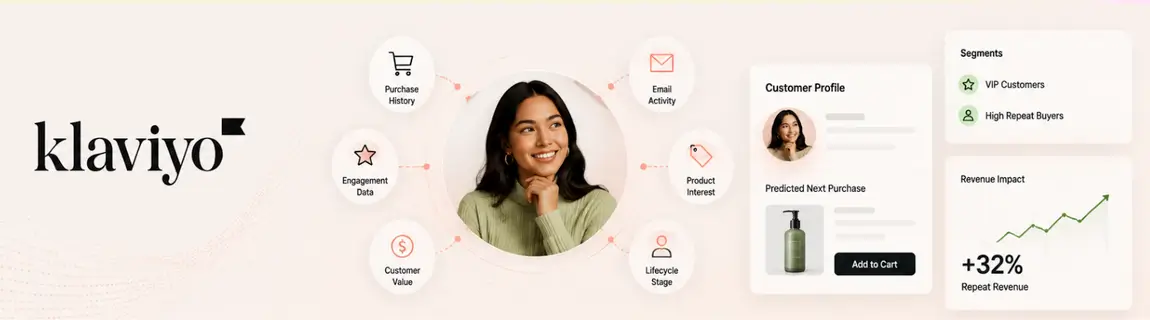
The problem is rarely that the data does not exist. The problem is that it is not always connected, structured or used in a way that changes the customer experience. For many retailers, this creates a gap between what the business knows about its customers and how it communicates with them.
Most retailers are not short on customer data.
They have order history in their eCommerce platform, customer profiles in Shopify, purchase records in POS, product and inventory data in ERP, engagement data in email, and sometimes loyalty, CRM and support data sitting somewhere else again.
A customer may have purchased multiple times before, but still receive the same campaign as a first-time buyer. A high-value customer may be treated the same as a discount-only customer. A lapsed customer may not be identified until they are long gone. A customer who repeatedly buys from one category may still receive generic product messaging.
This is where customer data becomes commercially important. When retailers can connect customer, order, behavioural and product data, they can create more relevant journeys that encourage customers to return, buy again and build a stronger relationship with the brand.
Klaviyo can play an important role in that process.
For retailers using platforms like Shopify, Shopify Plus, Adobe Commerce or other eCommerce systems, Klaviyo can help activate customer data through email, SMS, segmentation and automation. The opportunity is not simply to send more marketing.
The opportunity is to use customer data to drive repeat revenue.
Why customer data matters for repeat revenue
Repeat revenue depends on understanding the customer after the first purchase. A first order tells a retailer something useful, but it is only the beginning of the relationship. It may show what the customer bought, when they bought, how much they spent and which category they were interested in.
Over time, customer data can show much more.
It can reveal:
- How often a customer buys
- Which products or categories they prefer
- Whether they buy at full price or on promotion
- How long they usually wait between purchases
- Whether they respond to email, SMS or both
- Whether they are becoming inactive
- Whether they are likely to become a high-value customer
- Whether they are ready for replenishment, cross-sell or win-back messaging
This type of data is valuable because it gives retailers a better understanding of customer intent. Without it, marketing often becomes generic. With it, retailers can communicate with customers based on behaviour, value and timing. That is where repeat revenue starts to become more predictable.
The issue is not data collection. It is data activation. Many retailers already collect large amounts of customer data. The challenge is turning that data into action. A retailer may know that a customer bought a specific product, but does that trigger a relevant post-purchase journey?
They may know that a customer has not purchased in 120 days, but does that move the customer into a win-back segment? They may know that a customer regularly buys from one category, but does that influence the products they are shown? They may know that a customer has a high lifetime value, but does that change how the customer is treated?
This is the difference between data collection and data activation. Data collection is having the information.
Data activation is using that information to change what happens next. Klaviyo helps retailers activate this data by using it to power segments, flows, campaigns, product recommendations, email journeys and SMS communication.
However, the quality of the outcome depends on the quality of the data feeding into the platform.
Where retail customer data usually lives
For many retailers, customer data sits across several systems.
This may include:
- eCommerce platform: customer profiles, orders, carts, checkout activity and product views
- ERP: product data, stock availability, pricing, order fulfilment and account information
- POS: in-store transactions, store-level activity and offline customer behaviour
- CRM: customer status, account ownership, preferences and sales history
- Loyalty platform: points, tiers, rewards and member status
- Customer service platform: returns, issues, support history and customer sentiment
- Marketing platform: email engagement, SMS consent, campaign activity and automation performance
When these systems are disconnected, the customer view is incomplete. That limits what retailers can do.
For example, an online customer may also purchase in-store, but if POS data is not connected, the retailer may underestimate their value.
A trade customer may have account-specific pricing or purchasing patterns in an ERP, but if that information is not available for marketing segmentation, the customer may receive irrelevant promotions.
A loyalty member may be close to reaching the next tier, but if that data is not activated, the retailer misses a timely opportunity to encourage another purchase. This is why integration matters. The more complete the customer view, the more relevant the customer journey can become.
How Klaviyo helps turn customer data into revenue
Klaviyo gives retailers a practical way to use customer data across email and SMS.
When connected properly, it can help retailers create segments and automated journeys based on customer behaviour.
This may include:
- New subscribers who have not purchased
- First-time buyers
- Customers ready for a second purchase
- Customers who regularly buy from a specific category
- Customers with high lifetime value
- Customers likely to replenish
- Customers who have abandoned checkout
- Customers who have viewed a product but not purchased
- Customers who have not purchased recently
- Customers who engage with emails but have not converted
These segments can then drive more relevant communication.
Instead of asking “what campaign should we send this week?”, retailers can ask better questions.
What does this customer need next?
What do they already know about the brand?
What have they purchased before?
When are they most likely to buy again?
What would make this message more useful?
Should we use email, SMS or both?
Is this customer worth protecting from discount fatigue?
That shift is important.
It moves the retailer away from campaign-led marketing and towards customer-led marketing.
Customer data should change the customer journey
The real value of customer data is not in a report. It is in the customer experience. A retailer should be able to use customer data to change what a customer receives, when they receive it and why.
For example:
A first-time buyer may receive product education, reassurance, delivery guidance and a reason to come back. A repeat customer may receive complementary product recommendations or early access to new arrivals. A high-value customer may receive VIP treatment rather than generic discounting. A customer who buys consumables may receive a replenishment reminder at the right time.
A customer who has not purchased recently may receive a win-back journey based on their previous interests. A trade customer may receive messaging based on account type, buying frequency or product range. This is how customer data becomes commercially useful.
It helps retailers make the next interaction more relevant.
Start with the most useful data points
Retailers do not need every possible data point to improve repeat revenue. A good starting point is to identify the data that is most likely to influence customer behaviour.
Useful data points often include:
- Last purchase date
- Number of orders
- Total spend
- Average order value
- Products purchased
- Categories purchased
- Products viewed
- Cart and checkout behaviour
- Email engagement
- SMS consent
- Customer tags
- Loyalty status
- Location
- Customer type
- Discount usage
- Time between purchases
These data points can support practical segmentation.
For example:
Customers with one order can be placed into a first-to-second purchase journey.
Customers with multiple orders and high total spend can be treated as VIPs.
Customers who repeatedly purchase the same product type can receive category-specific recommendations.
Customers who have not purchased within their usual buying window can receive a reactivation journey.
Customers who view products but do not purchase can receive education, social proof or product reminders.
The goal is not to make the data model complex.
The goal is to make the customer journey smarter.
Use customer data to improve lifecycle marketing
A strong customer data strategy should support the full customer lifecycle.
That means retailers should think beyond individual campaigns.
They should consider how customer data can support each stage of the relationship.
Subscriber to first purchase
Not every subscriber becomes a customer. Some customers join a list for a discount, product launch, content, event or future purchase.
Klaviyo can help retailers use engagement and browsing behaviour to move subscribers towards their first purchase. This may include welcome messaging, brand education, product recommendations, bestsellers, social proof or category-specific content.
First purchase to second purchase
The period after the first purchase is one of the most important stages in the customer lifecycle.
Customer data can help retailers understand what the customer bought, what they may need next and when they are likely to return.
This journey can include product education, complementary products, replenishment timing, review requests and a carefully timed second-purchase offer where appropriate.
Active customer to loyal customer
Customers who buy more than once should not be treated the same as first-time buyers.
Retailers can use order frequency, total spend, category interest and engagement data to create more relevant journeys for active customers.
This may include early access, new arrivals, category-specific campaigns, bundles, loyalty messaging or personalised recommendations.
Loyal customer to VIP customer
High-value customers often deserve a different experience.
Retailers can use lifetime value, purchase frequency and engagement data to identify their best customers.
These customers may not need more discounts.
They may respond better to recognition, exclusivity, service, early access or loyalty benefits.
At-risk customer to reactivated customer
Customers can become inactive for many reasons.
They may have found another supplier. They may have bought a product with a long replacement cycle. They may have lost interest. They may simply need a reminder at the right time.
Klaviyo can help retailers build win-back journeys based on purchase timing, category history and customer value.
The strongest win-back journeys are not always discount-led.
Often, relevance matters more than urgency.
Why integration quality affects marketing performance
Klaviyo can only activate the data it receives.
If Shopify data is incomplete, product data is poor, customer tags are inconsistent or ERP and POS data are disconnected, segmentation becomes weaker.
This can lead to issues such as:
- Customers receiving irrelevant campaigns
- Repeat customers being treated as new customers
- VIP customers being over-discounted
- In-store buyers being excluded from online journeys
- Trade customers receiving consumer messaging
- Product recommendations not matching availability
- Reporting not reflecting the full customer relationship
For retailers with more complex operations, integration quality becomes a major factor in marketing performance.
This is especially true for retailers with:
- Multiple stores
- Online and in-store sales
- B2B and B2C customers
- Trade accounts
- Large product catalogues
- Multiple warehouses
- ERP-driven stock and pricing
- Loyalty programs
- Customer-specific pricing
- Multiple brands or regions
In these environments, customer data strategy is not just a marketing task.
It becomes an eCommerce, integration and operations task.
The role of Shopify, ERP, POS and CRM data
For many retailers, Shopify provides the core eCommerce customer and order data. That is a strong foundation. However, some of the most valuable customer context may sit outside Shopify.
ERP data may show product availability, account pricing, trade terms or fulfilment status. POS data may show in-store purchases that are not visible online. CRM data may show customer type, account status or sales ownership.
Loyalty data may show tier, points balance or reward eligibility. When this data is available to Klaviyo, retailers can create more useful customer journeys.
For example:
A customer who buys both online and in-store can be recognised as a higher-value customer.
A trade customer can be placed into a different journey from a direct-to-consumer shopper.
A loyalty member close to a reward threshold can receive a timely message.
A customer who buys from a category with low stock availability can be handled differently from a customer browsing products that are readily available.
This is where OSE’s role becomes important.
The value is not only in connecting Klaviyo to Shopify.
The value is in understanding which data matters, where it lives and how it should be used to improve the customer journey.
Avoid using customer data only for discounting
One of the risks with customer data is using it only to send more offers.
Discounting has a role, but it should not be the only lever.
Customer data can also support:
- Product education
- Better recommendations
- Replenishment reminders
- Loyalty recognition
- Service messaging
- Category-specific content
- Review requests
- Back-in-stock alerts
- New product launches
- Warranty or care information
- Cross-sell and upsell journeys
This matters because repeat revenue should not come at the expense of margin.
A strong customer data strategy helps retailers identify when a discount is needed and when a more relevant message may be enough.
Measure the commercial impact of customer data
To understand whether customer data is being used effectively, retailers need to measure more than email activity.
Opens and clicks are useful, but they are not the end goal.
Retailers should also measure:
- Repeat purchase rate
- Customer lifetime value
- Revenue from automated flows
- Revenue by customer segment
- First purchase to second purchase conversion
- Time between purchases
- Win-back revenue
- VIP customer revenue
- Average order value by segment
- Email and SMS opt-in rates
- Unsubscribe and opt-out rates
- Revenue influenced by product or category journeys
The aim is to understand whether customer data is helping the business create more valuable customer relationships.
That means looking at revenue, retention and margin, not just campaign activity.
Where retailers should start
A practical starting point is to audit how customer data is currently being collected and used.
Retailers should ask:
- What customer data do we already have?
- Which systems hold that data?
- Is Shopify passing the right data into Klaviyo?
- Are ERP, POS, CRM or loyalty systems holding important customer information?
- Are customers segmented by lifecycle stage, value and behaviour?
- Are post-purchase, replenishment and win-back journeys in place?
- Are high-value customers treated differently?
- Are B2B and trade customers receiving relevant communication?
- Are we overusing discounts?
- Are we measuring repeat revenue and customer lifetime value?
This does not need to become a large data transformation project from day one.
Retailers can start by identifying the highest-value customer journeys and the data required to support them.
From there, the strategy can mature over time.
Final thought
Customer data is only valuable when it changes what happens next. For retailers, that means using data to create more relevant customer journeys, stronger segmentation and better-timed communication. Klaviyo provides a practical way to activate that data through email, SMS and automation.
But the real opportunity is bigger than the marketing platform. It is about connecting the right data from Shopify, ERP, POS, CRM and other systems, then using it to drive repeat revenue. Retailers that do this well can move beyond generic campaigns and build more profitable customer relationships.
They can recognise the difference between a first-time buyer, a loyal customer, a lapsed customer, a trade customer and a high-value customer. That is where customer data becomes a growth asset.
And that is where repeat revenue becomes more achievable.
Using customer data to drive repeat revenue requires more than having the right information
It requires that information to be connected, structured and flowing so Klaviyo can actually use it to create more relevant customer journeys.
For retailers running Shopify alongside an ERP, POS, loyalty platform or CRM, that connection is where the real opportunity sits.
At OSE, we help Australian retailers identify where their customer data is being collected but not activated and build the integrations, segments and lifecycle automations needed to turn it into repeat revenue.
Whether you’re looking to improve an existing Klaviyo setup, connect your Shopify store with your broader technology stack, or understand which customer journeys are most likely to increase retention and Customer Lifetime Value, we’d love to help.
Let’s start the conversation.