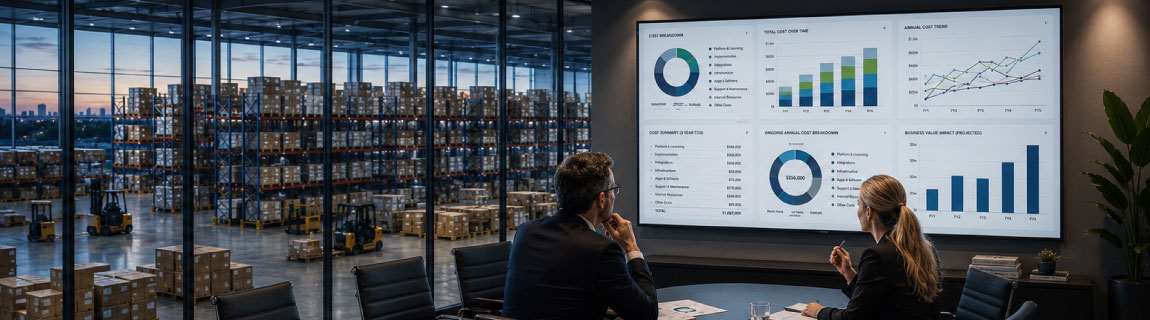
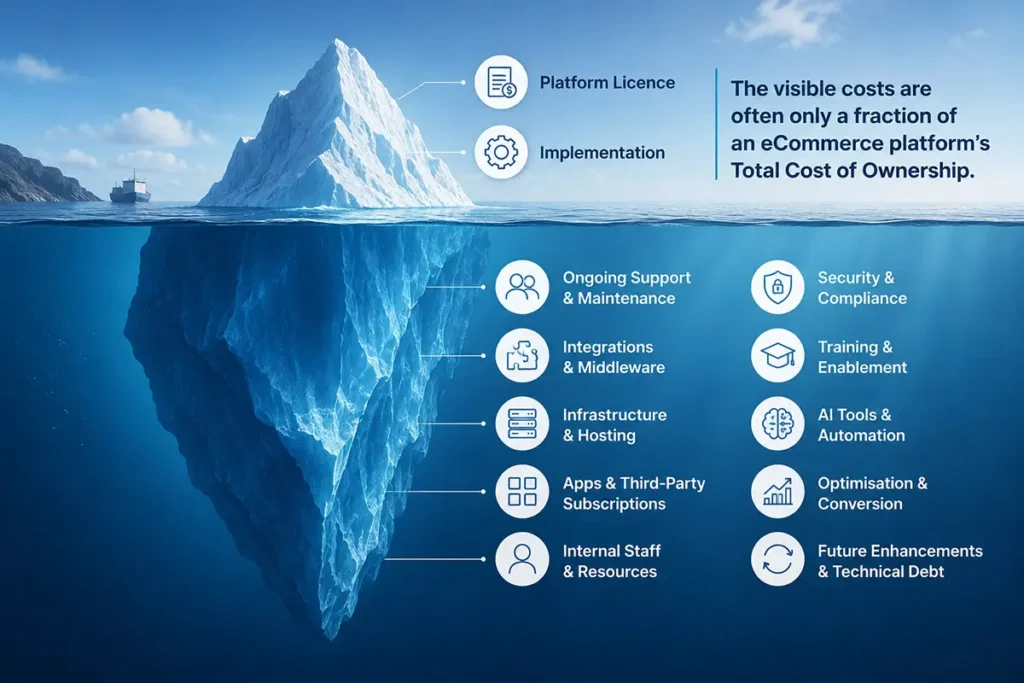
When businesses evaluate a new eCommerce platform, the conversation often begins with implementation costs or software licence fees.
While these are important, they only represent a small part of the overall investment.
The real cost of an eCommerce platform is measured over many years, not on the day it goes live.
This is known as Total Cost of Ownership (TCO).
Calculating TCO provides a much clearer understanding of what your platform will actually cost to operate over its lifetime. It also enables a fair comparison between platforms such as Shopify Plus, Adobe Commerce and other enterprise solutions, helping businesses make better long-term investment decisions.
In this guide, we’ll explain what Total Cost of Ownership means, which costs should be included and how to calculate TCO using a practical enterprise example.
What is Total Cost of Ownership?
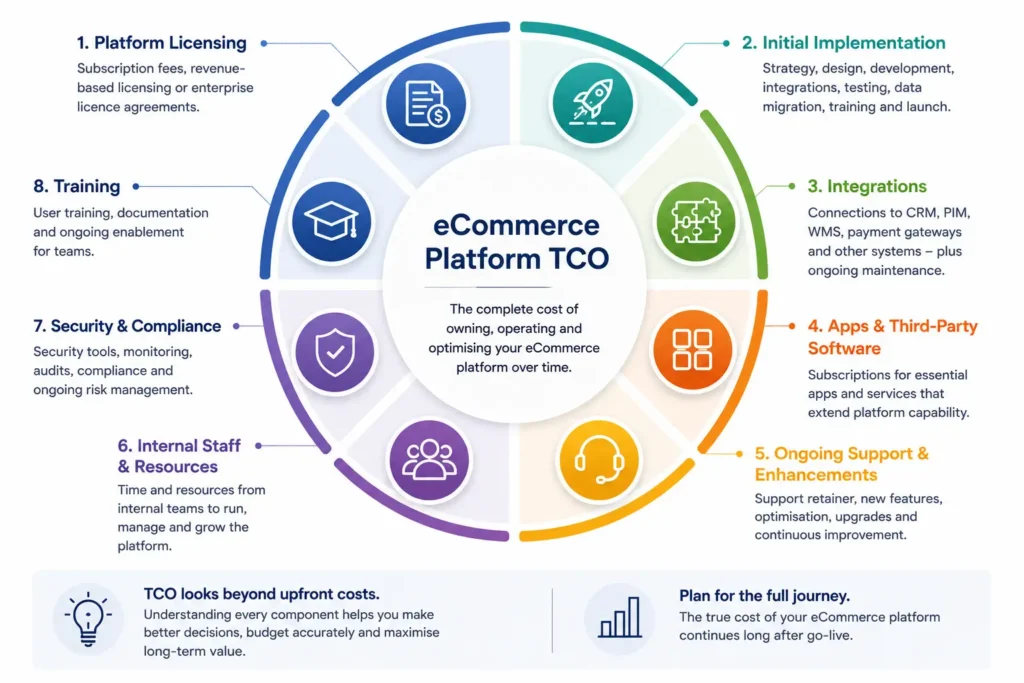
Total Cost of Ownership is the complete cost of purchasing, implementing, operating and continually improving an eCommerce platform over its useful life.
Unlike a simple implementation estimate, TCO considers every significant cost involved in delivering and supporting your online business.
These costs typically include:
- Initial implementation
- Platform subscription or licensing
- Ongoing support and enhancements
- Third-party applications
- Internal staff
- Security and compliance
- Training and enablement
Looking at these costs together provides a much more accurate understanding of the true investment required to operate an enterprise eCommerce platform.
Why TCO Matters
Many organisations unintentionally compare platforms based on implementation cost or annual licence fees alone.
This can lead to poor investment decisions.
For example, one platform may have a lower subscription cost but require significantly more internal resources, ongoing development and third-party software to achieve the same outcome.
Another platform may appear more expensive initially but require substantially less effort to maintain over the long term.
Understanding Total Cost of Ownership allows businesses to answer questions such as:
- Which platform is actually less expensive over five years?
- What annual budget should we allocate after launch?
- Which ongoing costs should be included in our business case?
- Where are the biggest opportunities to improve operational efficiency?
- Which platform provides the strongest long-term value?
Rather than focusing on the cheapest platform, TCO helps businesses identify the platform that delivers the greatest value over its lifecycle.
The Major Components of eCommerce Platform TCO
Initial Implementation
The implementation phase is typically the largest one-off investment.
This generally includes:
- Discovery workshops
- Solution architecture
- UX and UI design
- Development
- Data migration
- Payment gateway configuration
- Testing
- Deployment
- Project management
- Training
For many enterprise projects, implementation is a significant upfront investment. However, it is only the beginning of the platform’s lifecycle.
Platform Subscription
Most enterprise platforms include an annual software subscription or licence.
This cost generally remains consistent year after year and should always be included when calculating long-term ownership costs.
Ongoing Support and Enhancements
A successful eCommerce platform is never truly finished.
Leading retailers continually invest in:
- New functionality
- Conversion optimisation
- Customer experience improvements
- Performance optimisation
- Bug fixes
- Security updates
- Platform upgrades
Many businesses allocate an annual support budget to ensure the platform continues evolving alongside customer expectations.
Apps and Third-Party Software
Modern eCommerce platforms rely on specialist applications to extend functionality.
These may include:
- Product reviews
- Loyalty programs
- Email marketing
- SMS marketing
- Search and merchandising
- Personalisation
- Returns management
- Analytics
- AI tools
While individual subscriptions may appear relatively inexpensive, together they represent an ongoing operational cost that should be included in any TCO calculation.
Internal Staff
One of the most overlooked costs is internal labour.
Marketing teams, eCommerce managers, customer service staff, IT teams and operations personnel all contribute to the ongoing success of the platform.
Tasks such as product management, merchandising, promotions, content updates, reporting and campaign management require significant internal resources that form part of the platform’s true ownership cost. Seek.com.au currently lists the average salary of an eCommerce Manager at $110k to $130k AUD per year.
Security and Compliance
Security is not a one-time exercise.
Businesses should budget for ongoing activities including:
- Security monitoring
- Penetration testing
- Compliance reviews
- Software updates
- Risk management
Although relatively small compared with implementation or support costs, these investments are essential for protecting both the business and its customers.
Training
As platforms evolve and new staff join the business, ongoing training ensures teams continue using the platform effectively.
While training is typically one of the smaller components of TCO, it remains an important part of long-term operational planning.
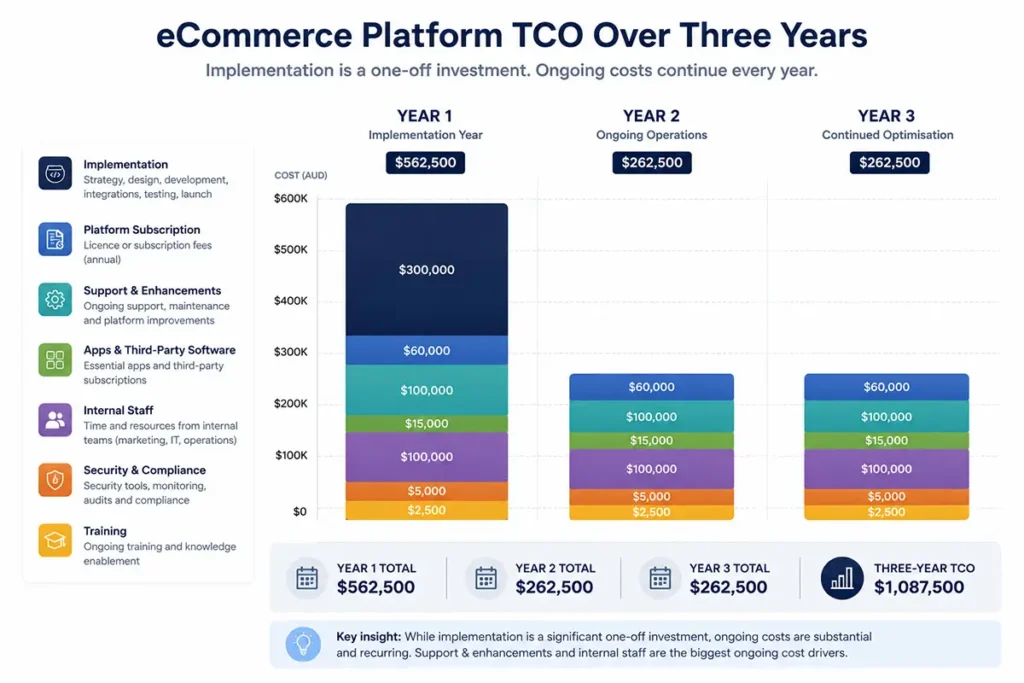
Example Three-Year TCO Calculation
The example below illustrates a typical enterprise eCommerce implementation.
| Cost Category | Year 1 | Year 2 | Year 3 |
|---|---|---|---|
| Initial implementation | $300,000 | – | – |
| Platform subscription | $60,000 | $60,000 | $60,000 |
| Ongoing support & enhancements | $100,000 | $100,000 | $100,000 |
| Apps & third-party software | $15,000 | $15,000 | $15,000 |
| Internal staff | $100,000 | $100,000 | $100,000 |
| Security & compliance | $5,000 | $5,000 | $5,000 |
| Training | $2,500 | $2,500 | $2,500 |
| Total | $582,500 | $282,500 | $282,500 |
Three-Year Total Cost of Ownership: $1,147,500
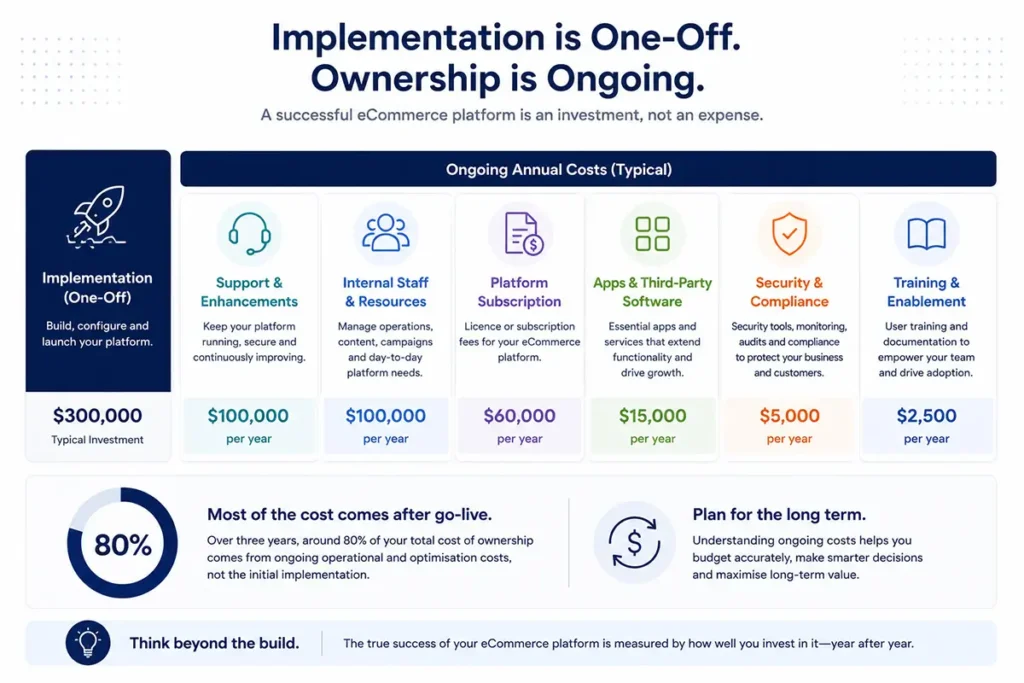
While the implementation represents the largest upfront investment, almost half of the total ownership cost occurs after the platform has launched.
This highlights why businesses should budget for the complete lifecycle of the platform rather than focusing solely on implementation.
Common Costs Businesses Forget
Many business cases underestimate Total Cost of Ownership because they overlook ongoing operational expenses.
The most commonly forgotten costs include:
- Internal staff
- Continuous platform improvements
- App subscriptions
- AI software
- Conversion optimisation
- Product content updates
- Customer experience enhancements
- Staff training
- Security monitoring
- Analytics platforms
Although these costs may appear relatively small individually, they accumulate over the life of the platform and can significantly influence long-term budgets.
TCO Should Always Be Considered Alongside ROI
Understanding Total Cost of Ownership is only one side of the investment equation.
The objective isn’t simply to reduce costs.
The objective is to maximise business value.
A platform with a higher Total Cost of Ownership may generate significantly greater revenue, reduce manual processes, improve customer experience and support future growth.
These benefits often produce a substantially stronger Return on Investment than a platform chosen purely because it appeared cheaper to implement.
For this reason, every TCO assessment should be considered alongside an ROI analysis when preparing an eCommerce business case for a replatform or ongoing budget.
Final Thoughts
Choosing an eCommerce platform is a long-term business investment, not simply a software purchase.
By understanding the complete Total Cost of Ownership, businesses can make more informed platform decisions, develop more accurate budgets and avoid unexpected operational costs after launch.
Rather than comparing platforms purely on licence fees or implementation costs, evaluate the complete lifecycle of ownership, including support, internal resources, applications, security and continuous improvement.
Businesses that take this broader view are far more likely to select a platform that delivers lasting value and supports sustainable growth for many years to come.