
For many retailers, growth has traditionally meant finding more customers.
More traffic.
More advertising.
More campaigns.
More new customer acquisition.
That approach still matters, but it is becoming harder to rely on alone. Customer acquisition costs remain high. Competition for attention is intense. Privacy changes have made targeting less predictable. At the same time, consumers expect more relevant communication from the brands they choose to buy from. This creates a major opportunity for retailers.
The next phase of eCommerce growth is not only about reaching more people. It is about getting more value from the customers you already have. For many brands, that value is already sitting inside their customer database. The challenge is knowing how to use it.
Most retailers are collecting more data than they are using, modern eCommerce platforms capture a significant amount of customer behaviour.
A retailer may know:
- What a customer purchased
- When they last purchased
- Which products they viewed
- Which categories they browse
- Whether they buy full price or on promotion
- Which emails they open
- Whether they prefer SMS, email or both
- Which products they repeatedly come back to
- Whether they are a first-time buyer or a loyal customer
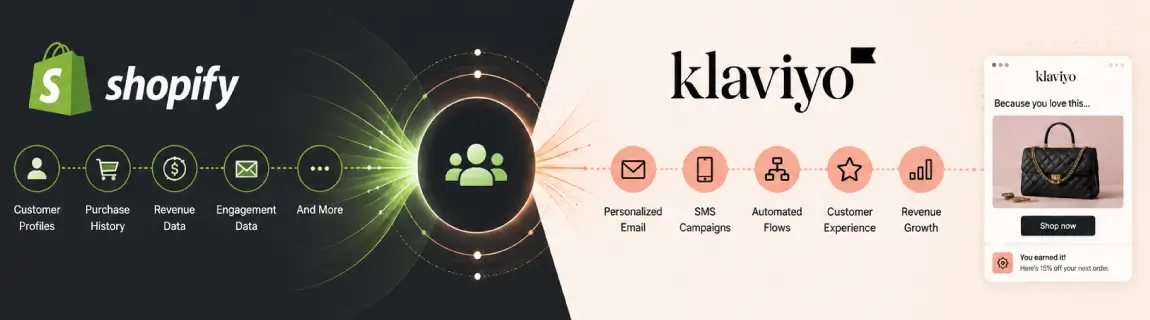
The issue is not usually a lack of data. The issue is that the data often sits across multiple systems and is not being used to drive meaningful customer journeys. The eCommerce platform may hold the order and product data. Klaviyo may hold marketing engagement and customer profile data. POS, ERP, CRM or loyalty systems may hold additional customer information.
When these systems are not connected properly, retailers often default to broad campaigns.
Everyone receives the same offer.
Everyone receives the same newsletter.
Everyone receives the same product message.
That may still generate revenue, but it leaves a lot of opportunity behind. Customer data becomes valuable when it changes the experience customer data only becomes commercially useful when it changes what the customer sees, receives or experiences.
A simple example is the difference between sending the same campaign to every customer and sending different messages based on lifecycle stage. A first-time buyer may need education, confidence and product guidance. A repeat customer may respond better to replenishment, new arrivals or loyalty-based messaging.
A dormant customer may need a different reason to come back.
A high-value customer may not need discounting at all.
This is where platforms like Klaviyo become powerful. They allow retailers to turn customer behaviour into segmented, automated and personalised communication. The result is not just better marketing. It is a better customer experience. The biggest missed opportunities are often simple many retailers assume personalisation means complex AI, large data projects or advanced modelling.
In reality, some of the highest-value opportunities are often much simpler.
They include:
1. First purchase to second purchase journeys
The second purchase is one of the most important moments in the customer lifecycle.
A customer who buys once may still be testing the brand. A customer who buys twice is far more likely to become a repeat customer.
Retailers should be asking:
- What happens after the first order?
- Is the customer educated on the product?
- Are they shown complementary items?
- Are they encouraged to return at the right time?
- Are they treated differently from someone who has never purchased?
A strong post-purchase journey can help turn a transaction into an ongoing customer relationship.
2. Category-based personalisation
Not all customers are interested in the same products.
A customer who regularly buys from one category should not receive the same experience as a customer who buys from another.
Category behaviour can influence product recommendations, email content, promotional messaging and cross-sell opportunities.
This is especially important for retailers with large catalogues, multiple brands or both B2C and B2B customer segments.
3. Replenishment and repeat purchase timing
Many retailers sell products that have a natural repeat purchase cycle.
This may include consumables, apparel basics, beauty products, health products, pet products, parts, accessories or seasonal items.
If a retailer knows the average time between purchases, they can communicate before the customer starts looking elsewhere.
This is one of the clearest examples of using customer data to protect future revenue.
4. Win-back journeys
Not every customer is lost forever.
Some customers simply need the right message at the right time.
A customer who has not purchased in 90, 120 or 180 days should not be treated the same as an active customer.
Win-back campaigns can be built around timing, previous product interest, order value or category history.
The key is to avoid generic discounting where possible.
A good win-back journey should feel relevant, not desperate.
5. High-value customer treatment
Many retailers underuse their best customers.
High-value customers often receive the same campaigns as everyone else, even though they may have a much stronger relationship with the brand.
These customers may respond better to early access, exclusive products, loyalty recognition, personalised recommendations or VIP experiences.
In many cases, the opportunity is not to discount more.
It is to recognise the customer properly.
Integration is what makes this work properly
Personalised marketing depends on the quality of the data behind it.
For retailers using Shopify, Adobe Commerce or other eCommerce platforms, the marketing platform is only as strong as the data being passed into it.
That means product data, order data, customer data and behavioural data need to be accurate, structured and available in the right systems.
This is where many retailers hit a ceiling.
They may have Klaviyo in place, but only use basic campaigns.
They may have Shopify connected, but not be using deeper segmentation.
They may have customer data in ERP, POS or loyalty systems that never makes its way into marketing journeys.
They may have strong customer behaviour data, but no clear strategy for how to use it.
To get the full value, retailers need both the right platform and the right implementation.
That includes:
- Clean customer and order data
- Accurate product feeds
- Meaningful segmentation
- Lifecycle automation
- Integrated email and SMS journeys
- Clear measurement across campaigns and flows
- Ongoing optimisation based on customer behaviour
The goal is not more emails. It is more relevant communication.
One of the risks with marketing automation is volume.
Retailers can mistake automation for simply sending more messages.
That is not the objective.
The objective is to send better messages.
A customer should receive communication that reflects who they are, what they have done and what they are likely to need next.
That may mean sending more messages to some customers and fewer to others.
It may mean using SMS only for certain moments.
It may mean excluding customers from promotions they do not need.
It may mean using content, education or product guidance instead of discounting.
Better customer data allows retailers to move from campaign-driven marketing to customer-led marketing.
The commercial opportunity is significant
For retailers under pressure from rising acquisition costs, improving repeat purchase performance can have a meaningful impact.
A small increase in repeat purchase rate, average order value or customer lifetime value can change the economics of growth.
This is especially important when advertising becomes more expensive.
Retailers that rely too heavily on acquisition are often forced to keep spending more to maintain growth.
Retailers that improve retention and repeat revenue create a stronger foundation.
They are not just buying the next transaction.
They are building a more valuable customer base.
Where retailers should start
Retailers do not need to solve everything at once.
A practical starting point is to review the customer lifecycle and identify where revenue is being lost.
Key questions include:
- What happens after a customer’s first purchase?
- How quickly do customers usually come back?
- Which categories have the strongest repeat purchase behaviour?
- Which customers are becoming inactive?
- Which customers are most valuable?
- Are email and SMS journeys personalised by behaviour?
- Is Shopify, Klaviyo and the broader technology stack sharing the right data?
- Are campaigns being measured by revenue, retention and lifetime value, not just opens and clicks?
Once those gaps are clear, retailers can prioritise the journeys most likely to drive revenue.
Final thought
The next major growth opportunity for many retailers may not come from a larger advertising budget.
It may come from making better use of the customers they already have.
With the right eCommerce platform, clean customer data and a platform like Klaviyo, retailers can create more relevant customer journeys that improve retention, repeat purchase and lifetime value.
For retailers looking to grow more profitably, that is where the opportunity is.
Unlocking revenue inside your existing customer database requires more than good campaigns.
It requires clean, connected customer data, the right automation strategy and a technology stack that shares information across your eCommerce platform, ERP and customer engagement tools.
At OSE, we help Australian retailers identify where repeat revenue is being lost and build the customer journeys needed to recover it, improving repeat purchase rates, increasing Customer Lifetime Value and creating more relevant experiences for the customers you’ve already earned.
Whether you’re looking to get more from Klaviyo, connect your Shopify or Adobe Commerce store with your broader systems, or simply understand where your customer data gaps are costing you, we’d love to help.