
Enterprise B2B commerce has changed significantly over the past decade. Wholesale businesses are no longer looking for an online catalogue with basic ordering capabilities. They expect digital commerce platforms to integrate seamlessly with ERP systems, support customer-specific pricing, automate purchasing workflows and provide the flexibility to adapt as their operations evolve.
For many organisations, the platform evaluation comes down to two market leaders: Adobe Commerce and Shopify Plus.
Both are proven enterprise commerce platforms with mature B2B capabilities, extensive integration options and global ecosystems of developers and technology partners. Both support organisations processing millions of dollars in online revenue and integrate with a variety of leading ERP platforms.
Despite this, the platforms take very different approaches to enterprise commerce.
Adobe Commerce has traditionally focused on flexibility and extensibility. Built on an open architecture and available as both Adobe Commerce on Cloud (PaaS) and the newer Adobe Commerce as a Cloud Service (SaaS), it provides organisations with significant control over how their commerce platform is configured, extended and integrated.
Shopify Plus takes a different approach. As a fully managed SaaS platform, Shopify removes much of the operational overhead associated with managing enterprise commerce infrastructure while continuing to expand its native B2B capabilities, APIs and first-party applications. Over the past several years, Shopify has invested heavily in enterprise functionality, making it a compelling option for many manufacturers, wholesalers and distributors.
Choosing between the two is rarely a question of which platform is “better”. The more important question is which platform best aligns with your business model, operational complexity and long-term digital strategy.
At OSE, we’ve worked with organisations across both Adobe Commerce and Shopify Plus, delivering enterprise B2B solutions integrated with ERP, CRM, PIM, warehouse management and marketing platforms. In our experience, the most successful projects begin by understanding the operational requirements of the business rather than selecting a platform based on brand recognition or feature lists.
In this guide, we’ll compare Adobe Commerce and Shopify Plus across the areas that matter most to enterprise B2B organisations, including:
- Platform architecture and deployment models
- Native B2B capabilities
- Customer account management and company structures
- Pricing, catalogues and merchandising
- ERP integration and API architecture
- Search, AI and product discovery
- Extensibility and customisation
- Security, upgrades and ongoing ownership
- Total cost of ownership
- Which platform is best suited to different business requirements
Rather than declaring a single winner, our goal is to help you understand where each platform excels, where each has trade-offs and how to select the solution that will best support your business over the long term.
Enterprise eCommerce at a Glance
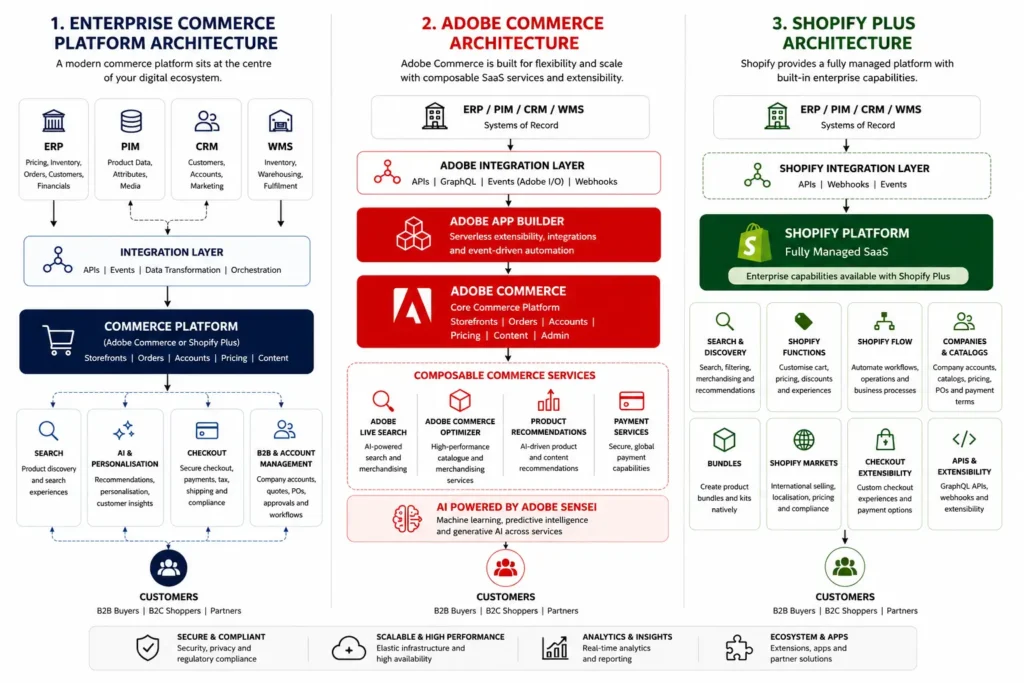
While Adobe Commerce and Shopify Plus take different architectural approaches, both sit at the centre of a broader enterprise technology ecosystem. The diagram below illustrates how each platform integrates with ERP, CRM, PIM and warehouse systems while supporting modern B2B commerce capabilities.
What Modern B2B Commerce Actually Requires
Comparing feature lists alone rarely leads to the right platform decision. Modern B2B commerce is no longer just about accepting online orders. It has become an extension of core business operations, connecting customers, sales teams, ERP systems and fulfilment processes into a single digital experience.
Before comparing Adobe Commerce and Shopify Plus, it’s worth understanding the capabilities that enterprise organisations typically require.
Company Account Management
Unlike B2C commerce, B2B organisations often sell to companies rather than individuals. A single customer may have multiple buyers, branch locations, purchasing departments and finance teams, each requiring different permissions and levels of access.
An effective B2B platform should support company account hierarchies, multiple users, role-based permissions and delegated administration without requiring complex custom development.
Customer-Specific Pricing and Catalogues
Many wholesalers and manufacturers negotiate pricing individually with customers or customer groups. Businesses may also offer different product catalogues based on customer type, location, distributor agreements or contractual obligations.
The ability to synchronise pricing directly from an ERP system while presenting personalised catalogues online is a key requirement for many enterprise organisations.
Purchasing Workflows
Business purchasing is often governed by internal approval processes. Junior buyers may be able to prepare orders, while managers approve purchases before they are submitted.
Support for approval workflows, purchase orders, payment terms and sales-assisted ordering can significantly improve operational efficiency for both customers and internal sales teams.
ERP Integration
For most enterprise organisations, the commerce platform is not the system of record.
Inventory, pricing, customers, orders, invoices and fulfilment are typically managed within ERP platforms purpose-built to handle the rigour of inventory and stock management at scale.
A successful commerce platform should integrate reliably with these systems while supporting business-specific workflows rather than forcing organisations to adapt their operations to fit commerce software.
Search, Merchandising and Product Discovery
B2B catalogues can contain tens or even hundreds of thousands of products. Buyers expect fast, relevant search results, intelligent filtering, product recommendations and merchandising tools that help them find products quickly.
Modern AI-powered search capabilities are becoming increasingly important as product ranges continue to grow.
Scalability and Long-Term Flexibility
Perhaps the most overlooked consideration is how well the platform will support the business over the next five to ten years.
New sales channels, acquisitions, international expansion, changing customer expectations and evolving ERP platforms all place additional demands on an organisation’s commerce platform. Selecting a solution that can adapt to future business requirements is often more valuable than selecting the platform with the longest feature list today.
With these requirements in mind, we can now compare how Adobe Commerce and Shopify Plus approach enterprise B2B commerce, beginning with the underlying architecture that shapes every aspect of ownership, integration and long-term scalability.
Platform Architecture: SaaS vs PaaS and Why It Matters
One of the biggest differences between Adobe Commerce and Shopify Plus isn’t what customers see on the front end. It’s how the platforms are architected behind the scenes.
The deployment model influences everything from upgrades and security to extensibility, operational overhead and how quickly your business can adopt new capabilities.
While Adobe Commerce and Shopify Plus can both deliver outstanding enterprise commerce experiences, they take fundamentally different approaches to platform ownership.
Adobe Commerce
Adobe Commerce has traditionally been delivered as a Platform as a Service (PaaS) solution through Adobe Commerce on Cloud.
Under this model, Adobe manages the underlying cloud infrastructure, while merchants retain control over the commerce application itself. This provides significantly greater flexibility than a traditional SaaS platform, allowing organisations to customise almost every aspect of the application to meet complex business requirements.
For businesses with highly specialised operational processes, this flexibility can be a significant advantage. Custom checkout experiences, complex B2B workflows, bespoke integrations and industry-specific functionality can all be developed directly within the platform.
However, greater flexibility also brings additional operational responsibility.
Major platform upgrades need to be planned, tested and deployed if on PaaS. Customisations need to be reviewed as part of the upgrade process to ensure ongoing compatibility, and businesses typically maintain a structured release cycle to adopt new Adobe Commerce versions and security updates.
For many enterprise organisations, this is an acceptable trade-off. The platform becomes a strategic business application that evolves alongside the organisation’s operational requirements.
Adobe Commerce as a Cloud Service
Adobe is also investing heavily in Adobe Commerce as a Cloud Service, representing a significant evolution of the platform.
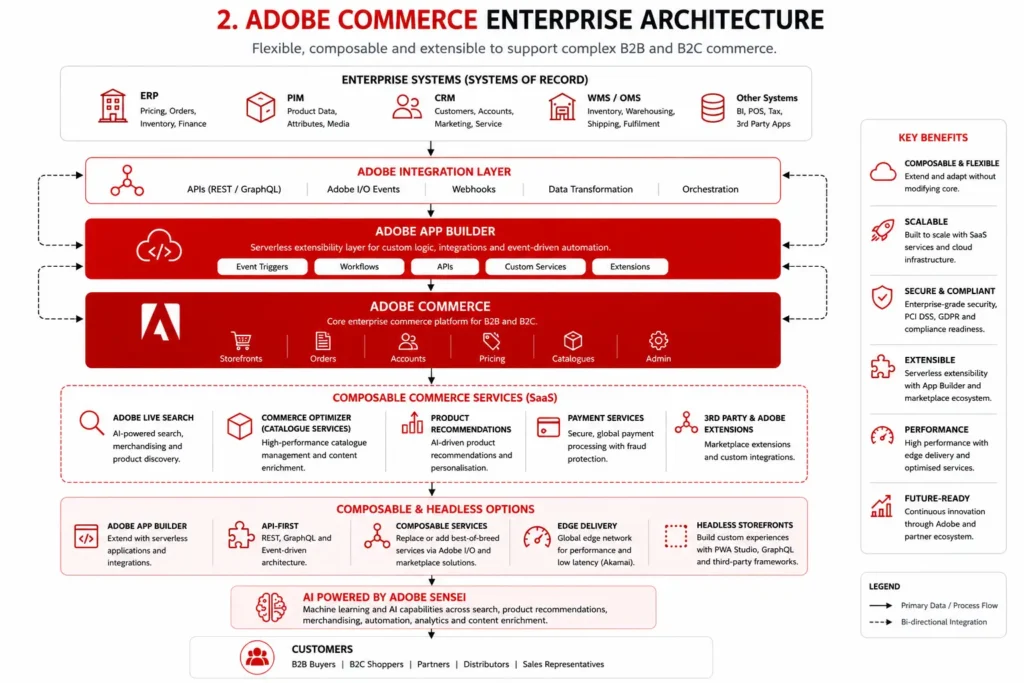
Rather than relying solely on a traditional PaaS architecture, Adobe is progressively delivering more capabilities as managed SaaS services while maintaining the flexibility expected by enterprise organisations.
Services such as Adobe Live Search, Adobe Catalogue Service and Adobe Product Recommendations demonstrate this direction. These capabilities are delivered independently of the core commerce application, allowing merchants to benefit from continuous innovation without waiting for major platform upgrades.
This composable approach enables organisations to adopt new Adobe services as they become available while reducing the amount of functionality that needs to be maintained directly within the core application.
As Adobe continues to expand its SaaS services, the distinction between traditional PaaS and fully managed SaaS platforms is becoming less defined.
Shopify Plus
Shopify Plus is built as a fully managed Software as a Service (SaaS) platform.
Unlike Adobe Commerce on Cloud, merchants do not manage the underlying application or infrastructure. Shopify is responsible for hosting, security, performance, platform upgrades and the continuous delivery of new functionality.
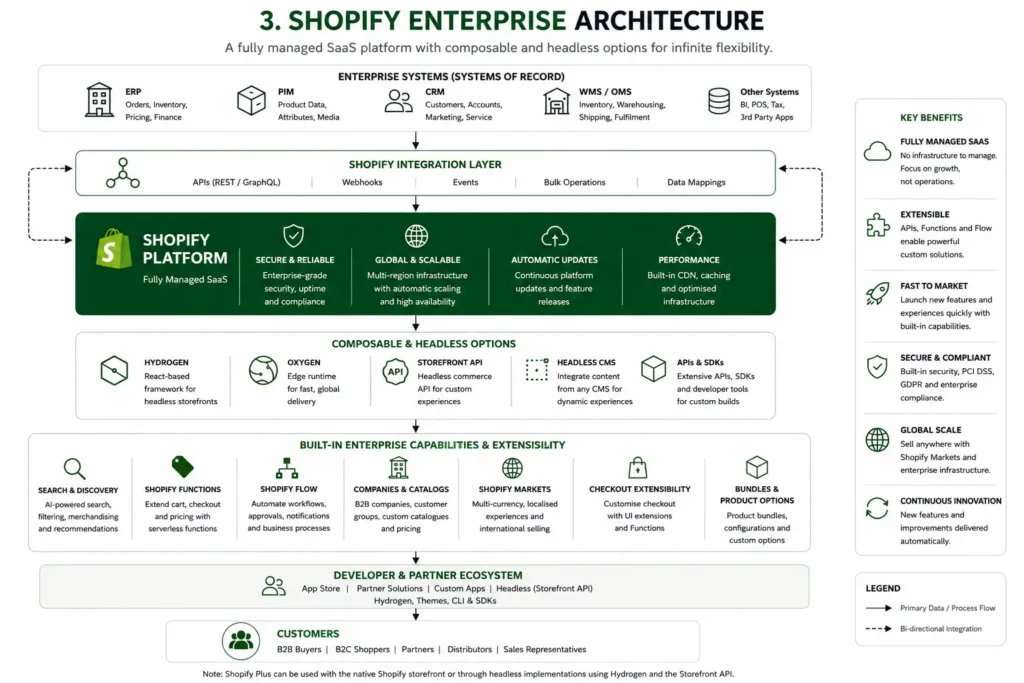
One of Shopify’s greatest strengths is its operational simplicity.
New platform capabilities are released continuously, often becoming available automatically without requiring merchants to undertake upgrade projects. This allows businesses to focus on merchandising, marketing and customer experience rather than maintaining the underlying commerce platform.
For many organisations, particularly those with lean internal technology teams, this significantly reduces the long-term cost and complexity of platform ownership.
The trade-off is that Shopify deliberately limits modification of the core platform. Rather than changing core application behaviour, businesses extend Shopify using APIs, Shopify Functions, Checkout Extensibility, UI Extensions, and a growing ecosystem of first-party and third-party applications.
This architectural approach has enabled Shopify to innovate rapidly while maintaining exceptional platform stability across hundreds of thousands of merchants worldwide.
Continuous Innovation
Both vendors are increasingly investing in managed SaaS capabilities, although they approach innovation differently.
Adobe is expanding its ecosystem of composable commerce services with products such as:
- Adobe Live Search
- Adobe Catalogue Service
- Adobe Product Recommendations
- Adobe App Builder
- Adobe Experience Manager integration
- Adobe Experience Platform connectivity
These services can often be adopted independently, allowing organisations to modernise specific areas of their commerce platform without replacing their entire solution.
Shopify, meanwhile, continues to invest aggressively in native platform capabilities and first-party applications, including:
- Shopify Search & Discovery
- Shopify Flow
- Shopify Bundles
- Shopify Functions
- Checkout Extensibility
- Shopify Markets
- Shopify Collective
- Shopify Sidekick
Rather than relying on platform upgrades, these capabilities are introduced through Shopify’s continuous release model, allowing merchants to benefit from new functionality almost immediately.
Which Architecture Is Right?
Neither approach is inherently better.
Businesses with highly specialised operational requirements, significant custom business logic or deep enterprise integrations may value the flexibility offered by Adobe Commerce and its expanding ecosystem of SaaS services.
Businesses seeking to minimise operational overhead while benefiting from rapid innovation may find Shopify Plus aligns more closely with their long-term technology strategy.
In our experience, the decision should not be based solely on whether a platform is SaaS or PaaS. It should be based on how much flexibility your business genuinely requires, how your technology team operates and the level of operational ownership you’re prepared to maintain over the lifetime of the platform.
Native B2B Capabilities
Adobe Commerce and Shopify Plus both provide mature B2B functionality designed to support manufacturers, wholesalers, distributors and enterprise retailers. While many of the core capabilities are now comparable, the way each platform approaches B2B commerce differs considerably.
Rather than asking which platform has the longest feature list, organisations should consider how closely each platform aligns with their sales processes, customer relationships and operational requirements.
Company Accounts
Unlike B2C commerce, a B2B customer is rarely a single individual.
A customer may represent an organisation with multiple branches, purchasing departments, finance teams and administrators, each requiring different permissions and responsibilities.
Both Adobe Commerce and Shopify Plus support company-based account structures, allowing multiple users to belong to the same organisation while maintaining appropriate access controls.
Adobe Commerce
Adobe Commerce has long provided sophisticated company account functionality through its native B2B module.
Key capabilities include:
- Company account hierarchies
- Multiple buyers within a company
- Company administrators
- Role-based permissions
- Multiple business locations
- Sales representative support
- Purchase Order workflows
- Credit purchasing
- Payment terms
- Quote management
These capabilities are tightly integrated throughout the platform, making Adobe Commerce particularly well suited to organisations with complex purchasing structures or established procurement processes.
Shopify Plus
Shopify Plus has invested significantly in its native B2B capabilities over recent years.
Using Shopify Companies, merchants can create business customers with multiple contacts, locations and purchasing permissions. Customer-specific catalogues, payment terms, purchase orders and B2B checkout experiences are now managed natively within Shopify.
For many manufacturers and wholesalers, Shopify’s B2B functionality now satisfies the majority of operational requirements without relying heavily on third-party applications.
Customer Pricing
Customer-specific pricing is one of the most important capabilities for enterprise B2B commerce.
Most wholesale businesses negotiate pricing based on customer agreements, buying groups, annual volume commitments or distribution arrangements. In almost every implementation, this pricing originates from the ERP rather than the commerce platform.
Adobe Commerce
Adobe Commerce supports sophisticated pricing models including:
- Customer group pricing
- Shared Catalogue pricing
- Tier pricing
- Special pricing
- Contract pricing
- ERP-driven pricing
- Customer-specific promotional pricing
Because pricing is highly extensible, organisations can implement almost any pricing model required by their business.
Shopify Plus
Shopify Plus delivers customer-specific pricing through Catalogs and B2B price lists.
Combined with Shopify Companies, merchants can assign pricing to individual businesses or customer groups while maintaining a streamlined administration experience.
For businesses with standard wholesale pricing structures, Shopify’s native capabilities are often sufficient. More complex pricing models, particularly those driven dynamically by ERP calculations, can also be achieved through API integrations where required.
In both platforms, we recommend that the ERP remains the source of truth for pricing wherever possible, ensuring consistency across sales channels.
Product Catalogues
Different customers frequently require access to different products.
Distributors may only sell selected brands. International customers may purchase different product ranges. Contract customers may have access to exclusive products or negotiated assortments.
Adobe Commerce
Adobe Commerce uses Shared Catalogues to provide highly flexible catalogue segmentation.
Organisations can:
- Hide products
- Restrict categories
- Display customer-specific assortments
- Support multiple brands
- Create industry-specific catalogues
- Synchronise catalogue assignments with ERP systems
Adobe is also continuing to invest in Adobe Catalogue Service, which improves catalogue scalability and performance while supporting increasingly large product ranges.
Shopify Plus
Shopify Plus provides customer-specific Catalogs that integrate directly with Shopify Companies.
These allow merchants to control:
- Product visibility
- Customer pricing
- Market-specific assortments
- B2B purchasing experiences
Shopify’s growing investment in native merchandising tools such as Search & Discovery and Bundles complements these catalogue capabilities, allowing merchants to improve product discovery without introducing unnecessary platform complexity.
Purchasing Workflows
Enterprise B2B purchasing rarely follows a simple “Add to Cart” process.
Orders may require internal approval, purchase orders, payment terms, sales representative involvement or manual review before fulfilment.
Adobe Commerce
Adobe Commerce provides mature support for complex purchasing workflows including:
- Purchase Orders
- Approval workflows
- Quote negotiation
- Credit purchasing
- PunchOut Catalogue
- Company administrators
- Sales-assisted ordering
- Requisition Lists
- Quick Order by SKU
- Bulk ordering
These capabilities have been available for many years and are well suited to organisations with established procurement processes.
Shopify Plus
Shopify Plus now includes native support for:
- Purchase Orders
- Payment Terms
- B2B Checkout
- Draft Orders
- Customer-specific checkout experiences
- Shopify Flow automation
For many organisations, Shopify Flow can automate common purchasing processes without requiring custom development, while APIs allow more specialised approval workflows where required.
Which Platform Provides Better Native B2B Functionality?
From a feature perspective, the gap between Adobe Commerce and Shopify Plus has narrowed considerably over the past several years.
Adobe Commerce continues to offer exceptional flexibility and a mature B2B framework capable of supporting highly customised purchasing experiences.
Shopify Plus, meanwhile, has rapidly evolved from a platform that relied heavily on applications into one that now delivers comprehensive B2B capabilities as part of the core platform.
In our experience, the decision is rarely determined by a single B2B feature. More often, it comes down to the complexity of the organisation’s operational processes, the level of customisation required and how closely the platform aligns with existing ERP and business workflows.
OSE Perspective
We no longer view Adobe Commerce as the default choice for every enterprise B2B implementation, nor Shopify Plus as suitable only for simpler wholesale operations. Both platforms are capable of supporting sophisticated B2B commerce. The more important consideration is how the business operates behind the scenes. Organisations with highly customised procurement workflows may benefit from Adobe Commerce’s flexibility, while businesses looking to reduce operational overhead without compromising core B2B capability will often find Shopify Plus an exceptionally strong enterprise platform.
Integration Architecture
For most enterprise organisations, the commerce platform is only one component of a much larger technology ecosystem.
Customer information, inventory, pricing, purchasing, fulfilment, finance and reporting are typically managed by specialist business systems such as Microsoft Dynamics 365, SAP, Infor M3, NetSuite, MYOB, Pronto or Cin7.
The success of an eCommerce implementation depends not only on the commerce platform itself, but on how effectively it integrates with these systems.
In our experience, Adobe Commerce and Shopify Plus are both exceptionally capable integration platforms. The quality of an integration is rarely limited by the APIs available. Instead, successful projects are built on well-designed integration architecture that clearly defines system ownership, data flows and business processes.
APIs
Both Adobe Commerce and Shopify Plus provide mature, enterprise-grade APIs that support real-time integration with external business systems.
Adobe Commerce
Adobe Commerce provides comprehensive REST and GraphQL APIs covering almost every aspect of the platform, including:
- Products
- Customers
- Orders
- Inventory
- Pricing
- Catalogues
- Quotes
- Company accounts
- Purchase Orders
- B2B entities
Combined with Adobe’s event framework and extensibility model, these APIs provide significant flexibility for organisations requiring highly customised integrations.
Shopify Plus
Shopify Plus also provides a mature API platform built around GraphQL, REST APIs and webhooks.
Developers have access to APIs covering:
- Products
- Customers
- Orders
- Inventory
- Companies
- Catalogs
- Markets
- Payments
- Fulfilment
- Metafields
- Customer Accounts
Shopify’s API platform has evolved rapidly over recent years and is now capable of supporting sophisticated enterprise integration scenarios without requiring modification of the underlying platform.
From an integration perspective, both platforms provide the capabilities expected of modern enterprise commerce solutions.
System Ownership
One of the most common causes of integration problems is uncertainty about which system owns particular data.
Regardless of platform, we recommend clearly defining a system of record before integration development begins.
For example:
| Business Data | Typical System of Record |
|---|---|
| Products | ERP or PIM |
| Inventory | ERP |
| Customer pricing | ERP |
| Customer accounts | ERP or CRM |
| Orders | Commerce Platform, synchronised to ERP |
| Shipment updates | ERP or WMS |
| Invoices | ERP |
| Financial data | ERP |
This architectural approach reduces duplication, improves data quality and simplifies long-term maintenance.
Adobe App Builder
One area where Adobe Commerce has introduced significant innovation is Adobe App Builder.
Adobe App Builder is a managed serverless extensibility platform that enables organisations to build integrations, workflows and business services outside the core Adobe Commerce application.
Rather than embedding custom integration logic directly into the commerce platform, developers can create independent services that respond to Adobe Commerce events, communicate with external systems and automate business processes.
Typical use cases include:
- ERP orchestration
- Product information synchronisation
- Customer account provisioning
- AI-powered business workflows
- Third-party API integration
- Data transformation
- Background processing
- Event-driven automation
By moving integration logic outside the core application, organisations can reduce technical debt while improving maintainability and scalability.
For businesses adopting Adobe Commerce as a Cloud Service, Adobe App Builder also aligns closely with Adobe’s broader composable commerce strategy.
Shopify’s Integration Model
Shopify approaches extensibility differently.
Rather than providing a dedicated integration platform such as Adobe App Builder, Shopify encourages organisations to extend the platform using its APIs, webhooks, Shopify Functions, Checkout Extensibility and modern cloud services.
This architecture has several advantages.
Businesses can keep the Shopify platform itself relatively lightweight while implementing sophisticated integration logic within their own cloud environment or enterprise integration services.
This separation also contributes to Shopify’s ability to deliver continuous platform upgrades without disrupting customer-specific customisations.
ERP Connectors
An increasing number of ERP vendors now provide native integrations for Shopify.
Solutions are available for platforms including Microsoft Dynamics 365 Business Central, NetSuite, MYOB and several cloud ERP systems, allowing businesses to synchronise products, inventory and orders with relatively little configuration.
These connectors can be an excellent starting point for straightforward commerce implementations.
However, enterprise organisations often have operational requirements that extend well beyond standard synchronisation.
Examples include:
- Customer-specific pricing generated by the ERP
- Multi-warehouse inventory allocation
- Complex fulfilment rules
- Sales representative ordering
- Company-specific approval workflows
- Multiple trading entities
- Custom business logic
- Integration with additional business systems
In these situations, native ERP connectors frequently require extension or replacement to support the organisation’s operational model.
The objective should never be to use the simplest connector available. It should be to implement an integration architecture that accurately reflects how the business operates.
Search, Merchandising and AI
Finding products quickly has become one of the most important factors influencing both customer experience and conversion rates.
For B2B organisations managing thousands, or even hundreds of thousands, of SKUs, effective search and merchandising is no longer a nice-to-have feature. It is fundamental to helping customers locate products, discover alternatives and place orders efficiently.
Both Adobe Commerce and Shopify Plus have invested heavily in this area over recent years, although their strategies differ considerably.
Adobe Commerce
Adobe’s search and merchandising strategy has evolved beyond the traditional capabilities of the core platform.
Rather than relying solely on native catalogue search, Adobe now delivers several SaaS-based merchandising services that integrate with Adobe Commerce while benefiting from independent release cycles and continuous innovation.
Adobe Live Search
Adobe Live Search replaces the standard catalogue search experience with an AI-powered search service designed for enterprise commerce.
Key capabilities include:
- AI-driven relevance
- Typo tolerance
- Faceted navigation
- Search merchandising
- Synonym management
- Search recommendations
- Product recommendations
- Real-time behavioural learning
Because Live Search operates as a SaaS service, merchants benefit from ongoing improvements without waiting for major Adobe Commerce platform upgrades.
For businesses managing large product catalogues, Live Search can significantly improve product discovery while reducing the operational effort associated with search tuning.
Adobe Catalogue Service
Adobe Catalogue Service is another important evolution of the Adobe Commerce platform.
Rather than serving product information directly from the traditional application layer, Catalogue Service delivers catalogue data through Adobe’s cloud services, improving scalability and supporting faster access to merchandising data.
As Adobe continues to invest in its SaaS architecture, services such as Catalogue Service will play an increasingly important role in supporting enterprise-scale product catalogues.
Shopify Plus
Shopify has taken a different approach.
Rather than delivering standalone enterprise merchandising products, Shopify has steadily expanded the native capabilities available within the platform.
Over the past several years, Shopify has introduced a growing collection of first-party applications and platform services that now form a significant part of the Shopify ecosystem.
Shopify Search & Discovery
Search & Discovery has become Shopify’s primary merchandising application.
It provides merchants with tools to improve product discovery without requiring additional third-party software.
Capabilities include:
- Product filtering
- Synonym management
- Search boosting
- Product recommendations
- Related products
- Collection merchandising
Because the application is maintained directly by Shopify, new capabilities are delivered continuously alongside the broader platform.
Shopify Bundles
Shopify Bundles enables merchants to create bundled product experiences directly within Shopify.
Rather than relying on third-party applications for common merchandising scenarios, businesses can create fixed bundles while inventory remains synchronised across the underlying products.
For retailers and manufacturers, this provides a simpler way to promote complementary products and increase average order value.
Shopify Flow
Although primarily recognised as an automation platform, Shopify Flow also contributes to merchandising by enabling businesses to automate catalogue management, customer segmentation, tagging and operational workflows without custom development.
Combined with Shopify Functions and Checkout Extensibility, Flow allows merchants to automate many merchandising and operational processes that previously required bespoke applications.
Artificial Intelligence
Artificial intelligence is rapidly becoming part of both commerce platforms.
Adobe continues to invest across the broader Adobe Experience Cloud ecosystem, incorporating AI into search, merchandising, personalisation and customer experiences through services such as Adobe Live Search and Adobe Experience Platform.
Shopify is also investing heavily in AI across its platform.
Capabilities such as Shopify Sidekick, intelligent merchandising features and AI-assisted administration demonstrate Shopify’s commitment to simplifying day-to-day commerce operations while continuing to expand native platform functionality.
While the two vendors have different strategies, both are embedding AI throughout their platforms rather than positioning it as a standalone feature.
A Changing Platform Landscape
Perhaps the most significant trend is not which platform has the better search engine.
It is that both Adobe and Shopify are progressively bringing more enterprise capabilities into their own ecosystems.
Adobe is expanding through composable SaaS services such as Live Search, Catalogue Service and App Builder.
Shopify is expanding through tightly integrated first-party applications including Search & Discovery, Flow, Bundles, Markets, Checkout Extensibility and Functions.
As a result, businesses are becoming less dependent on third-party applications for core commerce functionality than they were only a few years ago.
This shift simplifies platform ownership while allowing organisations to benefit from continuous innovation delivered directly by each vendor.
Enterprise Feature Comparison
The table below summarises how Adobe Commerce and Shopify Plus compare across the capabilities most commonly evaluated during enterprise commerce projects.
| Capability | Adobe Commerce | Shopify Plus | OSE Perspective |
|---|---|---|---|
| Deployment Model | PaaS (Adobe Commerce on Cloud) and evolving SaaS services through Adobe Commerce as a Cloud Service | Fully managed SaaS | Both are moving toward managed services, but Adobe still offers greater platform control. |
| Platform Upgrades | Planned application upgrades for PaaS deployments. Adobe SaaS services are continuously updated. | Continuous platform upgrades managed entirely by Shopify. | Shopify has significantly lower operational overhead. Adobe Cloud Service is reducing this gap. |
| Infrastructure Management | Adobe-managed cloud infrastructure (PaaS) with merchant-managed application lifecycle. | Fully managed by Shopify. | Shopify removes almost all infrastructure responsibility. |
| Native B2B Features | Comprehensive B2B feature set including Companies, Shared Catalogues, Purchase Orders, Quotes and Approval Workflows. | Mature native B2B functionality including Companies, Catalogs, Purchase Orders and Payment Terms. | Both platforms now support sophisticated B2B implementations. |
| Company Accounts | Native | Native | Comparable capabilities. |
| Multiple Buyers per Company | Native | Native | Comparable capabilities. |
| Roles & Permissions | Advanced role management | Role-based company permissions | Both support enterprise purchasing structures. |
| Customer-specific Pricing | Native Shared Catalogues and ERP-driven pricing | Native Catalogs and Price Lists with ERP integration | Comparable. ERP should remain the source of truth. |
| Customer-specific Catalogues | Shared Catalogues | Catalogs | Comparable. |
| Purchase Orders | Native | Native | Comparable. |
| Payment Terms | Native | Native | Comparable. |
| Quote Management | Native B2B Quote functionality | Typically delivered using Draft Orders or custom workflows | Adobe currently provides the more mature native experience. |
| Third-Party Payment Providers | Supported with no extra charges | Supported, with extra charges | Significant B2C drawback of Shopify, minor issue in Shopify B2B. |
| Approval Workflows | Native Approval Rules | Achievable through Shopify Flow and custom development | Adobe has the stronger native capability. Shopify offers excellent flexibility through automation. |
| Quick Order / SKU Ordering | Native Quick Order | Custom implementation or application | Adobe advantage. |
| Requisition Lists | Native | Custom implementation | Adobe advantage for organisations with repeat purchasing. |
| Multi-store Support | Native | Expansion Stores and Shopify Markets | Both are strong, with different implementation models. |
| International Commerce | Highly configurable | Shopify Markets | Shopify Markets has simplified many global commerce scenarios. |
| Search | Adobe Live Search | Shopify Search & Discovery | Both continue to evolve rapidly. |
| Catalogue Services | Adobe Catalogue Service | Native Shopify catalogue architecture | Adobe’s SaaS catalogue services are becoming increasingly compelling for large catalogues. |
| Merchandising | Adobe Live Search, Product Recommendations, Catalogue Service | Search & Discovery, Bundles, Collections | Strong capability across both platforms. |
| Artificial Intelligence | Adobe Experience Platform, Live Search AI and Adobe ecosystem services | Shopify Sidekick and growing AI capabilities | Both vendors are investing heavily in AI. |
| API Platform | REST, GraphQL, Events | GraphQL, REST and Webhooks | Both provide enterprise-grade APIs. |
| ERP Integration | Excellent | Excellent | Integration success depends on architecture rather than platform capability. |
| App Builder | Native managed extensibility platform | No direct equivalent | Significant Adobe advantage for enterprise integrations and event-driven architecture. |
| Platform Extensibility | Extensive platform customisation | APIs, Functions, Checkout Extensibility and Extensions | Adobe provides greater application flexibility. Shopify intentionally limits core modification. |
| Checkout Customisation | Extensive | Checkout Extensibility | Shopify has modernised checkout customisation considerably while maintaining SaaS stability. |
| Automation | Custom workflows and Adobe ecosystem | Shopify Flow | Shopify Flow provides excellent native operational automation. |
| App Ecosystem | Adobe Marketplace | Shopify App Store | Shopify has the larger commercial application ecosystem. |
| Performance Optimisation | Merchant configurable | Shopify managed | Shopify removes much of the optimisation responsibility. |
| Operational Overhead | Higher for PaaS deployments | Low | Shopify is generally easier to own and operate. |
| Long-term Flexibility | Exceptional | High | Adobe remains the platform of choice where extensive application customisation is required. |
There Is No Universal Winner
Looking solely at feature comparisons can be misleading.
Both Adobe Commerce and Shopify Plus are capable of supporting sophisticated enterprise B2B commerce. The most successful implementations are rarely determined by whether one platform offers an additional feature or configuration option.
Instead, platform selection should be driven by operational complexity, internal technical capability, integration requirements and long-term business objectives.
At OSE, we typically spend considerably more time understanding business processes than comparing feature matrices. Once operational requirements are clearly defined, the most suitable platform often becomes much easier to identify.
Total Cost of Ownership
When evaluating enterprise commerce platforms, implementation cost is only one part of the equation. A platform will typically remain in place for many years, making ongoing operational costs just as important as the initial investment.
Organisations should consider several factors when assessing total cost of ownership, including:
- Platform licensing
- Initial implementation
- Hosting and infrastructure
- Internal technology resources
- Ongoing support and maintenance
- Platform upgrades
- Third-party applications
- Future development and enhancement
Adobe Commerce and Shopify Plus take different approaches to platform ownership, and these differences become more apparent over time.
Adobe Commerce
Adobe Commerce provides exceptional flexibility, but that flexibility comes with greater operational responsibility.
For organisations running Adobe Commerce on Cloud (PaaS), application upgrades should be planned, tested and deployed as part of an ongoing release strategy. Security updates, platform enhancements and custom modules all require appropriate governance to ensure long-term platform stability.
Regardless of the platform’s deployment model, merchants still need appropriate controls around accounts, extensions, integrations and internal access. See our guide on how to protect your eCommerce site from hackers for a practical checklist.
Many enterprise organisations are comfortable with this model because the commerce platform is considered a strategic business application that evolves alongside their operations.
Adobe’s growing portfolio of SaaS services, including Adobe Live Search, Adobe Catalogue Service and Adobe App Builder, is also reducing some of the traditional operational overhead associated with maintaining highly customised commerce platforms.
Shopify Plus
Shopify Plus significantly reduces many of the operational tasks associated with enterprise commerce.
Platform upgrades are managed by Shopify, infrastructure is fully maintained by the vendor, and new functionality is introduced through continuous platform releases rather than scheduled upgrade projects.
This allows internal teams to spend less time maintaining the platform and more time focusing on merchandising, customer experience and business growth.
While organisations may still invest in custom applications, integrations and new functionality, these activities are typically driven by business innovation rather than platform maintenance.
For many businesses, this lower operational overhead is one of Shopify Plus’s greatest strengths.
Looking Beyond Cost
Lower operational overhead does not automatically make one platform the better investment.
Some organisations derive significant value from Adobe Commerce’s flexibility because it enables highly specialised customer experiences, procurement workflows and business processes that would otherwise require compromise.
Conversely, businesses with more standardised operational models may achieve a lower total cost of ownership by adopting Shopify Plus and taking advantage of its managed SaaS architecture.
The most successful platform decisions consider both the operational cost of ownership and the business value created over the lifetime of the platform.
Which Platform Is Right for Your Business?
After comparing architecture, B2B capability, integration, search, AI and long-term ownership, one question remains:
Which platform should you choose?
There is no universal answer.
Both Adobe Commerce and Shopify Plus are capable of supporting sophisticated enterprise B2B commerce. The right choice depends on your operational requirements, internal capabilities and long-term business strategy.
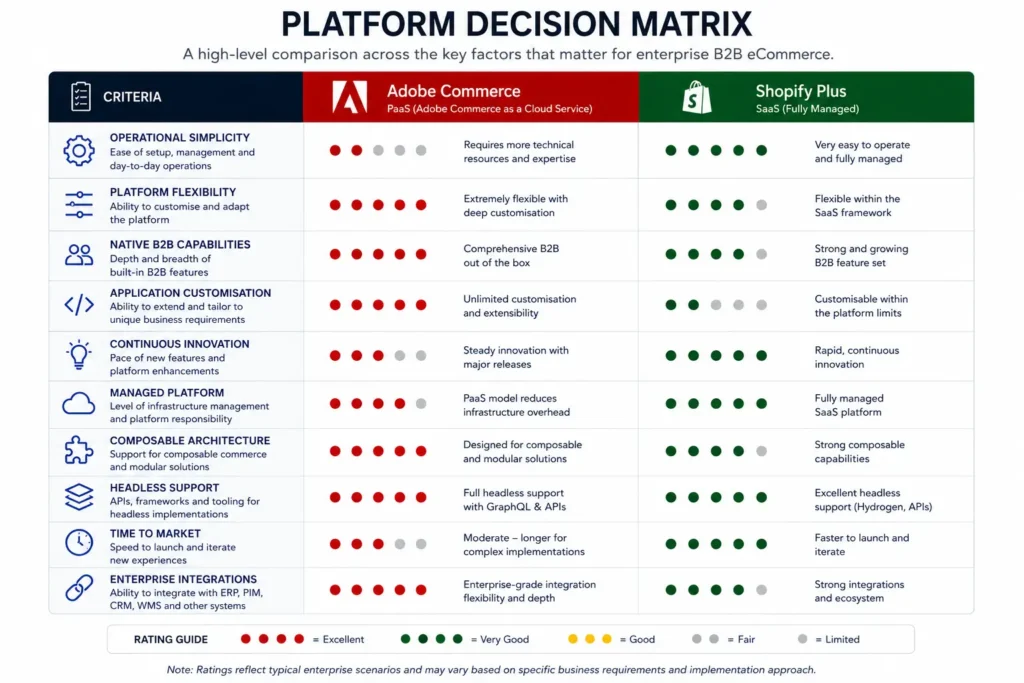
Adobe Commerce May Be Better Suited If…
Adobe Commerce is often an excellent choice for organisations that require extensive flexibility and deep application customisation.
Typical characteristics include:
- Highly customised B2B purchasing workflows
- Complex customer-specific pricing models
- Advanced procurement or approval processes
- Multiple brands with unique operational requirements
- Extensive product catalogues and sophisticated merchandising requirements
- Significant internal technical capability
- Existing investment in the Adobe Experience Cloud ecosystem
- Business requirements that extend well beyond standard commerce functionality
For these organisations, Adobe Commerce provides a highly extensible platform that can be tailored to support complex operational processes.
Shopify Plus May Be Better Suited If…
Shopify Plus is frequently well suited to organisations looking to balance enterprise capability with operational simplicity.
Typical characteristics include:
- Manufacturers and wholesalers seeking rapid implementation
- Organisations modernising legacy commerce platforms
- Businesses looking to reduce ongoing platform maintenance
- Companies embracing standardised business processes
- Retailers requiring strong B2B and B2C capabilities on a single platform
- Organisations wanting continuous access to new platform features without upgrade projects
- Lean internal technology teams focused on business outcomes rather than infrastructure management
Shopify Plus has matured considerably in recent years and now supports many enterprise B2B scenarios that previously required more heavily customised platforms.
Real-World Considerations
Every enterprise commerce project is different.
While feature comparisons provide a useful starting point, platform selection is rarely determined by individual capabilities alone.
Your ERP System Matters More Than Many Businesses Expect
In many enterprise projects, the ERP system ultimately has a greater influence on the implementation than the commerce platform itself.
Customer pricing, inventory, fulfilment, financial processes and product information are typically managed within the ERP. Designing a robust integration architecture and clearly defining system ownership is often more important than comparing individual platform features.
Business Processes Should Drive Technology Decisions
Successful implementations begin by understanding how the business operates.
Questions worth asking include:
- How are customer prices managed?
- How are approvals handled?
- Are there multiple warehouses?
- How are products maintained?
- How many trading entities exist?
- Do sales representatives place orders on behalf of customers?
- Are there unique fulfilment or procurement workflows?
These operational requirements frequently determine the most appropriate platform.
Consider Your Internal Resources
Technology decisions should also reflect the skills available within the organisation.
Some businesses maintain dedicated digital teams responsible for ongoing platform enhancement.
Others rely on smaller marketing or eCommerce teams focused on merchandising and customer experience.
Selecting a platform that aligns with your internal capability is often just as important as selecting the platform with the most features.
Final Thoughts
A decade ago, comparing Adobe Commerce and Shopify Plus was relatively straightforward.
Adobe Commerce was widely recognised for its flexibility and customisation, while Shopify focused on simplicity and ease of use.
Today, the landscape has changed considerably.
Adobe continues to evolve through services such as Adobe Live Search, Adobe Catalogue Service, Adobe App Builder and Adobe Commerce as a Cloud Service, extending the platform beyond its traditional PaaS foundations.
At the same time, Shopify has rapidly expanded its enterprise capabilities through Companies, Catalogs, Search & Discovery, Flow, Functions, Checkout Extensibility, Markets and an increasingly mature B2B offering.
Both platforms are now capable of supporting sophisticated enterprise commerce implementations.
The better platform is not determined by the length of a feature checklist. It is determined by how well the platform supports your operational model, integrates with your technology ecosystem and enables your business to grow over the long term.
At OSE, we work with organisations to evaluate Adobe Commerce and Shopify Plus based on their unique operational requirements rather than platform preference. By understanding your business processes, integration requirements and long-term digital strategy, we help identify the platform that delivers the greatest value for your organisation, both today and into the future.