
For many Shopify retailers, growth has traditionally been driven by customer acquisition.
More ads.
More traffic.
More first-time buyers.
More campaigns.
That approach still matters, but it is becoming harder to rely on alone. Advertising costs remain high, customers are harder to target, and retailers are under pressure to grow revenue without simply increasing spend. This is why repeat purchase strategy has become so important.
For Shopify retailers, one of the strongest opportunities is not just attracting more customers. It is using customer data more effectively to bring existing customers back. This is where Klaviyo can play an important role.
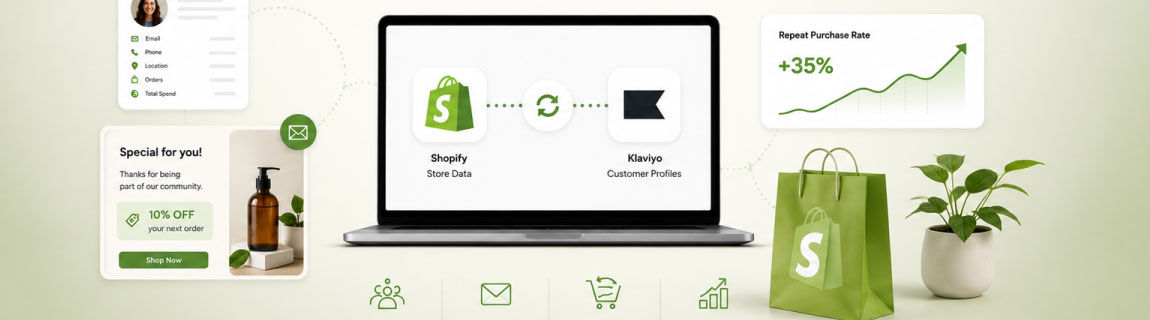
When Shopify and Klaviyo are integrated properly, retailers can use customer, product and order data to create more relevant email and SMS journeys. These journeys can help increase repeat purchases, improve customer retention and grow customer lifetime value.
The key is to treat Klaviyo as more than an email platform. It should become part of the customer growth engine.
Why Shopify and Klaviyo work well together
Shopify holds some of the most valuable data in an eCommerce business. That includes customer profiles, order history, product purchases, abandoned carts, product views and checkout activity.
Klaviyo allows retailers to use that data to build targeted customer journeys across email and SMS. Instead of sending the same message to every customer, retailers can create flows and campaigns based on real customer behaviour.
For example, a retailer can communicate differently with:
- A customer who has just made their first purchase
- A customer who has purchased three times before
- A customer who viewed a product but did not buy
- A customer who abandoned checkout
- A customer who has not purchased in 120 days
- A customer who regularly buys from a specific category
- A high-value customer who should not need heavy discounting
This is where the value of the Shopify and Klaviyo integration becomes clear.
It allows retailers to move from broad campaign marketing to behaviour-based customer communication.
The goal is not just more email
One mistake retailers can make with marketing automation is assuming the goal is to send more messages.
It is not.
The goal is to send more relevant messages. A good Klaviyo and Shopify setup should help retailers answer questions like:
What has this customer purchased?
What are they likely to need next?
When are they likely to buy again?
Which products or categories are they interested in?
Should this customer receive a discount, education, product guidance or loyalty recognition?
Is this customer new, active, at risk or highly valuable?
When those answers are used properly, email and SMS become more useful to the customer and more profitable for the retailer.
Step 1: Connect Shopify and Klaviyo properly
The first step is to ensure Shopify and Klaviyo are connected correctly. At a basic level, this allows Klaviyo to receive Shopify customer, product, order and behavioural data.
However, retailers should not stop at simply installing the integration.
The quality of the setup matters.
Retailers should check that:
- Customer profiles are syncing correctly
- Order history is being captured accurately
- Product catalogue data is available
- Viewed product, added to cart and checkout events are working
- Consent settings for email and SMS are configured correctly
- Customer tags and segments are meaningful
- Historical data has been imported where appropriate
- Tracking is tested before key flows are activated
This foundation is important because every future segment, campaign and automation depends on the quality of the data.
If the data is incomplete, the customer journey will be incomplete.
Step 2: Build the right customer segments
Once Shopify data is flowing into Klaviyo, the next step is segmentation.
Segmentation is where many retailers can unlock immediate value.
Instead of treating the database as one audience, customers can be grouped based on behaviour, value and lifecycle stage.
Useful Shopify and Klaviyo segments may include:
- First-time customers
- Repeat customers
- VIP customers
- Customers who purchased from a specific category
- Customers who purchased a specific product
- Customers likely to replenish
- Customers who have not purchased recently
- Customers who subscribed but have never purchased
- Customers who abandon checkout
- Customers who engage with email but do not buy
These segments allow retailers to communicate with more context.
A first-time customer may need reassurance and education. A loyal customer may respond better to early access. A dormant customer may need a timely reason to return.
The message should change because the customer’s relationship with the brand is different.
Step 3: Create a first purchase to second purchase journey
One of the most important journeys for any retailer is the movement from first purchase to second purchase.
A first order is valuable, but it does not guarantee loyalty.
The customer may still be testing the brand. They may have purchased because of a promotion. They may not yet understand the full range of products available.
A strong post-purchase journey can help turn that first transaction into a longer-term relationship.
This journey may include:
- Thank-you messaging
- Product education
- Delivery and usage guidance
- Cross-sell recommendations
- Category-specific content
- Review requests
- Replenishment reminders
- A second-purchase incentive where appropriate
The timing should reflect the type of product sold.
For example, a consumable product may need a replenishment reminder after a predictable period. A fashion retailer may focus on complementary products or new arrivals. A parts or accessories retailer may focus on compatibility, fitment or related products.
The purpose is to make the next purchase feel natural.
Step 4: Use abandoned cart and checkout flows carefully
Abandoned cart and abandoned checkout flows are often among the first automations retailers build.
They are important, but they need to be handled carefully.
A basic abandoned cart flow may recover some revenue, but a better flow considers the customer, the product and the buying context.
Retailers should consider:
- Whether the customer is new or returning
- Whether the product is high-value or low-value
- Whether the customer needs more information before buying
- Whether social proof or reviews would help
- Whether the product has urgency or scarcity
- Whether a discount is actually required
Too many retailers move too quickly to discounting.
In many cases, customers may simply need reassurance, product detail, shipping information, payment options or a reminder.
The goal should be to recover revenue without training customers to wait for a discount.
Step 5: Build category and product-specific journeys
Not every customer has the same intent.
A customer browsing one category may have very different needs from a customer browsing another.
This is especially important for retailers with large catalogues, multiple brands, technical products or both B2C and B2B audiences.
Shopify product and category data can be used inside Klaviyo to create more relevant journeys.
For example:
A beauty retailer may create different post-purchase journeys for skincare, haircare and cosmetics.
A fashion retailer may personalise based on menswear, womenswear, footwear or accessories.
A parts retailer may communicate based on product type, vehicle fitment, brand or usage.
A B2B retailer may tailor messages based on trade customer type, account structure or buying frequency.
The more relevant the message, the more likely the customer is to return.
Step 6: Create replenishment and repeat purchase reminders
For many retailers, repeat purchase behaviour follows a pattern. Customers may buy again after 30, 60, 90 or 120 days depending on the product.
If a retailer can identify that pattern, Klaviyo can be used to trigger timely reminders.
This can work particularly well for:
- Consumables
- Health and beauty products
- Pet products
- Food and beverage
- Apparel basics
- Workwear
- Parts and accessories
- Seasonal products
- Products with replacement cycles
The key is timing.
A reminder sent too early can feel irrelevant. A reminder sent too late may arrive after the customer has purchased elsewhere.
Shopify purchase history gives retailers the data needed to understand when customers are likely to buy again. Klaviyo can then help automate the communication around that moment.
Step 7: Treat high-value customers differently
Not all customers contribute equally to revenue. High-value customers often deserve a different experience, but many retailers still send them the same campaigns as everyone else.
This can be a missed opportunity.
VIP and high-value customer segments can be used to offer:
- Early access to new products
- Exclusive launches
- Loyalty recognition
- Personalised recommendations
- Invitations to events or experiences
- Higher-value content
- Less aggressive discounting
This matters because the goal is not always to push the next sale. Sometimes the goal is to protect the relationship.
A customer who already buys regularly may not need a discount. They may simply need to feel recognised, understood and valued.
Step 8: Win back customers before they are lost
Every retailer has customers who stop buying. The question is whether the business can identify them early enough to bring them back.
Klaviyo can help retailers build win-back journeys using Shopify order history and customer behaviour. A win-back journey may be triggered when a customer has not purchased within a certain period. However, the timing should depend on the product and customer type.
For some retailers, 60 days may indicate risk. For others, 180 days may be normal.
A good win-back strategy should consider:
- Previous purchase history
- Average time between orders
- Product category
- Customer value
- Email engagement
- Discount sensitivity
- Whether the customer has viewed products recently
The message should not always be “here is a discount”.
It may be better to show new arrivals, remind the customer of products they previously liked, highlight bestsellers or provide useful content.
Step 9: Use SMS for the right moments
SMS can be highly effective, but it should be used with care. Retailers should avoid treating SMS as simply another version of email.
SMS is more direct and personal, which means it should be reserved for moments where immediacy matters.
Good SMS use cases may include:
- Time-sensitive offers
- Back-in-stock alerts
- Order or delivery updates
- VIP launches
- High-intent cart recovery
- Replenishment reminders
- Limited product releases
The key is restraint.
If SMS is overused, customers may opt out. If it is used carefully, it can become a valuable part of the customer journey.
Step 10: Measure the right outcomes
Retailers should not judge Klaviyo performance only by opens and clicks. Those metrics are useful, but they do not tell the full commercial story.
A better measurement approach includes:
- Revenue from flows
- Revenue from campaigns
- Repeat purchase rate
- Time between purchases
- Customer lifetime value
- First purchase to second purchase conversion
- Win-back revenue
- SMS opt-in and opt-out rates
- Revenue by customer segment
- Revenue by product category
The goal is to understand whether the integration is helping customers buy again, buy sooner and buy more relevant products.
That is where Klaviyo becomes more than a marketing tool.
It becomes a retention and revenue platform.
Common mistakes to avoid
Integrating Klaviyo with Shopify is not difficult at a basic level, but using it well requires strategy.
Retailers should avoid these common mistakes:
Sending the same campaigns to everyone
Broad campaigns may still have a place, but they should not be the only approach.
Customer behaviour should influence communication.
Overusing discounts
Discounts can work, but they should not become the default solution.
Education, product relevance, social proof and timing can often drive action without reducing margin.
Ignoring the post-purchase journey
Many retailers focus heavily on acquisition and cart recovery, but underinvest in what happens after the first purchase.
This is often where repeat revenue is won or lost.
Not using product and category data
Product data is one of the most useful inputs for personalisation.
If customers are buying from different categories, they should not all receive the same journey.
Failing to clean customer data
Poor data leads to poor segmentation.
Before building advanced journeys, retailers should make sure customer, product and order data is accurate.
Measuring activity instead of revenue
Email opens and clicks matter, but the bigger question is whether Klaviyo is increasing repeat purchases and customer lifetime value.
What a strong Shopify and Klaviyo setup should include
A strong setup should usually include:
- Shopify and Klaviyo integration configured correctly
- Email and SMS consent handled properly
- Core customer segments created
- Welcome flow
- Abandoned cart and checkout flows
- Browse abandonment where appropriate
- Post-purchase journey
- First purchase to second purchase journey
- Product review journey
- Replenishment reminders
- Win-back journey
- VIP or high-value customer journey
- Campaign calendar
- Revenue and retention reporting
- Ongoing optimisation
Not every retailer needs every flow immediately.
The best approach is to prioritise the journeys most likely to increase revenue and retention first.
Why implementation matters
Klaviyo can be powerful, but the value depends on how well it is implemented. A basic setup may allow retailers to send campaigns and create simple flows.
A more mature setup connects Shopify data, customer behaviour, product information and lifecycle strategy into a more complete customer journey.
For larger retailers, this may also involve other systems such as ERP, POS, CRM, loyalty, customer service or data platforms.
That broader integration can create a more accurate view of the customer.
For example, a retailer may want to use:
- Online order history from Shopify
- In-store purchase history from POS
- Customer status from CRM
- Product availability from ERP
- Loyalty tier or points balance
- Trade account data for B2B customers
When this data is connected properly, Klaviyo can support more relevant and profitable customer communication.
Final thought
Integrating Klaviyo with Shopify is not just about connecting two platforms. It is about using customer data to increase repeat purchases, improve retention and grow customer lifetime value.
The retailers that do this well are not simply sending more emails. They are creating more relevant customer journeys.
They understand who the customer is, what they have purchased, when they are likely to buy again and what message is most likely to help them return.
For Shopify retailers looking to grow more profitably, that is where the opportunity sits.
Getting the most from Shopify and Klaviyo requires more than a basic integration.
It requires clean customer and order data, a clear lifecycle strategy and, for retailers running ERP, POS, loyalty or CRM systems alongside Shopify, the right connections between platforms so Klaviyo is working with a complete picture of every customer.
At OSE, we help Australian Shopify retailers implement and optimise Klaviyo properly building the customer journeys, segments and automations that increase repeat purchase rates, improve customer retention and grow Customer Lifetime Value.
Whether you’re setting up Klaviyo for the first time, improving an existing implementation, or looking to connect your Shopify store with your broader technology stack, we’d love to help.
Let’s start the conversation.