

Traditional search engine optimisation (SEO) is no longer the only way customers discover products online. Increasingly, shoppers are asking questions directly to AI-powered search platforms like ChatGPT, Google AI Overviews, Google Gemini, Perplexity and Microsoft Copilot. Rather than returning a list of websites, these platforms generate answers, recommend products and cite retailers they consider authoritative.
For eCommerce businesses, this represents a significant shift. Success is no longer measured solely by where your products rank in Google Search, but whether AI platforms choose to reference and recommend them.
While no business can guarantee its products will appear in AI-generated responses, there are proven strategies that significantly improve your chances. In this guide, we’ll explore how AI search works, what influences product visibility, and the practical steps you can take to optimise your product catalogue for the future of search.
What is AI Search?
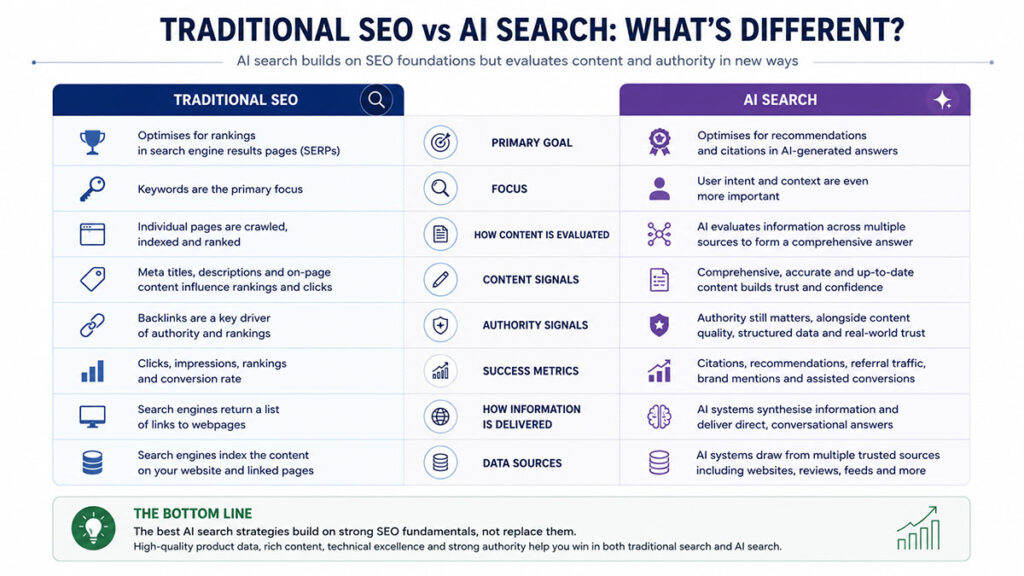
AI search uses large language models (LLMs) to understand a user’s question and generate a conversational response rather than simply listing webpages.
Examples include:
- ChatGPT
- Google AI Overviews
- Google Gemini
- Perplexity
- Microsoft Copilot
- Claude
Instead of searching for:
“Men’s waterproof hiking boots”
A customer might ask:
“What’s the best waterproof hiking boot for winter hiking in Tasmania?”
The AI evaluates information from numerous trusted sources before recommending products it considers relevant.
This changes the way product information is discovered and presented.
How AI Platforms Find Products
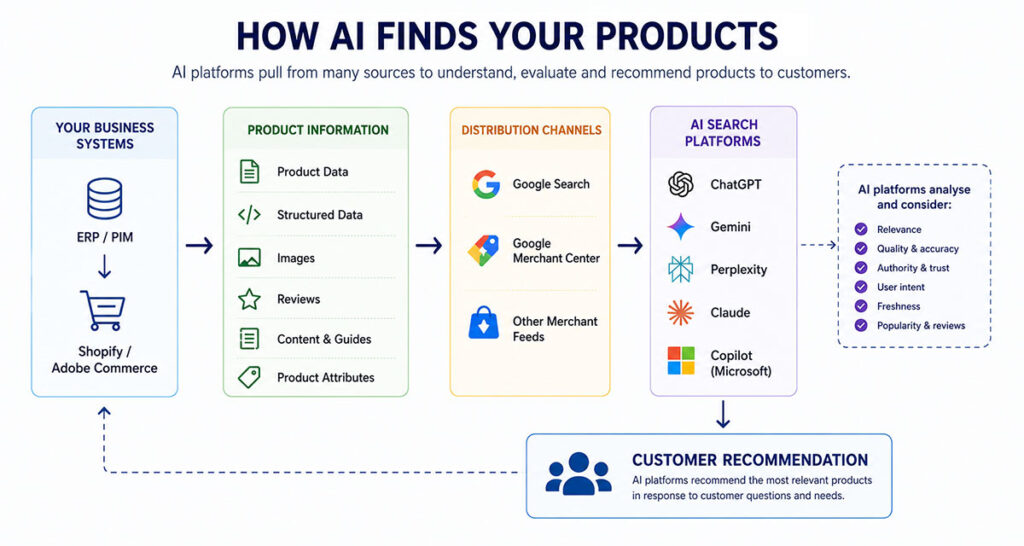
Although every AI platform works differently, they generally rely on a combination of signals.
These include:
- Publicly accessible websites
- Search engine indexes
- Structured data
- Merchant feeds
- Product reviews
- Brand authority
- Website quality
- Fresh content
- Technical accessibility
Unlike traditional search, AI attempts to understand the relationship between products, brands, customer intent and supporting information.
This makes comprehensive, high-quality product data more important than ever.
Start with High-Quality Product Data
AI can only understand the information available.
Poor product data often includes:
- Short descriptions
- Missing specifications
- Generic manufacturer copy
- Limited attributes
- Poor categorisation
- Missing dimensions
- Inconsistent naming
Well-structured product information gives AI significantly more context.
High-quality product pages should include:
- Detailed descriptions
- Complete specifications
- Product dimensions
- Materials
- Compatibility information
- Warranty details
- Installation information
- Frequently asked questions
- Use cases
- Feature comparisons
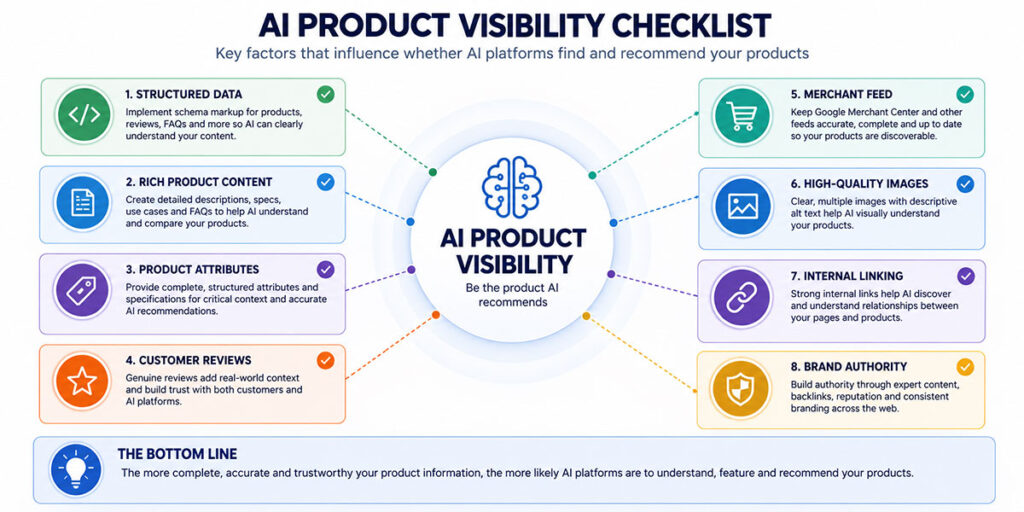
The richer your product information, the easier it becomes for AI to understand exactly what you’re selling.
Implement Comprehensive Structured Data
Structured data remains one of the strongest technical signals available.
For product pages, this should include appropriate Schema.org markup such as:
- Product
- Offer
- AggregateRating
- Review
- BreadcrumbList
- Organisation
Where appropriate, additional schema may also include:
- FAQPage
- HowTo
- VideoObject
Structured data helps search engines and AI platforms understand products beyond the visible page content.
Build Rich Product Attributes
Many retailers only publish a product description.
AI performs better when products include structured attributes such as:
- Colour
- Size
- Material
- Brand
- Model number
- Weight
- Finish
- Capacity
- Industry
- Application
- Compatibility
These attributes allow AI to answer highly specific customer questions.
For example:
“Which stainless steel outdoor ceiling fan is suitable for coastal environments?”
Without structured attributes, AI has little confidence recommending a product.
Keep Product Information Accurate
AI values current information.
Ensure your catalogue maintains:
- Current pricing
- Accurate inventory
- Correct availability
- Updated specifications
- Current images
- Active products
Synchronising your ERP with your commerce platform helps maintain data consistency and reduces the likelihood of outdated information being surfaced.
Optimise Product Images
Images are increasingly being analysed by AI.
Best practices include:
- High resolution photography
- Multiple product angles
- Lifestyle imagery
- Descriptive filenames
- Image alt text
- Consistent branding
AI can extract information from imagery in addition to traditional metadata to better understand your products. Ensuring you take the time to enrich your products with high quality imagery can assist your products to appear in AI and traditional image search facilities.
Create Helpful Buying Content
AI platforms frequently reference educational content rather than product pages alone.
Supporting articles may include:
- Buying guides
- Comparison articles
- Installation guides
- Troubleshooting content
- Industry advice
- Frequently asked questions
This supporting content establishes topical authority and provides AI with additional context when recommending products.
Strengthen Internal Linking
Well-connected websites help AI understand relationships between products.
Examples include:
- Product to category
- Category to buying guide
- Product comparisons
- Brand pages
- Solution pages
Strong internal linking improves discoverability for both search engines and AI systems.
Encourage Genuine Customer Reviews
Reviews provide additional product context beyond manufacturer descriptions.
They often contain valuable information about:
- Product quality
- Durability
- Performance
- Installation
- Fit
- Real-world use
Authentic customer reviews help AI understand where products perform well. Developing a strategy to incentivise your customers to leave product reviews can be very effective for online retailers.
Build Brand Authority
AI appears more likely to reference businesses that demonstrate authority.
This includes:
- Expert content
- Industry publications
- Quality backlinks
- Positive customer reputation
- Consistent branding
- Comprehensive website content
Authority is built over time rather than through any single optimisation.
Monitor Your Merchant Data
Google Merchant Center remains an important source of product information.
Ensure your feeds include:
- Accurate pricing
- Product identifiers
- Availability
- Images
- Shipping information
- GTINs where applicable
Maintaining accurate merchant feeds improves consistency across Google’s ecosystem.
Measure AI Traffic
AI referrals are becoming easier to identify through analytics platforms.
Monitor traffic from:
- ChatGPT
- Perplexity
- Gemini
- Copilot
- Other AI referrers
Over time, this data can help identify which content performs best within AI-generated recommendations.
The Future of Product Discovery
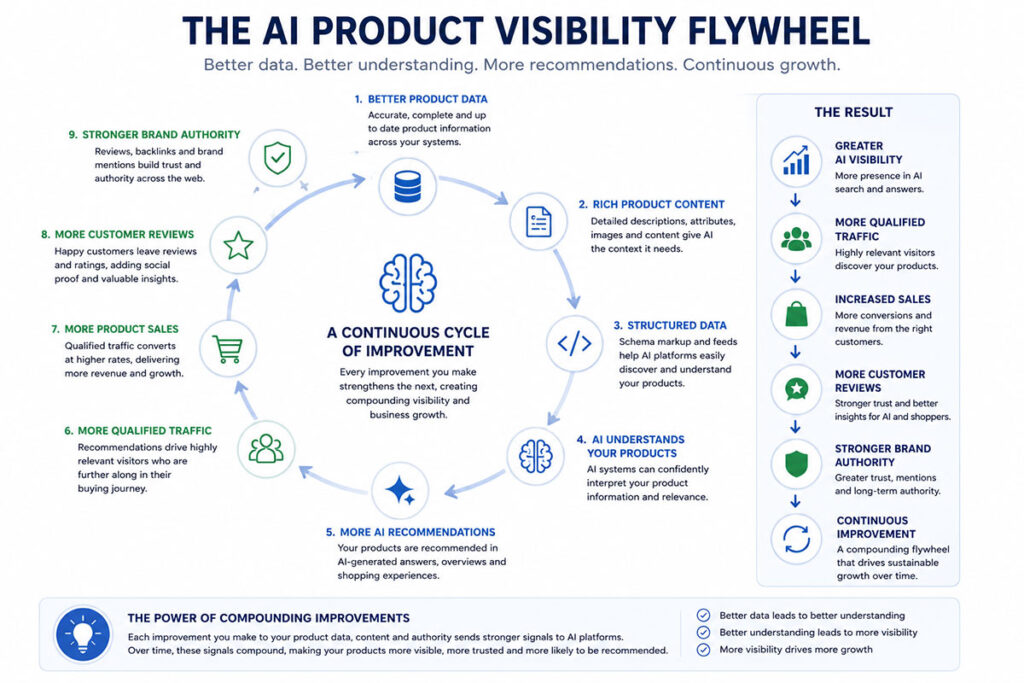
AI search is unlikely to replace traditional search overnight, but it is already changing how customers discover products.
Rather than simply optimising for search engines, businesses should focus on creating product information that is clear, accurate, comprehensive and genuinely useful. These same qualities improve visibility across Google Search, AI platforms and your own on-site search experience.
Businesses that invest in high-quality product data today will be better positioned as AI becomes an increasingly important source of product discovery.
How OSE Helps Businesses Prepare for AI Search
At OSE, we believe successful AI visibility starts with exceptional product data.
Our team helps retailers and wholesalers improve the quality of their product catalogues through structured data, ERP integration, product information management, AI-assisted product enrichment and technical SEO. By combining accurate operational data with compelling customer-facing content, we help businesses create product catalogues that are easier for both customers and AI platforms to understand.
As AI search continues to evolve, businesses with well-structured, information-rich catalogues will be in the strongest position to benefit from the next generation of product discovery.