


Selling automotive parts online presents challenges that simply do not exist in most other forms of eCommerce.
A customer buying a pair of shoes generally needs to choose a size and colour. A customer buying a suspension component, brake part or engine component needs to know whether that specific product will fit their vehicle.
That difference changes almost everything.
Automotive eCommerce businesses need to manage complex product catalogues, vehicle compatibility data, sophisticated search experiences, ERP integrations, multiple warehouses, retail locations, trade customers and potentially millions of relationships between products and vehicles.
For established automotive retailers, manufacturers, distributors and parts suppliers, the eCommerce platform therefore needs to be much more than an online catalogue.
It needs to become part of the organisation’s broader commerce infrastructure.
In this guide, we look at the major considerations involved in building an automotive eCommerce platform, from registration and Year Make Model lookups through to parts data providers, ERP integration, B2B commerce, product search, SEO and platform selection.
Why Automotive eCommerce Is Different
Automotive eCommerce is fundamentally a data problem.
The product itself is only one part of the equation.
An automotive retailer may sell 50,000 products, but those products could collectively have millions of relationships with vehicles.
A single brake pad, for example, might fit dozens or hundreds of vehicle variants across different:
- Makes
- Models
- Years
- Series
- Engines
- Body types
- Transmissions
- Drivetrains
The challenge is not simply displaying the brake pad online.
The challenge is determining whether that brake pad is appropriate for the particular vehicle the customer owns and making that process fast and easy.
This is why automotive eCommerce architecture frequently includes several systems working together:
- eCommerce platform
- ERP
- Product Information Management system
- vehicle or parts database
- search engine
- warehouse or inventory systems
- point-of-sale systems
- CRM
- marketing automation
- middleware and integration services
The quality of the customer experience ultimately depends on how effectively these systems exchange and interpret data.
1. Vehicle Identification Is at the Heart of Automotive eCommerce
One of the most important decisions in an automotive eCommerce project is how customers identify their vehicle.
There are several approaches, and sophisticated automotive retailers will often provide more than one.
Registration Lookups
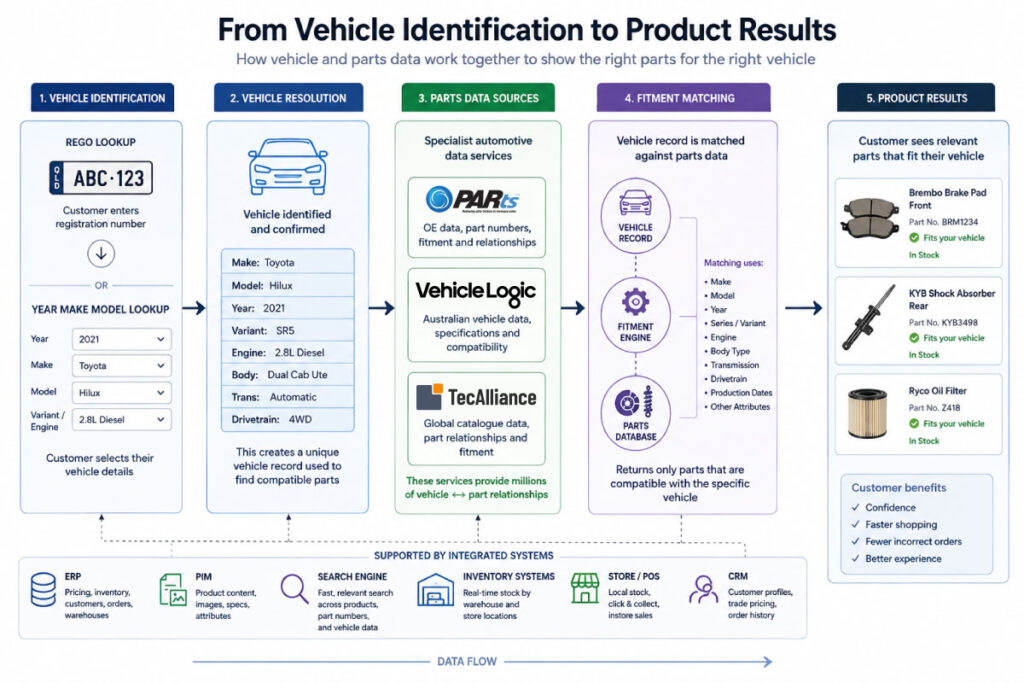
Registration or rego lookup can provide one of the simplest experiences for the customer.
Rather than asking the customer to understand their vehicle specification, they enter their registration number.
The website can then identify the vehicle and use that information to filter compatible products.
A typical journey might look like:
Enter Registration → Identify Vehicle → Confirm Vehicle → Display Compatible Products
This can significantly reduce friction, particularly for consumers who may know they drive a Toyota Hilux but do not necessarily know the exact series, engine or production variant.
However, a registration lookup is not usually the entire solution.
The registration service identifies the vehicle. That vehicle then needs to be mapped against the parts and fitment data used by the eCommerce catalogue.
That distinction is important.
Year Make Model Lookups
Year Make Model, often abbreviated to YMM, is another widely used approach.
A customer progressively selects:
Year → Make → Model → Series/Variant → Engine
The exact hierarchy depends on the catalogue.
Once the vehicle has been identified, the website can filter products based on compatibility.
YMM can also work extremely well alongside registration lookup.
For example, a retailer might offer:
Find parts for your vehicle
Enter your rego
or
Select your vehicle
Providing both methods gives customers flexibility while still resolving the journey into a common vehicle record behind the scenes.
Remembering the Customer’s Vehicle
The experience should not necessarily end when the customer performs their first search.
Once a vehicle has been selected, the website can remember it.
Customers can then see:
Fits your vehicle
or
Does not fit your vehicle
throughout the shopping experience.
Registered customers can potentially maintain a virtual garage containing several vehicles.
For trade customers, that concept can be extended even further.
A mechanic or workshop might regularly purchase parts for hundreds of different vehicles. Making it fast to switch between vehicle profiles can dramatically improve ordering efficiency.
2. Automotive Parts Data Is a Critical Part of the Architecture
One of the biggest mistakes when planning an automotive eCommerce project is assuming the ERP contains everything required to create the online catalogue.
It often doesn’t.
An ERP may contain:
- SKU
- product name
- cost
- selling price
- inventory
- warehouse
- supplier
- basic category information
But the eCommerce experience may require significantly richer information.
This can include:
- vehicle compatibility
- technical specifications
- dimensions
- alternate part numbers
- OEM references
- product relationships
- superseded products
- installation information
- vehicle attributes
- product images
- technical documentation
This is where specialist automotive parts data services can become extremely important.
Depending on the market, catalogue and business requirements, automotive businesses may work with services such as PartsDB, Vehicle Logic and TecDoc.
These platforms and data sources can provide important information about vehicles, parts and compatibility relationships.
The eCommerce architecture therefore needs to answer a fundamental question:
Which system owns each piece of data?
For example:
ERP → pricing, inventory and commercial product information
Parts data service → vehicle and fitment information
PIM → enriched product content and digital assets
eCommerce platform → customer-facing merchandising and content
Search platform → indexed product and vehicle relationships
Getting these responsibilities right early in the project can prevent enormous complexity later.
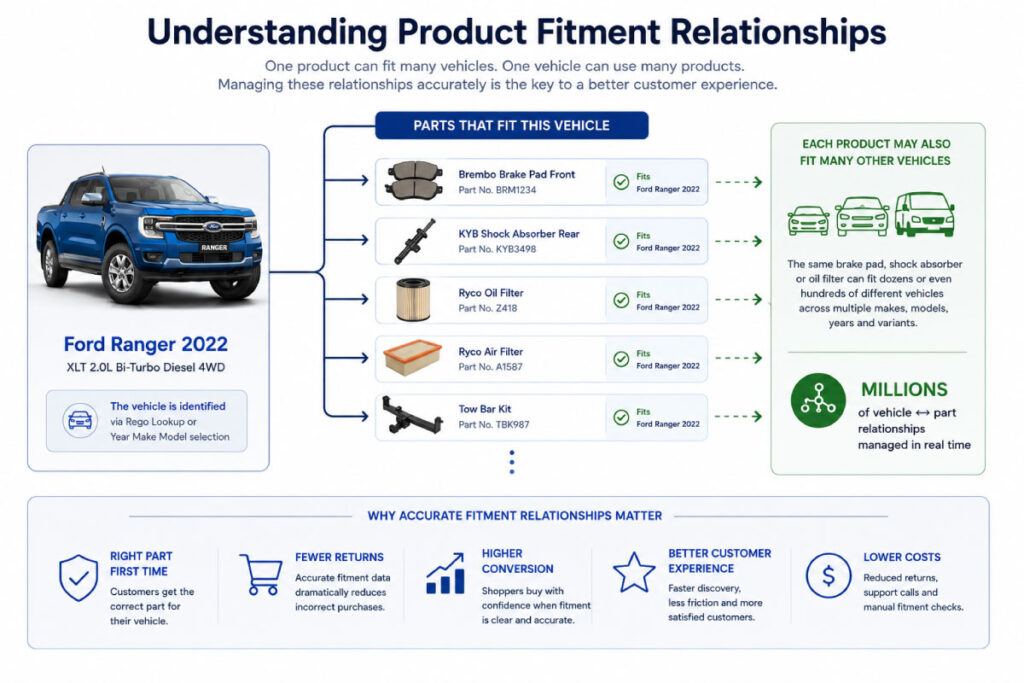
3. Product Fitment Is More Complicated Than a Product Attribute
A common mistake is treating vehicle compatibility as another product attribute.
It isn’t.
A product might have relatively simple attributes such as:
- Brand: Brembo
- Material: Ceramic
- Position: Front
- Product Type: Brake Pad
But fitment represents relationships.
The same product could fit:
- Vehicle A
- Vehicle B
- Vehicle C
- Vehicle D
- Vehicle E
And each vehicle could have thousands of compatible products.
This is effectively a many-to-many relationship.
At scale, the number of relationships can become enormous.
For this reason, simply importing every possible vehicle relationship into standard eCommerce product attributes may not be the best architecture.
A more sophisticated implementation may maintain fitment data within a specialist data service or database and make it available to the eCommerce platform and search engine through APIs or middleware.
The correct approach depends on catalogue size, search requirements and the capabilities of the chosen commerce platform.
4. Search Is Often More Important Than Navigation
Traditional eCommerce places significant emphasis on category navigation.
Automotive customers frequently behave differently.
They want to answer one question:
Do you have the part I need for my vehicle?
That makes search particularly important.
An automotive search experience may need to understand:
- SKU
- part number
- OEM number
- manufacturer number
- product name
- vehicle
- brand
- category
- alternate part number
- superseded part number
- technical terminology
- common abbreviations
Trade customers can be particularly search-driven.
A mechanic who knows the exact part number does not want to navigate through five category levels. They want to enter the part number, confirm availability and order.
Consumers may behave differently.
They might start with their vehicle and then browse:
Toyota Hilux → Brakes → Brake Pads
A strong automotive eCommerce platform should support both behaviours.
5. The Customer Should Be Able to Shop by Vehicle
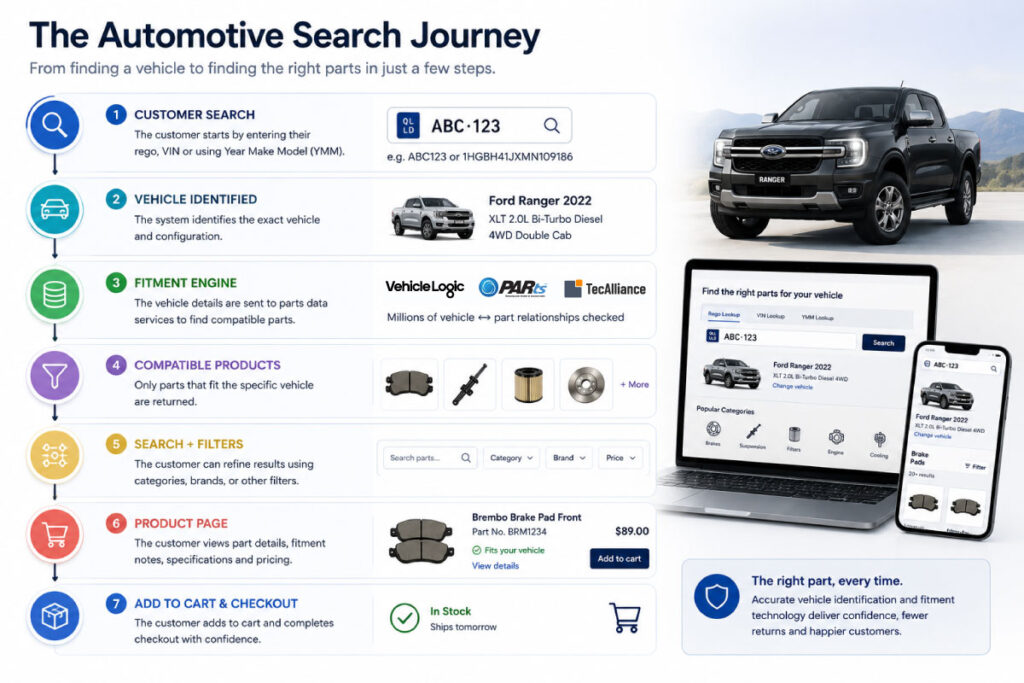
Once the customer has identified their vehicle through rego lookup or Year Make Model selection, the entire shopping experience can change.
Instead of showing the complete catalogue, the site can show only parts for your 2022 Ford Ranger.
Categories might then include:
- Brakes
- Suspension
- Filters
- Engine
- Electrical
- Cooling
- Drivetrain
- Accessories
This dramatically reduces the cognitive load placed on the customer.
It also creates opportunities to merchandise products around the vehicle rather than simply around the catalogue.
The selected vehicle can persist throughout the customer’s session so that compatibility information can be displayed on product listing pages, search results and product pages.
6. Automotive Category Architecture Should Be Customer-First
ERP category structures rarely make ideal eCommerce category structures.
They were usually created for internal operations rather than customer discovery.
An ERP might classify products according to:
- supplier
- accounting category
- warehouse group
- internal product family
Customers may think about the same catalogue completely differently.
For example:
Brakes → Brake Pads → Front Brake Pads
or
Suspension → Shock Absorbers
or simply:
Parts for my Ford Ranger
The eCommerce taxonomy should therefore be designed around how customers search and shop.
The ERP taxonomy can remain intact internally while mapping rules translate products into the appropriate eCommerce categories.
This is another area where good product data architecture becomes critical.
7. ERP Integration Is the Backbone of the Platform
For established automotive businesses, the eCommerce platform rarely operates independently.
The ERP often remains the commercial system of record.
Depending on the business, platforms might include systems such as:
- Pronto Xi
- SAP
- Microsoft Dynamics
- NetSuite
- MYOB
- Cin7
- other automotive-specific business systems
The integration might need to synchronise:
ERP → eCommerce
- Products
- Pricing
- Inventory
- Customers
- Customer-specific pricing
- Warehouse availability
- Credit limits
- Promotions
eCommerce → ERP
- Orders
- Customers
- Payments
- Shipping selections
- Order notes
- Account applications
The architecture becomes more complicated when vehicle and fitment data originates from another platform such as PartsDB, Vehicle Logic or TecDoc.
You may then have:
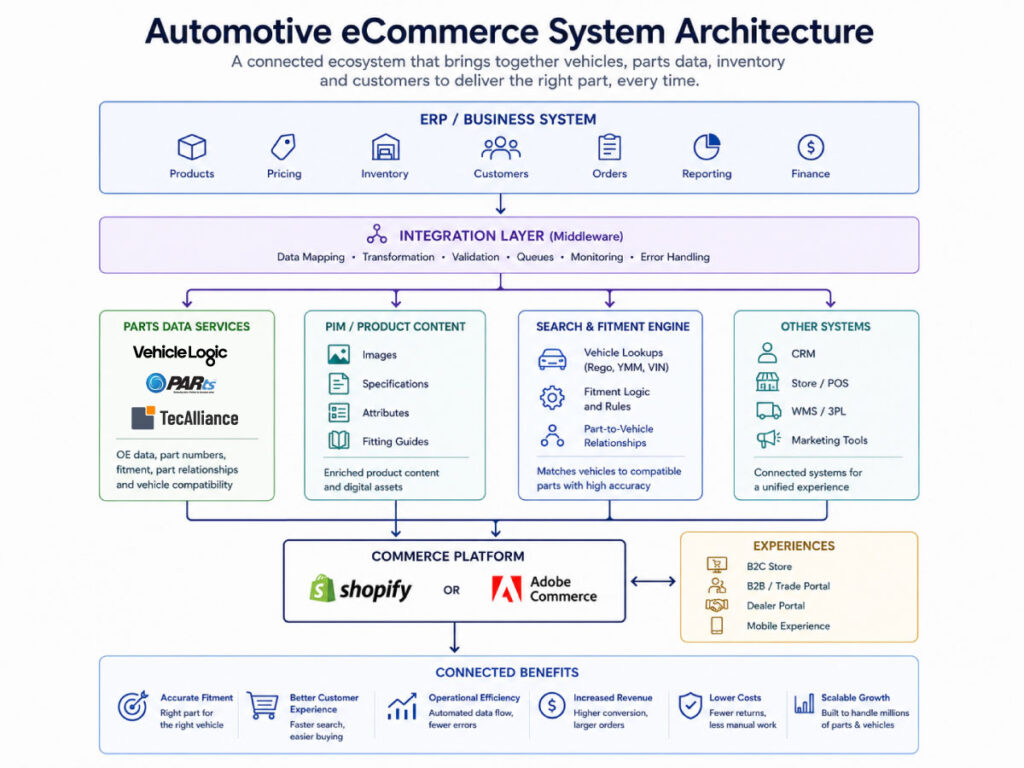
ERP + Automotive Parts Data + PIM → Integration Layer → eCommerce Platform
This is why automotive eCommerce projects need to be approached as integration projects as much as website projects.
8. Real-Time Inventory Can Be Particularly Important
Automotive customers often need products quickly.
A customer whose vehicle is off the road may not be willing to wait a week for a part.
Trade customers may need the product within hours.
This makes inventory visibility extremely valuable.
Instead of simply displaying:
- In Stock
an automotive retailer may be able to display:
- Brisbane: 4 available
- Sydney: 7 available
- Melbourne: 2 available
For businesses operating stores, warehouses and distribution centres, this can become significantly more sophisticated.
The website may determine the best fulfilment location based on:
- customer location
- inventory
- delivery time
- warehouse priority
- freight cost
- store availability
This creates a much stronger omnichannel experience.
9. Store Networks Create Significant Opportunities
Automotive retail is often highly location-driven.
A national automotive business may operate dozens or hundreds of stores, workshops or dealers.
The website should therefore understand multiple locations. Customers might need to:
- find their nearest store
- check local stock
- book an installation
- arrange Click & Collect
- request a quote
- find an authorised dealer
- contact a workshop
Individual store pages can also become valuable SEO assets.
Rather than having a single generic store finder, each location can have its own indexable page containing:
- address
- opening hours
- phone number
- services
- directions
- local content
- structured data
This can help the organisation compete for highly valuable local automotive searches.
10. B2B Automotive Commerce Requires a Different Experience
Many automotive businesses serve both the public and trade customers.
Trying to force both groups through exactly the same buying journey can create problems.
A trade customer may expect:
- account-specific pricing
- contract pricing
- credit terms
- account balances
- invoice history
- quick ordering
- bulk ordering
- quotes
- purchase orders
- multiple users
- approval workflows
- multiple delivery locations
A consumer may simply want to find the correct brake pads and pay by credit card.
Modern commerce platforms make it possible to support both experiences within the broader commerce ecosystem.
This can be particularly valuable for automotive manufacturers and distributors that sell through dealer networks while also operating direct-to-consumer channels.
11. Product Data Quality Directly Affects Conversion
Poor automotive product data creates uncertainty, and uncertainty destroys conversion.
Imagine a customer viewing two similar products.
Product A contains:
- one small image
- short description
- no fitment information
Product B contains:
- multiple high-resolution images
- confirmed vehicle compatibility
- dimensions
- specifications
- installation information
- manufacturer part number
- warranty
- related products
Product B is significantly easier to buy with confidence.
This is why automotive businesses should treat product data as a commercial asset rather than simply an IT requirement.
A replatforming project can be an excellent opportunity to improve and restructure that data.
12. Product Pages Need to Answer the Fitment Question Immediately
For many automotive products, the most important information on the page is not the description.
It is:
Will this fit my vehicle?
If a customer has already selected their vehicle, the product page should ideally answer that immediately.
For example:
✓ Fits your 2021 Toyota Hilux 2.8L Diesel
If no vehicle has been selected:
Check if this fits your vehicle
The customer can then perform a rego lookup or Year Make Model selection without leaving the product page.
That reassurance can have a significant impact on conversion and can also reduce incorrect purchases and returns.
13. SEO for Automotive eCommerce Can Be Enormous
Automotive retailers can potentially target an extraordinary number of long-tail searches.
For example:
- brake pads for Toyota Hilux
- Ford Ranger suspension
- Mazda CX-5 air filter
- Toyota LandCruiser shock absorbers
At sufficient catalogue scale, the combinations become enormous.
However, automatically generating millions of pages is not necessarily an SEO strategy.
Search engines need useful, differentiated pages.
The architecture therefore needs to carefully determine which combinations deserve indexable landing pages and which should simply exist as filtered search experiences.
Strong automotive SEO architecture can include:
- category pages
- brand pages
- vehicle pages
- vehicle/category pages
- product pages
- store pages
- buying guides
- technical content
- fitment information
- structured data
- internal linking
The goal should be to create genuinely useful destinations rather than millions of thin combinations.
14. Automotive Product Data Is Becoming Important for AI Discovery
Product discovery is expanding beyond traditional Google search.
Consumers are increasingly using AI-powered search and assistants to research products, compare options and answer technical questions.
Structured automotive product data is well suited to this environment.
A retailer that clearly identifies:
Product → Brand → Part Number → Category → Vehicle Compatibility → Specifications
gives machines far more information than a retailer with poorly structured product titles and descriptions.
This makes structured data, consistent attributes and clearly defined fitment relationships increasingly valuable beyond the website itself.
The same investment that improves internal search, Google visibility and product filtering can also make the catalogue easier for AI systems to understand.
15. Choosing the Right eCommerce Platform
There is no single best eCommerce platform for every automotive business.
The right choice depends on the complexity of the operation.
Important considerations include:
- catalogue size
- fitment complexity
- B2B requirements
- ERP integration
- number of stores
- international requirements
- multi-brand requirements
- search complexity
- merchandising requirements
- internal development capability
- total cost of ownership
For many automotive retailers, the decision will eventually include platforms such as Shopify and Adobe Commerce.
Shopify
Shopify can be extremely effective where the organisation wants:
- SaaS infrastructure
- relatively low platform maintenance
- rapid development
- strong B2C functionality
- strong marketing ecosystem
- straightforward international expansion
However, complex automotive requirements such as vehicle fitment, specialist search, unusual pricing structures and sophisticated integrations need to be carefully architected rather than assumed to exist out of the box.
Adobe Commerce
Adobe Commerce can be particularly compelling for complex automotive businesses requiring:
- sophisticated catalogues
- highly customised product relationships
- advanced B2B
- multiple websites
- customer-specific pricing
- complex integrations
- extensive custom functionality
Its flexibility can be extremely valuable where the commerce platform needs to accommodate unusual automotive business rules.
The trade-off is that this flexibility requires stronger technical governance and typically greater implementation and ongoing development investment.
The platform decision should therefore start with the business architecture rather than a preference for a particular technology.
16. Don’t Choose the Platform Before Understanding the Data
This deserves particular emphasis.
Before deciding how an automotive website should be built, understand:
- Where does the product data come from?
- Where does vehicle data come from?
- Where does fitment data come from?
- Who owns pricing?
- Who owns inventory?
- How is a registration number resolved into a vehicle?
- How does that vehicle map to compatible parts?
- How frequently does each dataset change?
- How many product-to-vehicle relationships exist?
Those questions can materially change the recommended architecture.
For example, a catalogue using TecDoc may require a different approach from one using PartsDB, Vehicle Logic or proprietary manufacturer fitment data.
Likewise, an automotive retailer with 20,000 relatively simple products has very different requirements from a national parts distributor managing hundreds of thousands of SKUs and millions of fitment relationships.
Discovery should therefore happen before platform architecture is finalised.
17. Middleware Can Simplify Complex Automotive Architecture
When several systems are involved, connecting every platform directly to every other platform can create unnecessary complexity.
Imagine an environment containing:
- ERP
- eCommerce
- PartsDB
- PIM
- CRM
- POS
- warehouse systems
If every system communicates directly with every other system, maintaining those integrations can become increasingly difficult.
An integration or middleware layer can provide a more controlled architecture.
For example:
ERP → Middleware
Parts Data → Middleware
PIM → Middleware
Middleware → eCommerce
The middleware can handle:
- transformation
- mapping
- validation
- queues
- retries
- exception handling
- logging
- monitoring
This becomes particularly valuable when one platform is upgraded or replaced.
Instead of rebuilding every downstream integration, the organisation has a defined integration layer between systems.
18. Performance Matters When Catalogues Become Large
Large automotive catalogues can place considerable pressure on eCommerce platforms.
The issue is not simply the number of products.
It is the combination of:
Products × Vehicles × Fitment Relationships × Prices × Warehouses × Customer Groups
Search and filtering therefore need to be designed for scale.
Trying to perform complicated fitment queries directly against the core commerce database on every request can result in poor performance.
Depending on the architecture, specialised search technology can index product and vehicle relationships and return results extremely quickly.
This is particularly important when customers expect filtering to happen almost instantaneously.
19. Returns Can Be Reduced Through Better Fitment Data
Incorrect parts are expensive.
They create:
- freight costs
- customer service enquiries
- returns processing
- warehouse handling
- customer frustration
- lost future sales
Improving fitment accuracy therefore has a direct operational benefit.
A better eCommerce platform does not simply increase revenue.
It can reduce the cost of servicing that revenue.
Registration lookup, YMM selection, accurate fitment data and clear compatibility messaging all contribute to reducing incorrect purchases.
This should be considered when building the business case for an automotive eCommerce investment.
20. Think Beyond the Initial Website Build
Automotive eCommerce platforms should be designed as long-term digital infrastructure.
The first release might include:
- core eCommerce
- ERP integration
- vehicle lookup
- parts data integration
- search
- store locator
Future releases might introduce:
- trade portal
- workshop bookings
- personalised vehicle garages
- AI-assisted search
- advanced recommendations
- dealer portals
- marketplace integrations
- improved product data
- additional brands
- international expansion
Trying to deliver every possible capability in the initial project can dramatically increase risk.
A better approach is often to establish the correct architecture first and then progressively improve the customer experience.
What Does a Strong Automotive eCommerce Architecture Look Like?
There is no universal architecture, but a mature automotive commerce ecosystem might look something like:
ERP
Pricing, inventory, customers and orders
↓
Integration Layer
↙ ↓ ↘
Parts Data | PIM | Vehicle Data
PartsDB / Vehicle Logic / TecDoc | Product content | Rego / YMM
↓
Search & Fitment Layer
Vehicle compatibility, product discovery and filtering
↓
eCommerce Platform
Shopify / Adobe Commerce
↓
Customer
B2C / Trade / Dealer / Store
The important point is that the website is only one component.
The real platform is the ecosystem connecting product, vehicle, inventory, pricing and customer data.
Final Thoughts
Automotive eCommerce is one of the clearest examples of why successful digital commerce requires more than an attractive website.
The customer experience is ultimately determined by the quality of the underlying architecture.
Can the customer identify their vehicle easily?
Can they use their registration number or Year Make Model to find compatible products?
Can the website confidently tell them whether a product fits?
Can product and fitment data from services such as PartsDB, Vehicle Logic or TecDoc be combined effectively with pricing and inventory from the ERP?
Can a mechanic find a part by its number in seconds?
Can a consumer see whether their local store has the product available?
Can a trade customer see their own pricing and order on account?
Can the platform continue performing as the catalogue grows to hundreds of thousands of products and millions of vehicle relationships?
These are the questions that should drive an automotive eCommerce project.
For established automotive retailers, manufacturers and distributors, getting this architecture right can create advantages far beyond online sales.
It can improve product discovery, reduce incorrect orders, streamline operations, support trade customers, improve local store engagement and provide the foundation for new digital services.
The strongest automotive eCommerce platforms are therefore not simply online stores.
They are connected commerce systems that bring together vehicles, products, customers, inventory and locations to make an inherently complicated purchasing decision feel simple.