


A shopper adds a lamp, cushions and a side table to one basket. The nearest store has two of the items. Another branch has the third. The website offers delivery and Click & Collect, but someone behind the transaction still has to decide which location should supply each line and what the customer can realistically expect.
For larger homewares, hardware and electronics retailers, that decision can affect delivery charges, store workload and the quality of the customer experience. One basket may become two parcels, a stock transfer or a collection that takes longer than the shopper anticipated.
Omnichannel order management connects those choices across the website, stores and distribution centres. This guide focuses on how to route a mixed basket, decide when splitting is justified and preserve the promise through collection or delivery. The investment question is whether your current commerce and integration setup can govern those decisions, or whether you need a more capable order management layer.
Key Takeaways
- Define the customer promise before allocating a mixed basket.
- Compare complete fulfilment costs and service constraints, not parcel count alone.
- Connect reservations, transfers and readiness before expanding routing automation.
Define the customer promise before choosing the fulfilment location
Start with the options a shopper should be able to choose. These might include collecting everything from one store, receiving separate deliveries, waiting for a consolidated order or selecting a different collection location. Define what each option means before asking a platform to optimise it.
An order confirmation acknowledges the transaction. A collection promise says when goods should be obtainable at a named location. A dispatch notification describes a shipment. Treat these as separate commitments, particularly when one order contains several fulfilment groups.
Clear availability and delivery information should be part of the operating model. The Commerce Commission’s selling online guidance says availability information should be clear and accurate and delivery terms should be clear and achievable. The operating rules behind the website need to support the offer made to the customer.
Agree which decisions are fixed at checkout and which may change afterwards. If a local store rejects a pick, can the system reallocate the item without changing the arrival estimate? If a transfer adds time, who tells the customer and offers the permitted alternatives? Those answers belong in the service design.
Use actual problematic orders to define the scope. Include a mixed basket, a last unit that could not be found, a transfer-dependent collection and an order split across delivery services. Trace what the shopper saw, what each location received and where the original promise became unreliable.
Evaluate the basket, not just individual products

A product page can correctly show an item available at a store while the complete basket is unavailable there. Recheck the selected location and fulfilment method whenever the basket changes. Keep the customer informed when adding one item changes the options for all the others.
Mitre 10’s online shopping help provides a useful public example: it explains that a preferred fulfilment method may no longer be available once the cart contains multiple items. It also asks collection customers to confirm a preferred day and time. This illustrates the customer-facing decisions a mixed basket creates; it does not establish anything about the retailer’s internal systems.
For your own store, show the consequence at the point it becomes known. If the customer can collect two items today but must wait for the third, explain whether partial collection is offered. If the only supported option is to wait for the complete basket, make that clear before commitment.
Classify product constraints too. A large television, fragile mirror and small accessory may require different handling or delivery services. Even when every item is physically at one location, packing and service eligibility can prevent a single consignment. Product availability and shipment compatibility need separate checks.
Choose between a split, a transfer and a different promise
The fewest parcels is a useful objective, but it is not the only one. A single shipment from a distant location may arrive later or cost more than two local shipments. A store transfer can consolidate the customer handover while adding handling and another opportunity for delay.
Use a decision framework that makes the trade-offs explicit. Apply service eligibility and customer commitments first, then compare feasible options. A cheap route that cannot meet the published promise should not win simply because its freight estimate is lower.
| Option | When to consider it | Main check |
|---|---|---|
| Fulfil together from one location | One eligible location has the complete basket | Readiness, service and total delivery cost |
| Split across locations | Separate consignments better meet the agreed need | Extra handling, charges and customer communication |
| Transfer before collection or dispatch | Consolidation is valuable and time permits | Transfer capacity and a realistic revised readiness estimate |
| Offer another location or later date | The original promise is not feasible | Customer choice and a clear explanation before acceptance |
Compare the complete cost of each feasible route: picking, packing, parcel charges, transfers, customer contact and exception handling. Include delivery service constraints and the capacity of the locations doing the work. A freight-only calculation can shift cost into store labour or support.
For an illustrative electronics basket, suppose a television and mounting bracket are at one store while the cable is elsewhere. A split may be acceptable if the customer understands the arrival sequence. If installation depends on all three, sending the television first may not satisfy the real need. Capture that requirement rather than assuming faster dispatch of one line means a better outcome.
Treat available stock and available capacity separately
Allocation should use stock that is eligible for the proposed service. Exclude reservations and unavailable units according to the agreed rules, and account for products that cannot be picked or shipped from a particular store. Total company stock does not establish local readiness.
Then test capacity. A store can have the product but lack time to prepare more online orders before its collection cutoff. Location opening hours, collection hours and dispatch cutoffs may differ. Make those conditions available to the decision process instead of relying on staff to correct every optimistic promise.
Define when stock becomes committed and how the commitment reaches POS, commerce and the ERP or inventory service. Test two channels competing for the last unit, a cancelled order releasing a reservation and a failed pick triggering reallocation. Preserve the original commitment so a retry does not reserve the same demand twice.
Our inventory accuracy guide covers the underlying definitions and ownership. Order orchestration builds on that foundation by deciding where the eligible units should be used for this customer’s basket.
Make routing rules reflect your delivery network
A useful rule hierarchy starts with eligible products, locations and services, then applies the customer’s promise and the retailer’s commercial priorities. Write down the order of those rules. Changing their sequence can change whether the business prefers consolidation, speed or a particular source.
Shopify’s order routing documentation describes prioritising fewer split fulfilments, the destination market and the closest location. It also notes that closest is measured in a straight line. That is a platform behaviour to qualify against your delivery network, rather than proof of the quickest practical route.
For a multi-region retail network, compare actual carrier services and cutoffs across metropolitan, regional and remote destinations. A nearby store may not offer the required carrier service, while another location may have a suitable dispatch window. Do not substitute geographic proximity for service eligibility or an arrival commitment. Use the routes your carriers support and the packed goods they can handle.
Rural and oversized deliveries need explicit treatment within the same decision. Our rural delivery guide explores these issues using New Zealand as a market example, including address classification, service eligibility and pricing. An order-routing layer should preserve those decisions when choosing a source, not select a location that makes the checkout service impossible.
Also qualify the limits of native routing. Shopify’s setup guidance explains that minimising splits cannot prevent them when one location cannot complete the order, and that routing does not itself prevent overselling. Verify the configured behaviour before treating a routing feature as a complete inventory and promise solution.
Distinguish local collection from stock transferred to store
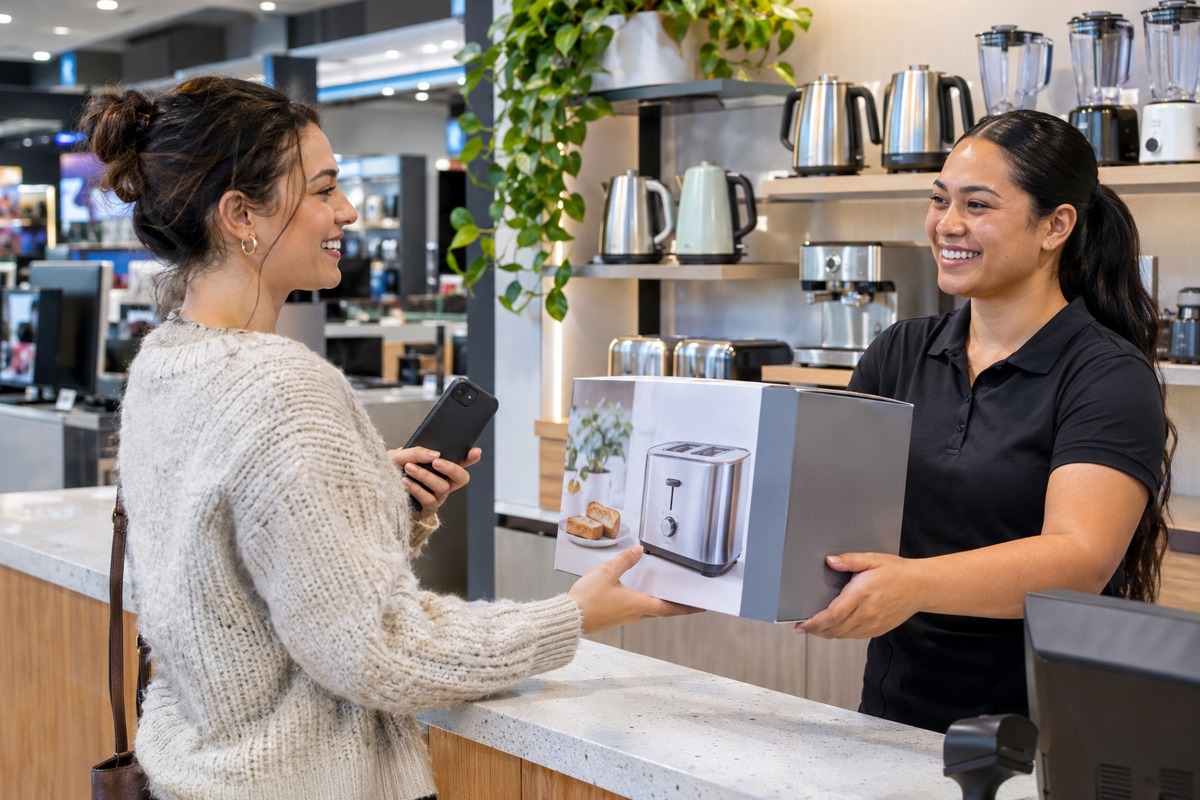
A collection option can represent goods already available locally or goods being brought to the selected store. Those are different services, even if both finish at the same counter. The customer needs a readiness estimate that reflects the actual path.
Noel Leeming’s Click & Collect guidance makes this distinction publicly: it describes faster collection where the preferred store has stock and a longer timeframe where goods must be sent to that store. It also separates the initial confirmation from the ready-to-collect email. The example shows why one generic collection message can be inadequate.
For a transfer-dependent order, track the transfer separately from customer handover. Record the source, destination, expected movement and receipt confirmation. A parcel leaving another location is not evidence that the selected store has received, checked and staged it for the customer.
Issue the ready notification from the state that proves readiness under your service policy. For a complete-order promise, that means all required lines are ready. If partial collection is supported, identify the available lines and explain what remains outstanding. Avoid a broad ready message that invites an unnecessary journey.
Keep the selected store and collection instructions consistent across checkout, confirmation and subsequent messages. Our click-and-collect experience guide covers the physical handover. This article’s routing decisions must feed that experience with dependable location and readiness information.
Keep one customer order visible across several fulfilments

The customer bought one basket, even when the retailer creates several internal jobs. Retain one understandable order view showing which items are being delivered or collected, the relevant location, expected timing and status for each group.
Associate tracking with the items in that shipment. A delivered status for one parcel should not imply that the complete order has arrived. Give customers a simple way to see the remaining goods and contact support without reconstructing the basket from several emails.
Decide when shipping charges are agreed and how operational changes affect them. A retailer-driven reallocation should not quietly introduce a new amount after the customer has accepted the order. Have the relevant business owners approve the permitted options and customer communications before automating the change.
Carry fulfilment method through every integration. An order export that contains the correct products but loses the distinction between pickup and delivery can create the wrong job downstream. Check commerce, ERP, POS, order management and any fulfilment partners using the same representative basket.
Maintain stable references between the customer order, line allocation, transfer and shipment. That makes it possible to change one fulfilment without duplicating the sale or losing the history support staff need. Record the reason and outcome whenever the system or a person reallocates a line.
Design the exception path as carefully as the routing rule
A store may reject a pick because the last unit is missing or damaged. A carrier cutoff may be missed. A transfer may arrive incomplete. Name an owner for each class of exception and decide how quickly the customer must receive an update.
Give staff enough context to choose among approved options. Show the original promise, remaining inventory, eligible alternatives and any change in readiness. A screen that only offers retry or cancel can leave customer service doing the real orchestration in spreadsheets.
Test a cancellation while a transfer or pick is already underway. Confirm that the business stops the right work, releases the right reservation and communicates the outcome. Prevent another system from recreating an old fulfilment instruction after the cancellation has been accepted.
For a failed source location, preserve the evidence before reallocating. Distinguish an unsuccessful pick from a delayed acknowledgement. The replacement instruction should represent the remaining need, with checks that the original location has not already dispatched or handed over the goods.
Decide whether you need an OMS or better use of existing systems
A dedicated order management system can be worth evaluating when allocation decisions span many locations, services and systems, and existing rules cannot govern them reliably. Define the missing capability before beginning a vendor comparison.
For a simpler network, a commerce platform’s routing features, stronger inventory integration and a clear store process may be enough. Adding another system introduces data flows, implementation work and ongoing ownership. Assess those obligations alongside the value of more sophisticated orchestration.
Ask suppliers to demonstrate a fixed set of baskets: complete local stock, a two-location split, a transfer-dependent collection, a bulky item with an accessory and a source rejected after acceptance. Include cancellation, delayed inventory and a customer changing collection location.
Require evidence at every boundary: what the customer sees, where inventory is committed, which location receives the job and how an exception is resolved. Compare the demonstrated result and operating responsibility rather than a checklist that merely says split shipments and Click & Collect are supported.
Pilot against promises kept and complete-order cost
Choose a small group of stores and a defined assortment for the first release. Include different location and product conditions so the pilot tests the decisions that matter, rather than only easy single-location orders.
Baseline split-order rate, collection readiness, cancellations, customer contacts and total handling cost. Separate avoidable splits from those required by stock, product or service constraints. A lower split rate can conceal slower delivery or more transfers if it is measured alone.
Review outcomes by store, order type and customer promise. Track whether the complete basket arrived or became collectible as offered, including the last outstanding line. Compare similar periods and account for promotions, stock availability and changing product mix before attributing an improvement to the routing change.
If you advertise store availability externally, keep it aligned with the same operational truth. Our Google local inventory guide covers the earlier discovery journey through a New Zealand market example. A stock message that attracts a shopper should lead into a collection or delivery option the order process can honour.
OSE’s commerce strategy and systems integration work can help connect the customer promise with inventory, routing and fulfilment responsibilities. A useful project should deliver an agreed rule hierarchy, integration scope, exception ownership and acceptance evidence. The commercial result needs to be measured after those capabilities are working.
If mixed baskets are creating costly exceptions, talk to OSE about your omnichannel order journey. Bring anonymised orders, current location rules, the promises shown at checkout and examples of splits or failed collections. They provide a concrete basis for deciding whether to improve the existing setup or invest in a new order management layer.
Frequently asked questions
No. The aim is to choose a feasible route that supports the customer promise and the retailer's operating priorities. A split can be appropriate when products or available stock require it. Compare the complete cost and customer outcome rather than treating one parcel as the only acceptable result.
Ship-from-store uses a retail location as the dispatch source for the customer's delivery. Transfer-to-store moves goods to a collection location before customer handover. The second route needs a separate receipt and readiness process; dispatch from the source does not prove the order is ready to collect.
Send it when the selected location has verified the goods required under the collection promise and can hand them over. For complete-order collection, all required lines must be ready. If partial collection is offered, state exactly which items are ready and what happens to the remainder.
No. Assess the allocation rules, exception volume and cross-system responsibilities first. Existing commerce routing and improved integration may cover a simpler operation. Consider an OMS when the required orchestration exceeds that setup's demonstrated capabilities, and compare implementation and ongoing ownership as part of the decision.
Review promises kept for the complete basket, collection readiness, avoidable splits, cancellations, customer contacts and total handling cost. Compare similar order types and periods. A fall in split shipments alone does not establish improvement if transfers, delays or support work rise at the same time.