
Deliver Same-Day and On-Demand Delivery to Your Customers
Customer expectations around delivery have changed dramatically over the past few years.
Fast shipping is no longer considered a competitive advantage. For many retailers, it’s simply expected.
While next-day delivery was once impressive, today’s customers increasingly expect their purchases to arrive within hours. Whether they’re ordering a last-minute gift, replacement laptop charger, pet food, flowers or a new coffee machine, convenience has become a major driver of purchasing decisions.
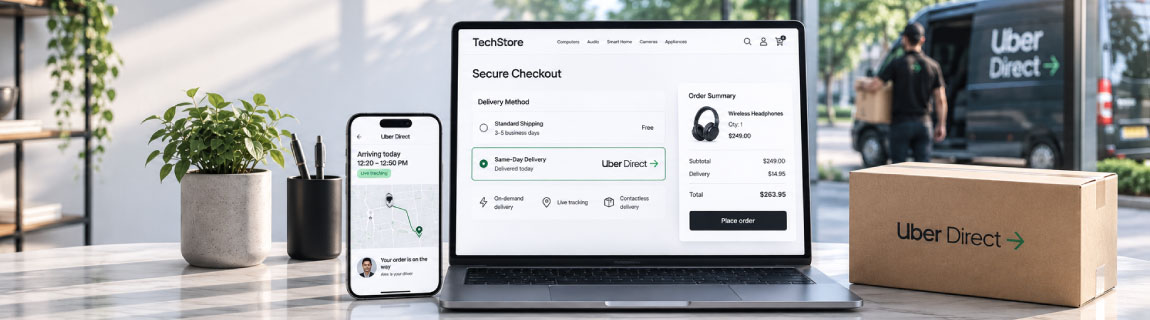
For retailers, offering same-day delivery no longer requires operating a fleet of vehicles or employing delivery drivers. Services such as Uber Direct allow businesses to leverage Uber’s driver network while maintaining their own customer relationships and brand experience.
In this article, we’ll explore how Uber Direct works, which retailers benefit most, what to consider before implementing it, and how it can be integrated into your eCommerce platform.
What is Uber Direct?
Uber Direct is Uber’s white-label delivery platform designed specifically for retailers.
Unlike the traditional Uber Eats marketplace, Uber Direct allows customers to purchase directly from your website or mobile app while using Uber’s driver network to complete the delivery.
From the customer’s perspective, the purchase is made entirely through your business.
Retailers can offer:
- Same-day delivery
- On-demand delivery
- Scheduled delivery windows
- Real-time delivery tracking
- Contactless delivery
- Delivery notifications
The customer never needs to install or use the Uber app to complete their purchase.
Which Retailers Benefit Most?
Uber Direct is particularly valuable for retailers selling products that customers often need quickly.
Examples include:
- Consumer electronics
- Computer retailers
- Camera stores
- Home appliances
- Florists
- Gift retailers
- Pet stores
- Pharmacies
- Hardware retailers
- Office supplies
- Gourmet food
- Liquor retailers (where permitted)
- Automotive parts
For example, a customer purchasing a laptop charger before an important meeting may happily pay a premium to receive it within an hour.
Likewise, someone purchasing flowers for a birthday or replacement printer ink for their business often values speed over shipping cost.
How Does Uber Direct Work?
A typical workflow looks like this:
- The customer shops on your website.
- At checkout, they select Same-Day Delivery.
- Your eCommerce platform checks whether the delivery address falls within your delivery radius.
- Once the order is paid, Uber Direct receives a delivery request.
- A nearby driver accepts the delivery.
- Staff prepare the order for collection.
- The driver collects the parcel.
- The customer receives live tracking updates.
- Delivery is completed.
The entire process can occur without your staff manually arranging a courier.
Should Same-Day Delivery Be Available for Every Product?
Not necessarily.
Most retailers apply business rules such as:
- Delivery radius
- Product weight
- Parcel dimensions
- Dangerous goods restrictions
- Delivery time
- Store inventory
- Trading hours
For example:
- Refrigerators may require traditional freight.
- Large televisions may exceed delivery limits.
- Batteries and hazardous goods may require special handling.
- Gift cards and accessories may be perfect candidates for same-day delivery.
Your website should automatically determine which delivery methods are available for each order.
Multi-Store Retailers Gain the Biggest Advantage
Retailers with multiple physical stores are often in the strongest position to offer same-day delivery.
Instead of shipping from a central warehouse, the order can be fulfilled by the nearest store with available inventory.
This provides several advantages:
- Faster delivery
- Lower delivery costs
- Better stock utilisation
- Reduced warehouse pressure
- Improved customer satisfaction
For businesses operating across Australia and New Zealand, store-based fulfilment is becoming an increasingly important competitive advantage.
Integrating Uber Direct with Shopify
Shopify provides an excellent foundation for same-day delivery.
Depending on your requirements, an implementation may include:
- Delivery eligibility at checkout
- Postcode validation
- Delivery radius calculations
- Store selection
- Real-time delivery pricing
- Automated dispatch
- Customer notifications
- Order status updates
Many retailers also integrate Shopify with their ERP or POS platform to ensure inventory is allocated from the correct location before requesting a driver.
Integrating Uber Direct with Adobe Commerce
Adobe Commerce offers even greater flexibility for retailers with complex fulfilment requirements.
Features commonly implemented include:
- Multiple fulfilment locations
- Advanced shipping rules
- Customer-specific delivery options
- Scheduled delivery windows
- ERP-driven inventory allocation
- Split shipments
- Multi-store routing
- Custom delivery logic
For enterprise retailers operating multiple brands or warehouses, Adobe Commerce can automate sophisticated delivery workflows while still providing a seamless customer experience.
Real-Time Delivery Tracking
One of the biggest advantages of Uber Direct is transparency.
Customers increasingly expect to know exactly where their order is.
Providing live tracking helps:
- Reduce customer enquiries
- Increase trust
- Improve delivery confidence
- Create a premium customer experience
For many retailers, this level of visibility rivals the experience offered by the world’s largest online marketplaces.
Delivery Costs and Customer Expectations
Offering same-day delivery doesn’t necessarily mean absorbing the cost.
Retailers commonly choose to:
- Charge the customer the full delivery cost
- Subsidise part of the delivery
- Offer free same-day delivery above a minimum spend
- Include same-day delivery as part of a loyalty program
The right approach depends on your product margins, customer expectations and competitive landscape.
Many businesses find that customers are willing to pay a premium when delivery speed is important.
Beyond Uber Direct
While Uber Direct is one of the leading solutions, it’s not the only option.
Depending on your location and business model, retailers may also consider:
- DoorDash Drive
- Sherpa
- Local courier integrations
- Regional delivery providers
- Specialist same-day logistics partners
The right solution depends on your geographic coverage, order volumes, delivery radius and integration requirements.
A flexible eCommerce platform allows retailers to support multiple delivery providers and adapt as their business grows.
Is Same-Day Delivery Right for Your Business?
Same-day delivery isn’t essential for every retailer, but for many businesses it has become a meaningful point of differentiation.
It is particularly effective when:
- Customers need products urgently.
- Physical stores can act as fulfilment centres.
- Products are relatively small and easy to transport.
- Margins support premium delivery options.
- The business competes on convenience and customer experience.
As customer expectations continue to evolve, retailers that make purchasing faster and more convenient are likely to see stronger conversion rates and higher customer satisfaction.
Final Thoughts
Uber Direct has made same-day delivery far more accessible than it once was.
Rather than investing in your own delivery fleet, retailers can integrate on-demand delivery directly into their eCommerce platform and offer customers a fast, reliable and fully branded delivery experience.
Whether you’re using Shopify or Adobe Commerce, integrating Uber Direct requires more than simply connecting an API. The best implementations consider inventory availability, fulfilment location, delivery eligibility, shipping rules, customer communication and operational workflows.
When planned correctly, same-day delivery becomes more than just another shipping option. It becomes a competitive advantage that helps retailers increase conversions, improve customer satisfaction and meet the growing expectations of modern online shoppers.