

Enterprise procurement has evolved significantly over the past decade. Organisations expect purchasing to be as simple as shopping online, while maintaining strict approval workflows, negotiated pricing and procurement policies. This is where Coupa has become a leading procurement platform.
For suppliers selling to enterprise customers, integrating Coupa with an eCommerce platform creates a seamless buying experience. Instead of manually processing purchase orders or maintaining separate catalogues, customers can browse products, create carts, submit purchase orders and automatically exchange procurement documents between systems.
Whether your business operates on Shopify, Adobe Commerce (Magento) or another enterprise commerce platform, a well-designed Coupa integration can reduce manual administration, improve purchasing accuracy and strengthen relationships with enterprise customers.
In this guide, we’ll explore how Coupa integrations work, common integration approaches and the key considerations for a successful implementation.
What is Coupa?
Coupa is a cloud-based Business Spend Management (BSM) platform that helps organisations manage procurement, purchasing, supplier relationships, expenses, invoicing and payments.
Large enterprises use Coupa to:
- Manage approved suppliers
- Control purchasing policies
- Streamline purchase approvals
- Automate procure-to-pay (P2P) processes
- Improve spend visibility
- Reduce procurement costs
For suppliers, this means enterprise customers often expect purchasing to occur through Coupa rather than placing traditional online orders.
Why Integrate Coupa with Your eCommerce Platform?
Without an integration, enterprise purchasing often involves duplicated effort.
A buyer may browse your website before recreating the same order within Coupa, or procurement teams may manually exchange spreadsheets, purchase orders and invoices.
An integration removes these inefficiencies by allowing purchasing information to flow automatically between systems.
Benefits include:
- Reduced manual order entry
- Faster procurement processes
- Improved purchasing accuracy
- Real-time product information
- Contract-specific pricing
- Better customer experience
- Lower administration costs
- Fewer procurement errors
Common Coupa Integration Scenarios
Although every implementation differs, most projects involve one or more of the following.
PunchOut Catalogue Integration
A PunchOut integration allows buyers to leave Coupa temporarily and shop within your eCommerce website.
Products are added to the shopping cart before the completed cart is returned to Coupa for approval and purchase order generation.
This provides customers with your full eCommerce experience while allowing procurement teams to maintain purchasing controls.
Purchase Order Integration
Once procurement approvals are complete, Coupa automatically generates purchase orders.
These can be transmitted directly into your eCommerce platform, ERP or order management system for fulfilment.
Invoice Integration
Suppliers can automatically send invoices back into Coupa, reducing manual processing and accelerating payment cycles.
Shipment Notifications
Order fulfilment updates, tracking information and shipment confirmations can also be exchanged automatically, providing procurement teams with complete order visibility.
Coupa Integration Architecture
A modern Coupa integration typically connects several business systems.
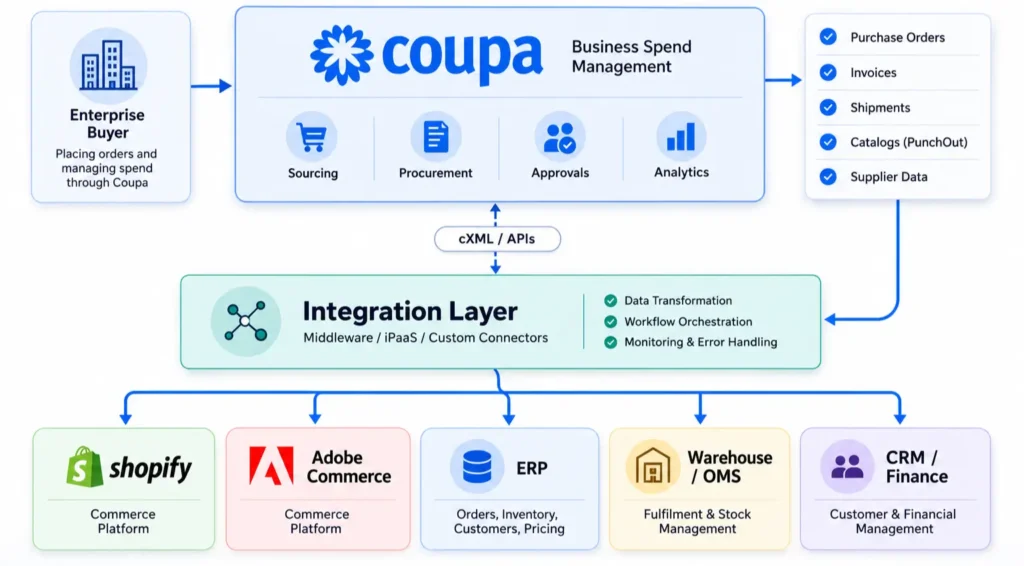
Many organisations use an integration platform or middleware to orchestrate these data flows rather than connecting every system directly.
This approach improves scalability, monitoring and long-term maintainability.
Integrating Coupa with Shopify
Shopify is increasingly being used by enterprise organisations for B2B commerce.
A Coupa integration with Shopify may include:
- PunchOut catalogues
- Customer-specific pricing
- Purchase order import
- Inventory availability
- Order status updates
- Invoice synchronisation
- Shipping confirmations
When combined with Shopify B2B functionality, organisations can provide enterprise buyers with a streamlined procurement experience while maintaining centralised procurement controls.
Integrating Coupa with Adobe Commerce
Adobe Commerce is commonly selected where organisations require more complex B2B workflows.
Typical Coupa integrations with Adobe Commerce (Magento) include:
- Company account structures
- Approval workflows
- Shared catalogues
- Customer-specific pricing
- PunchOut support
- ERP integration
- Multi-warehouse fulfilment
Adobe Commerce’s flexibility makes it well suited to organisations with sophisticated procurement requirements and highly customised purchasing experiences.
Key Integration Considerations
Successful projects involve more than simply exchanging data.
Planning should consider:
- Authentication and security
- cXML compatibility for PunchOut implementations
- API limits
- Error handling
- Retry mechanisms
- Monitoring and alerting
- Product catalogue synchronisation
- Pricing consistency
- Customer-specific catalogues
- Tax calculations
- Freight calculations
Investing in these areas early helps reduce operational issues after go-live.
Common Challenges
Some of the most common implementation challenges include:
- Multiple pricing agreements
- ERP synchronisation
- Customer catalogue management
- Complex approval workflows
- Inventory accuracy
- Supplier onboarding
- PunchOut session management
- Document validation
- Procurement policy compliance
These are typically addressed through careful solution architecture rather than customisations alone.
Why Experience Matters
Enterprise procurement integrations differ significantly from standard eCommerce projects.
Understanding procurement workflows, PunchOut catalogues, cXML messaging, ERP integration and enterprise purchasing processes is essential to delivering a reliable solution.
An experienced integration partner can help design an architecture that scales as procurement requirements evolve, while ensuring your commerce platform, ERP and procurement systems remain synchronised.
Conclusion
Coupa has become one of the leading procurement platforms for enterprise organisations, making integration an increasingly important capability for suppliers serving B2B customers.
Whether you’re implementing Shopify, Adobe Commerce or another enterprise commerce platform, a well-architected Coupa integration can streamline procurement, automate data exchange and improve the purchasing experience for both buyers and suppliers.
By combining modern APIs, cXML messaging and robust integration architecture, organisations can reduce manual administration while creating a connected commerce ecosystem that supports long-term growth.