
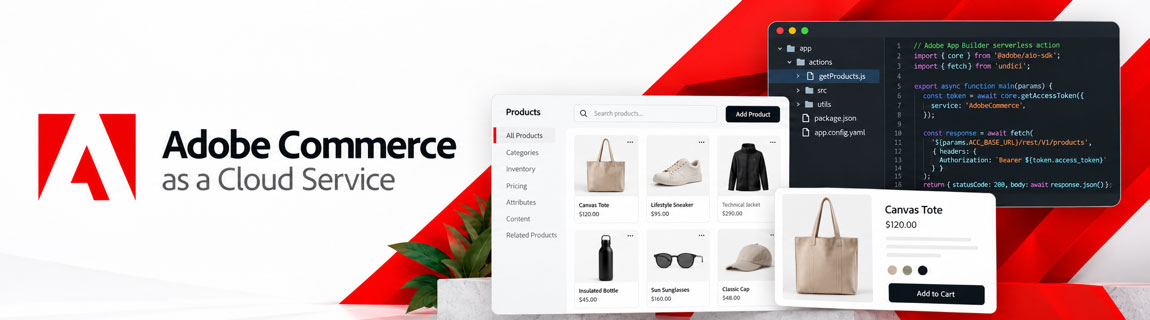

Recently, our team spent several days in Sydney with Adobe’s Head of Product, exploring Adobe Commerce as a Cloud Service (ACCS).
It was an opportunity to look closely at the product, discuss its architecture and understand what Adobe’s approach means for the businesses we work with.
We came away incredibly impressed.
The storefront speed was exceptional. The development capabilities were compelling. Combined with Adobe Developer App Builder, the platform presents exciting possibilities for delivering sophisticated commerce experiences.
What stood out most was how these capabilities fit together: agentic development grounded in Adobe’s recommended practices, powerful deployment workflows, extensibility outside the core application and faster delivery of websites and content.
For merchants considering their next eCommerce investment, ACCS deserves serious attention.
What is Adobe Commerce as a Cloud Service?
Adobe Commerce as a Cloud Service is Adobe’s SaaS commerce offering. Adobe manages the core application, infrastructure and platform updates, while implementation teams build experiences and extensions through supported services.
It is a different operating model from Adobe Commerce on Cloud infrastructure, where merchants and their partners retain greater responsibility for application upgrades and the underlying codebase.
Adobe’s ACCS overview explains the platform’s main components, including its storefront, merchandising services, product visuals and developer platform.
For business leaders, the significance is straightforward: more of the delivery team’s attention can move towards improving the customer experience and building useful capabilities.
For technical teams, ACCS changes how those capabilities are developed. Customisation centres on APIs, events and external applications, with clear boundaries around the managed commerce core.
Agentic coding with Adobe Commerce context
One of the most exciting areas we explored was agentic coding aligned with Adobe Commerce best-practice standards.
Generating code quickly is valuable. Generating it with relevant product knowledge, architectural guidance and supported implementation patterns is considerably more useful.
Adobe’s Commerce Developer Agent provides a structured workflow for planning development and generating App Builder extensions. It creates a blueprint that developers can review before proceeding, then produces code grounded in Adobe Commerce documentation and extensibility patterns.
Adobe also describes its Commerce Developer MCP as a way to bring product knowledge, validated coding practices and development guidance into the developer’s existing environment.
For OSE, the opportunity is accelerating implementation while maintaining engineering discipline. Developers still review, test and validate the output. The benefit is having stronger platform context available throughout the process, helping teams move from requirements to a reviewable implementation more efficiently.
Powerful deployment of custom functionality
The deployment capabilities were another highlight.
There is substantial value in a development workflow that connects planning, implementation, validation and deployment. Reducing friction between those stages can help teams deliver improvements more consistently.
Adobe documents a workflow in which developers can refine generated extensions, export the code or deploy directly to App Builder through the Commerce Developer Agent. Its migration and development guidance explains how these steps connect.
That distinction matters: custom functionality is deployed into the supported extensibility environment, rather than inserted into the managed Commerce core.
For merchants, this creates a compelling foundation for ongoing delivery. A new integration or business capability can have its own development lifecycle.
The practical benefit depends on good release management, testing and monitoring, but the platform provides a powerful starting point for organising that work.
An out-of-process approach to extensibility
ACCS’s out-of-process architecture is central to its appeal.
In traditional Commerce implementations, custom PHP modules can run within the application itself. That makes extensions closely connected to the core codebase and its upgrade requirements.
With Adobe Commerce out-of-process extensibility, custom logic and integrations run outside the Commerce application process. They communicate through supported APIs, events, webhooks and extension points.
This gives teams a different way to preserve the flexibility businesses need.
A merchant may require specialist fulfilment rules, external account services or a connection to an established operational system. Those requirements can be addressed through separate applications designed around the supported interfaces.
Our B2B eCommerce pricing article illustrates why architecture matters: customer agreements must remain consistent throughout the buying journey, regardless of where the underlying logic runs.
App Builder makes the proposition especially compelling
The combination of ACCS and Adobe Developer App Builder was particularly impressive.
App Builder provides a platform for building and deploying custom applications on Adobe infrastructure. Its serverless runtime supports the execution of application logic outside the Commerce core.
Several complementary tools expand what teams can build.
Adobe I/O Events supports event-driven applications, such as responding to an order being placed. Commerce Webhooks supports synchronous interactions where Commerce needs an external response during a process.
API Mesh can combine multiple API sources into a queryable GraphQL endpoint, while the Admin UI SDK enables custom menus and pages within the Commerce administration experience.
Together, these tools offer considerable scope for integration and operational functionality. Choosing the appropriate pattern for each requirement remains essential, particularly where external services affect checkout responsiveness or availability.
Storefront speed that immediately stood out
The website speed we experienced in Sydney was extraordinary.
The storefront felt lightning fast—among the most responsive commerce experiences we have seen. It was one of the clearest highlights of our time with the product.
That is our firsthand impression of the experience demonstrated, rather than a comparative industry benchmark. Nevertheless, it made Adobe’s direction immediately tangible.
Adobe Commerce Storefront uses Edge Delivery Services, with a storefront architecture decoupled from the commerce backend.
For shoppers, responsiveness affects the entire journey: opening categories, viewing products and moving between tasks. For trade buyers, it can influence how efficiently they assemble an order during a busy working day.
As we explored in moving B2B phone orders online, convenience is fundamental to adoption. A fast storefront helps create an experience customers want to use repeatedly.
Faster delivery of websites and content
Speed to market was equally compelling.
The opportunity extends beyond writing application code. Commerce teams also need to create landing pages, update campaigns, publish product information and respond to changing commercial priorities.
Adobe Commerce Storefront supports document-based authoring, alongside visual editing options described in the ACCS storefront overview.
This gives businesses different ways to organise content production, with developers establishing the components and design foundations that authors use.
Adobe’s AEM Assets integration also connects asset management with Commerce, helping teams manage and associate product imagery with relevant catalogue information.
Our assessment is that these capabilities can shorten the path from an idea to a published experience. The strongest results will come from combining the tools with clear content ownership, reusable components and efficient approval processes.
Rapid feature releases and a managed core
Another important shift is the platform’s release model.
Adobe manages updates to the ACCS core, giving merchants access to enhancements through its SaaS delivery approach. The ACCS release notes provide visibility into the platform’s development.
This changes how businesses plan their ongoing investment. Instead of organising substantial work around maintaining a particular core application version, teams can focus more attention on adopting useful capabilities and improving their own extensions.
There is still work to manage. Integrations, storefronts and custom applications need testing and operational ownership.
However, the combination of a managed core and separately developed functionality is attractive. It provides a foundation for more frequent improvements without making every feature dependent on changes inside the main Commerce application.
Support that strengthens the platform
The support we experienced during our time with Adobe was excellent.
Having direct access to product leadership allowed us to explore the reasoning behind the platform and discuss how its capabilities relate to implementation requirements.
That experience strengthened our confidence in the product’s direction.
For delivery teams, the wider documentation and reference material also matter. Adobe’s integration starter kit provides reference architecture and supporting tools for back-office integrations.
These resources give developers a more consistent foundation for building solutions. They also help merchants ask informed questions about how an implementation will be supported, extended and maintained after launch.
What existing Adobe Commerce merchants should consider
For existing merchants, evaluating ACCS should begin with their current requirements.
Adobe’s migration guidance makes clear that the transition involves applications, data, storefronts and integrations. Existing customisations need assessment against the new architecture.
A useful starting point is to identify which capabilities create commercial value, which can be simplified and which need redevelopment.
The objective should be a stronger operating model, supported by a realistic delivery plan.
OSE’s perspective on ACCS
Our time in Sydney left us enthusiastic about what ACCS makes possible.
The combination of exceptional storefront responsiveness, agentic development, powerful deployment workflows and App Builder extensibility creates a compelling platform for ambitious commerce businesses.
For OSE, the opportunity is helping merchants turn those capabilities into better customer experiences and faster delivery of commercially useful improvements.
If you are considering ACCS, speak with OSE about its fit for your business.