
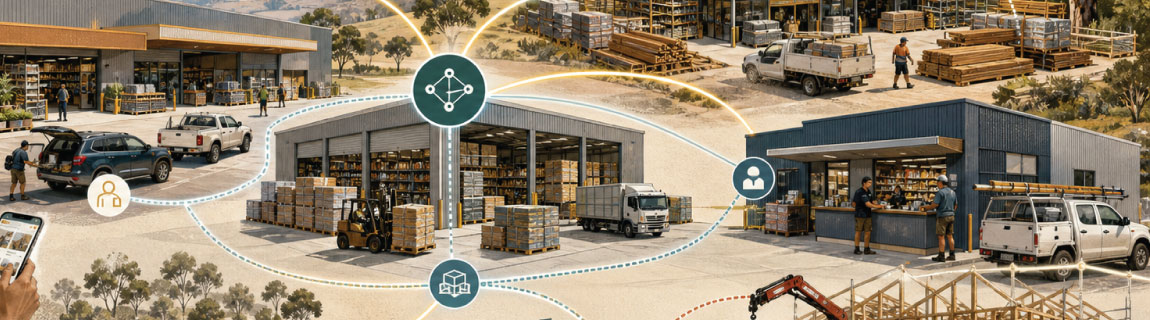
For large hardware retailers, ecommerce is no longer a separate sales channel.
It is the connective layer between product data, inventory, stores, distribution centres, suppliers, trade accounts and customers. When those elements work together, digital investment can increase revenue, improve gross margin, release working capital and lower the cost of serving customers.
When they do not, the website exposes the underlying fragmentation.
Customers encounter products they cannot find, stock they cannot trust, delivery options that appear too late and trade accounts that lose their value online. Internally, teams compensate through manual order handling, customer-service calls, store intervention and expensive fulfilment decisions.
The next stage of hardware ecommerce is therefore not another website redesign. It is commercial and operational transformation focused on measurable financial outcomes.
The opportunity is larger than online revenue
Australian consumers spent $9.9 billion online on home and garden products in 2025, an increase of 9.9% year on year. Online transactions represented 26% of total category spending, while more than half of Australian online shoppers purchased within the category.
The strongest hardware retailers are already benefiting from this shift.
Bunnings reported that digital sales increased from 6.3% to 7.6% of total sales in the first half of FY2026. Revenue increased 4.2% to $10.7 billion, while earnings excluding property contributions rose 5%. Digital growth was identified alongside value, repairs and maintenance, and range expansion as a contributor to performance.
But digital sales are only the most visible part of the opportunity.
A customer may research a product online and buy it in store. A trade customer may create a list digitally and complete the order through an account manager. A customer may use local stock information to choose which branch to visit. Ecommerce also affects the cost of answering questions, processing repeat orders, correcting mistakes and moving inventory.
Retailers that measure ecommerce only through completed online transactions risk undervaluing both the opportunity and the problems.
Hardware ecommerce is a financial system
Every significant ecommerce capability should connect to a financial lever.
| Ecommerce capability | Financial effect |
|---|---|
| Better product discovery | Higher conversion and revenue per visit |
| Accurate local availability | More captured demand and fewer cancelled orders |
| Structured product data | Lower service cost and improved discoverability |
| Smarter recommendations | Higher average order value and gross profit |
| Digital trade accounts | Lower order-processing cost and increased share of wallet |
| Distributed order management | Better inventory utilisation and fulfilment economics |
| Reliable delivery promises | Higher conversion and fewer service contacts |
| Assortment analytics | Reduced duplication and improved working capital |
| Store-based fulfilment | Faster service and greater return from network assets |
| Customer self-service | Lower cost-to-serve and fewer manual transactions |
This changes how investment should be prioritised.
The right question is not, “Which ecommerce features should we add?” It is, “Which customer and operational constraints are preventing the business from capturing revenue, protecting margin or using capital efficiently?”
1. Turn the store network into a digital advantage
A national or networked hardware retailer has an asset that pure-play competitors cannot easily reproduce: physical inventory close to customers, supported by knowledgeable people.
Yet many retailers present the store network online as little more than a collection of addresses.
A more valuable model uses stores as part of the digital proposition:
- Local stock is visible and dependable.
- Search results account for the customer’s selected location.
- Collection promises reflect each store’s actual capacity.
- Orders can be routed to the most economical fulfilment point.
- Store teams can see and manage digital demand.
- Customers can move between online and in-store service without starting again.
- Slow-moving inventory can be exposed to demand beyond the local catchment.
This can improve both revenue and return on inventory.
When stock exists within the network but cannot be found or purchased digitally, the retailer loses demand while continuing to fund the inventory. Conversely, exposing every item nationally without considering fulfilment cost can turn inventory visibility into margin erosion.
The objective is not simply to show stock. It is to make commercially intelligent promises about where an order should be fulfilled and what that promise will cost.
2. Fix product data before adding more digital features
Hardware catalogues contain some of the most demanding product information in retail.
A single range may require dimensions, materials, compatibility, voltage, capacity, pack quantity, finish, thread type, technical documents, compliance information and application guidance. The required attributes also vary substantially between categories.
At scale, poor product data has a compounding financial effect.
It contributes to:
- Failed searches
- Low category conversion
- Avoidable customer-service contacts
- Incorrect purchases and returns
- Weak product recommendations
- Ineffective filters
- Duplicated products
- Inaccurate marketplace feeds
- Slow onboarding of new ranges
- Limited visibility in search engines and AI shopping tools
This is why product-information management should be treated as commercial infrastructure, not catalogue administration.
The aim is not to make every product description longer. It is to make critical information structured, consistent and usable throughout the organisation.
A high-value product-data program begins by quantifying where data quality affects financial performance. That might include the categories with the highest search exits, the greatest return rates, the most service enquiries or the largest gap between traffic and conversion.
Improvement can then be prioritised according to commercial value rather than attempting to cleanse an entire catalogue uniformly.
3. Make technical product discovery a competitive capability
Hardware customers do not all search in the same way.
A trade customer may enter an exact SKU or supplier code. Another customer may use an abbreviation. A DIY customer may describe a task without knowing the product name. Measurements may be expressed in metric, imperial or trade terminology.
A conventional keyword search engine often treats these as separate requests. A strong hardware discovery system recognises their relationship.
It should understand:
- Product and supplier codes
- Partial codes
- Trade abbreviations
- Common misspellings
- Metric and imperial equivalents
- Product applications
- Compatibility relationships
- Technical attributes
- Brands and product families
- Local availability
- Customer segment and account range
Search is a material revenue lever because customers using it often have clearer purchasing intent.
The commercial opportunity is not measured by whether the search function returns results. It is measured through search conversion, gross profit per search session, zero-result revenue exposure and the proportion of customers who successfully find an available product.
Search data can also identify range gaps. If customers repeatedly look for specifications, products or brands that are unavailable, those queries provide a direct demand signal to merchandise and category teams.
4. Move from stock visibility to inventory orchestration
Displaying local stock is useful. Deciding how to use inventory across the network is more valuable.
Large hardware retailers may hold stock across stores, distribution centres, trade centres and suppliers. Franchise or member networks introduce additional complexities around ownership, pricing, ranges and fulfilment responsibility.
The ecommerce platform should not make these decisions in isolation. It needs access to rules governing:
- Available-to-promise inventory
- Safety stock
- Store and warehouse capacity
- Delivery zones
- Product dimensions and restrictions
- Split-order thresholds
- Fulfilment costs
- Customer promises
- Franchise or member economics
- Supplier-direct availability
- Margin and markdown priorities
The cheapest fulfilment location is not always the right one. Nor is the closest.
A decision may need to balance delivery cost, picking cost, stock age, future local demand, service level and the risk of splitting an order.
This is where distributed order management can materially affect the financial position. Better orchestration can capture more demand while reducing unnecessary transfers, cancellations, split shipments and expedited delivery costs.
It can also improve working-capital productivity by making existing inventory more commercially accessible.
5. Treat fulfilment as part of conversion and margin
Delivery has historically been managed after the purchase decision. Customers now evaluate it before they commit.
Australia Post reports that 73% of shoppers are more likely to shop online following a good delivery experience, while 69% want a range of delivery choices. Home and garden has a relatively high online average basket of $286.77, making both conversion and fulfilment economics material.
Hardware retailers face additional complexity:
- Heavy and oversized goods
- Dangerous goods
- Long-length products
- Fragile products
- Mixed baskets
- Vehicle or crane requirements
- Direct-to-site delivery
- Supplier fulfilment
- Regional service areas
- Uncertain site access
A generic parcel calculator will not solve this.
Customers need an accurate promise that explains the available service, price and expected timing. The retailer needs to understand the cost and margin effect of keeping that promise.
Every fulfilment proposition should be evaluated against:
- Conversion uplift
- Gross profit
- Picking and packing cost
- Delivery cost
- Split-shipment frequency
- Cancellation rate
- Customer-service demand
- Repeat purchase
- Store or distribution-centre capacity
Faster delivery is not automatically better. A faster service that increases conversion but destroys contribution margin is not a successful ecommerce initiative.
The right proposition may vary by customer, category, geography and basket.
6. Build a genuinely digital trade proposition
Trade ecommerce should not be a consumer storefront with account pricing added after login.
Professional customers operate through businesses, teams, jobs and approval structures. Their requirements can include:
- Contract or account-specific pricing
- Credit terms
- Purchase orders
- Multiple authorised buyers
- Spending permissions
- Cost centres
- Job references
- Quotes
- Saved lists
- Repeat ordering
- Invoice access
- Branch preferences
- Site delivery
- Account-manager involvement
Digitising these processes can produce value on both sides of the transaction.
Customers spend less time calling, emailing and re-entering recurring orders. The retailer reduces manual administration and allows account teams to focus on product advice, project opportunities and customer growth.
The financial prize is not merely lower transaction cost. A useful digital trade account can increase share of wallet by making the retailer easier to buy from.
Features should therefore be prioritised against customer economics. High-frequency trade customers may benefit most from rapid SKU entry, previous-order templates, list management and delegated purchasing. Project customers may place greater value on quoting, staged fulfilment and site-specific ordering.
The objective is to make the digital channel reflect how trade customers actually procure.
7. Use expertise to improve conversion—not just content output
Hardware retailers possess valuable knowledge across stores, category teams and supplier relationships.
Much of that knowledge remains unavailable online.
Customers may receive excellent guidance if they speak to an experienced team member, but encounter a generic product grid when they use the website. That gap limits conversion and makes the retailer easier to compare on price alone.
Expertise should be converted into structured buying assistance:
- Product-selection frameworks
- Compatibility information
- Project calculators
- Application guidance
- Comparison tables
- Technical-document access
- Substitution logic
- Required accessory identification
- Good-better-best recommendations
- Safety and compliance prompts
This information should sit inside the customer journey, not in an isolated content library.
A customer choosing a door lock should receive guidance on backset, handing and door thickness while browsing the category. A customer selecting a power tool should understand whether batteries and chargers are included. A trade customer viewing an unavailable product should see a technically appropriate substitute rather than a visually similar item.
Done well, digital expertise can increase conversion, reduce returns, grow basket value and protect margin by shifting the conversation beyond price.
8. Use personalisation to protect margin and relevance
Personalisation in hardware retail should not begin with homepage banners.
The more valuable applications are operational and transactional:
- Prioritising products available locally
- Showing a trade customer’s contracted range
- Recommending compatible accessories
- Recognising repeat purchase patterns
- Presenting relevant pack sizes
- Adjusting the experience for trade and DIY customers
- Reordering familiar products quickly
- Recommending substitutes based on technical suitability
- Suppressing products that cannot meet the required fulfilment promise
This form of personalisation reduces friction while improving the commercial quality of the basket.
It can also support margin. Recommendations can account for product availability, contribution, attachment probability and customer suitability rather than simply promoting bestsellers.
The constraint is data. Customer identity, product relationships, inventory and commercial rules must be dependable before personalisation can make good decisions consistently.
9. Design marketplaces around incremental profit
Marketplaces can extend range and improve customer acquisition without requiring the retailer to own every product.
They can also create operational and reputational risk.
Australian shoppers spent $18.9 billion through pure online marketplaces during 2025. Across Wesfarmers, Bunnings and Kmart marketplaces contributed to a group ecosystem with more than 400,000 additional online SKUs and over 700 additional sellers as of June 2026.
For a hardware retailer, marketplace strategy should address:
- Which range extensions are genuinely incremental
- Where third-party products complement owned inventory
- Seller standards and compliance
- Product-data quality
- Delivery promises
- Returns and service responsibility
- Cannibalisation of owned products
- Customer ownership
- Commission and contribution margin
- Brand trust
Gross merchandise value is not enough.
The marketplace should be evaluated through incremental gross profit, customer acquisition, repeat behaviour and the effect on owned-range sales. An expanded assortment only creates value when customers can navigate it confidently and the economics remain attractive after seller management, service and technology costs.
10. Connect ecommerce investment to working capital
Hardware retailers carry significant capital in inventory.
Digital investment can improve the productivity of that capital, but only when ecommerce, merchandise and supply-chain decisions are connected.
Examples include:
- Exposing slow-moving store stock to broader demand
- Using search data to identify unmet customer demand
- Improving substitutions when preferred products are unavailable
- Localising ranges using digital demand signals
- Reducing duplicated inventory across nearby locations
- Supporting supplier-direct fulfilment for selected long-tail products
- Identifying products frequently viewed but rarely purchased
- Understanding where poor availability is suppressing category demand
These are not website optimisations. They are inventory and assortment decisions informed by digital behaviour.
A retailer should be able to connect product views, searches, availability, orders, substitutions and fulfilment outcomes. That creates a richer demand signal than sales history alone because it captures what customers attempted to buy—not only what the retailer managed to sell.
11. Prioritise initiatives by financial value
Large ecommerce programs often accumulate long backlogs containing platform work, customer requests, operational fixes and executive priorities.
Without a common commercial model, prioritisation becomes subjective.
Each material initiative should have a hypothesis connecting it to one or more financial outcomes:
- Incremental revenue
- Gross-margin improvement
- Cost reduction
- Working-capital release
- Risk reduction
- Increased asset productivity
A practical value model might include:
Eligible demand × expected behavioural change × transaction value × contribution margin − implementation and operating cost
For example, a retailer with $1 billion in digitally influenced sales would create $5 million in incremental revenue from a sustained 0.5% improvement, before accounting for margin, channel movement and implementation costs.
The purpose of the model is not to create false precision. It is to make assumptions explicit and ensure teams measure the outcome after release.
Important measures may include:
- Conversion by category and fulfilment method
- Gross profit per visit
- Search-attributed revenue
- Digital influence on store sales
- Trade-customer digital adoption
- Average order contribution
- Split-shipment cost
- Cancellation and substitution rates
- Inventory turn
- Stock transfer frequency
- Customer-service cost per order
- Store picking productivity
- Delivery-promise accuracy
- Return reasons
This allows the ecommerce roadmap to compete for capital on the same basis as other business investments.
Technology is rarely the only constraint
Hardware retailers often have established ecommerce, ERP, POS, inventory, product-information, warehouse and customer systems.
Replacing those systems is not automatically the answer.
The larger challenge is frequently the operating model between them:
- Who owns product-data quality?
- Which system controls availability?
- Who defines the fulfilment promise?
- How are store costs recognised?
- Who benefits when one location fulfils demand generated elsewhere?
- Which team owns online-influenced store revenue?
- How are trade and consumer priorities balanced?
- Who can change commercial rules without a major development release?
Technology should support clear commercial decisions. It cannot resolve unclear ownership or incentives by itself.
For franchise and member networks, these questions become even more important. Metcash’s hardware business supports more than 350 Mitre 10 stores alongside Home Hardware and Total Tools. Its public strategy emphasises locally tailored ranges, store-network expansion, expertise and operational efficiencies rather than a one-size-fits-all format. Metcash Hardware
A successful digital model must preserve local relevance while creating sufficient consistency to deliver a reliable national customer experience.
What an industry-leading roadmap looks like
For a mature hardware retailer, the sequence should be determined by economic value and organisational readiness—not by whichever technology is currently receiving the most attention.
A strong roadmap typically moves through five stages.
1. Establish the financial baseline
Quantify digital revenue, digitally influenced sales, gross margin, cost-to-serve, inventory performance and fulfilment economics.
2. Identify value leakage
Locate the customer and operational failures responsible for lost conversion, avoidable cost, poor stock productivity and margin erosion.
3. Strengthen the commercial data layer
Improve the product, inventory, customer and fulfilment information required to make reliable decisions.
4. Optimise priority journeys
Focus on high-value categories, trade-customer tasks, product discovery and fulfilment propositions with material economic potential.
5. Scale through orchestration
Use connected inventory, stores, suppliers and customer data to make better decisions across the network.
AI, personalisation and automation become considerably more valuable at the fifth stage. Introduced earlier, they frequently automate incomplete data and fragmented processes.
The next competitive advantage is economic coordination
Hardware retailers already possess many of the assets required for ecommerce leadership:
- Trusted brands
- Extensive store networks
- Deep product ranges
- Local inventory
- Trade relationships
- Experienced teams
- Supplier partnerships
- Distribution capability
The opportunity is to make those assets work together more effectively.
That requires more than a polished storefront. It requires product data that supports confident decisions, inventory that can be orchestrated across the network, fulfilment promises based on real economics and digital trade services designed around how customers work.
The retailers that lead the next stage of hardware ecommerce will not necessarily be those with the most features. They will be those that make better commercial decisions across every customer interaction.
For agencies working in this sector, the standard should be equally clear: ecommerce strategy must do more than improve the interface. It must demonstrate how digital investment can increase revenue, protect margin, reduce cost and improve the productivity of working capital.
That is how ecommerce materially changes the financial position of a hardware retailer.