
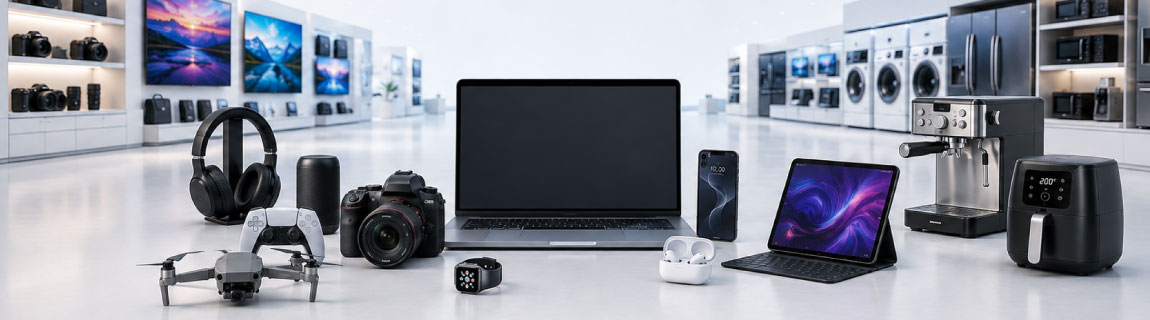
From national retailers like JB Hi-Fi, Harvey Norman and The Good Guys to specialist camera stores, computer retailers, audio specialists and independent consumer electronics businesses across Australia and New Zealand, today’s eCommerce landscape is more competitive than ever.
Whether you’re selling televisions, laptops, cameras, drones, appliances, networking equipment or premium audio systems, customers expect an online experience that is fast, intuitive and information-rich. They want accurate stock availability, detailed specifications, personalised recommendations and flexible fulfilment options, all backed by competitive pricing.
Behind the scenes, however, retailers are managing tens of thousands of products, multiple suppliers, constantly changing pricing, shrinking margins and growing competition from marketplaces.
Building an online store is no longer enough.
Success comes from combining the right eCommerce platform with accurate product data, seamless integrations and a customer experience that makes complex buying decisions easy.
In this article, we’ll explore the biggest eCommerce challenges facing electrical and consumer electronics retailers, and how leading businesses are overcoming them.
1. Managing Large and Complex Product Catalogues
Electrical and consumer electronics retailers often manage some of the largest product catalogues in retail.
A typical catalogue may include:
- Televisions
- Cameras and lenses
- Drones
- Computers and laptops
- Monitors
- Gaming hardware
- Home appliances
- Smart home devices
- Mobile phones
- Networking equipment
- Audio equipment
- Accessories
- Spare parts
Even smaller retailers can carry tens of thousands of SKUs, while enterprise retailers may manage hundreds of thousands of products and variants.
Each product requires:
- High-quality imagery
- Technical specifications
- Product comparisons
- Videos
- Warranty information
- User manuals
- Downloads
- SEO content
- Product attributes
- Categories
- Search data
Without well-structured product information, customers struggle to compare products and find the right solution.
Leading retailers invest in strong ERP integrations, Product Information Management (PIM) platforms and automated data enrichment to maintain product quality at scale.
2. Supplier Product xData is Rarely Standardised
Most retailers source products from multiple manufacturers and distributors.
Every supplier structures their data differently.
Some provide comprehensive product information, while others provide little more than a product code and short description.
This inconsistency creates challenges for:
- Product search
- Filters
- Categories
- Google Shopping
- AI-powered search
- Product comparisons
- SEO
Normalising supplier data before it reaches your website creates a far better customer experience and significantly reduces manual administration.
3. Pricing Changes Constantly
Consumer electronics is one of the fastest-moving retail sectors.
Retailers regularly manage:
- Promotional pricing
- Supplier rebates
- Cashback offers
- Bundle pricing
- Clearance campaigns
- Seasonal promotions
- Competitor pricing
Manual pricing updates quickly become unsustainable.
Automated pricing feeds from ERP and inventory systems help ensure pricing remains accurate across every channel while reducing operational overhead.
4. Customers Need Rich Technical Information
Unlike many retail categories, purchasing decisions are often driven by technical specifications rather than appearance alone.
Customers compare features such as:
- Screen size
- Processor
- Memory
- Storage
- Resolution
- Battery life
- Connectivity
- Compatibility
- Power consumption
- Warranty
- Dimensions
The easier it is for customers to compare products, the more likely they are to purchase with confidence.
Rich product content also reduces product returns by helping customers choose the right product the first time.
5. Search Has Become One of the Most Important Sales Tools
Many customers arrive knowing exactly what they’re looking for.
Examples include:
- Sony A7 IV
- Dyson V15
- Canon EOS R6
- Apple AirPods Pro
- LG OLED television
- Nintendo Switch
- ASUS gaming laptop
If search fails to recognise these products, customers often leave immediately.
Modern search should include:
- Predictive search
- Typo tolerance
- SKU recognition
- Brand recognition
- Synonyms
- AI recommendations
- Natural language search
For many electrical and consumer electronics retailers, search is one of the highest-converting features on the website.
6. Smart Filtering Improves Product Discovery
Large catalogues demand sophisticated filtering.
Customers expect to refine products by:
- Brand
- Price
- Screen size
- Processor
- Storage
- Resolution
- Lens mount
- Megapixels
- Colour
- Energy rating
- Operating system
- Availability
Well-designed faceted navigation makes large catalogues easier to browse while improving SEO through highly relevant category and filtered landing pages.
7. Accessories Drive Additional Revenue
The initial purchase is rarely the entire sale.
A customer purchasing a camera may also require:
- Memory cards
- Camera bags
- Batteries
- Tripods
- Filters
- Flashes
Someone purchasing a television may also buy:
- Soundbars
- HDMI cables
- Wall mounts
- Extended warranties
- Installation services
Intelligent cross-selling, AI recommendations and merchandising rules help increase average order value while improving the overall shopping experience.
8. Inventory Accuracy Builds Trust
Customers expect accurate inventory information before they commit to a purchase.
Modern retailers often manage inventory across:
- Distribution centres
- Retail stores
- Supplier warehouses
- Drop-shipping partners
Displaying:
- Real-time stock levels
- Click & Collect availability
- Store inventory
- Estimated delivery dates
helps build confidence while reducing customer service enquiries and abandoned carts.
9. Omnichannel Retail is Now the Standard
Today’s customers move seamlessly between online and physical stores.
Common buying journeys include:
- Research online before visiting a store
- Purchase online for Click & Collect
- Check stock at their nearest location
- Speak with a sales consultant before completing their purchase online
Delivering these experiences requires seamless integration between:
- ERP
- POS
- CRM
- Inventory management
- eCommerce
- Loyalty platforms
Retailers with connected systems provide a more consistent customer experience while improving operational efficiency.
10. AI and Google Are Changing Product Discovery
Product discovery is evolving rapidly.
Customers increasingly begin their buying journey using:
- Google Shopping
- Google AI Overviews
- ChatGPT
- Gemini
- Perplexity
- YouTube
- Social media
Retailers with structured product data, rich specifications and high-quality content are better positioned to appear across these emerging search experiences.
As AI becomes a larger part of online shopping, investing in product data quality becomes a long-term competitive advantage.
11. Website Performance Still Matters
Electrical and consumer electronics websites are often content-rich and highly integrated.
Common causes of slow performance include:
- Large product catalogues
- Heavy product imagery
- Third-party applications
- Slow ERP integrations
- Poor search indexing
- Inefficient code
Fast websites improve customer satisfaction, search visibility and conversion rates.
Performance should be treated as an ongoing investment rather than a one-off project.
12. Choosing the Right eCommerce Platform
Every retailer’s requirements are different.
When evaluating an eCommerce platform, consider:
- Catalogue size
- Product complexity
- ERP integration
- Search capability
- Multi-store support
- B2B functionality
- Scalability
- Performance
- Developer ecosystem
- Total cost of ownership
Platforms such as Shopify and Adobe Commerce are both capable of supporting sophisticated electrical and consumer electronics retailers, but success depends on thoughtful implementation, strong integrations and a scalable architecture.
The platform is only one part of the solution. High-quality product data, efficient operations and a customer-focused buying experience ultimately determine long-term success.
Final Thoughts
Electrical and consumer electronics retail is one of the most demanding sectors in eCommerce.
Retailers must balance large product catalogues, inconsistent supplier data, rapidly changing pricing, omnichannel fulfilment and increasingly sophisticated customer expectations.
The businesses that succeed are those that invest in accurate product information, intelligent search, robust integrations and scalable eCommerce technology.
Whether you’re a national retailer, an independent electrical store, a specialist camera retailer, an audio retailer, a computer retailer or a consumer electronics business looking to grow online, creating a seamless customer experience is one of the strongest competitive advantages you can build.
As customer expectations continue to evolve, retailers that combine operational excellence with outstanding digital experiences will be best positioned to grow revenue, improve customer loyalty and outperform the competition.