
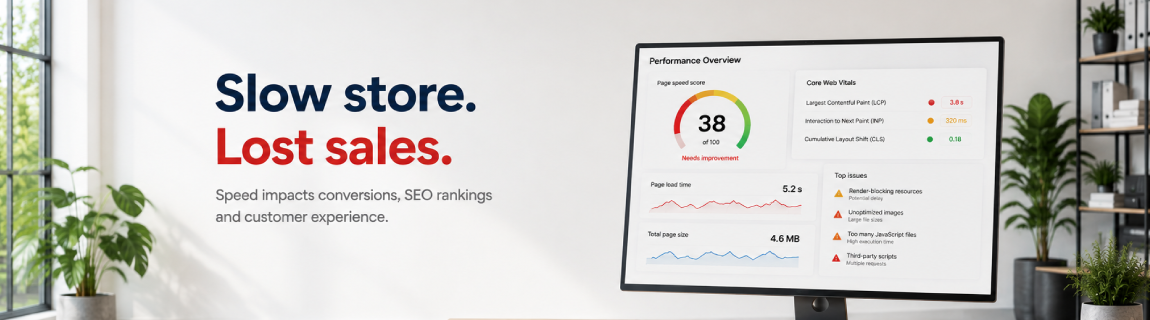
A slow eCommerce website doesn’t just frustrate customers. It costs you sales.
Whether you’re running Shopify, Adobe Commerce, BigCommerce, WooCommerce or another platform, website performance has a direct impact on conversion rates, customer satisfaction and search visibility. Even if your products, pricing and marketing are excellent, a slow website can undermine the entire customer experience.
The good news is that slow stores are rarely caused by the platform itself. More often, they’re the result of years of incremental changes, third-party apps, inefficient code, poor product data or integrations that haven’t been designed for scale.
In this guide, we’ll explore the most common reasons an eCommerce store becomes slow and the practical steps you can take to improve performance.
Why Website Speed Matters
Every second counts in eCommerce.
Research consistently shows that slower websites experience:
- Lower conversion rates
- Higher cart abandonment
- Increased bounce rates
- Reduced customer satisfaction
- Lower organic search visibility
- Reduced lifetime customer value
Customers have become accustomed to near-instant experiences from companies like Amazon, Apple and Google. They expect your website to respond just as quickly.
Performance is no longer a technical metric. It’s a business metric.
1. Too Many Apps and Third-Party Scripts
This is by far the most common cause of poor performance.
Over time, merchants install apps for:
- Reviews
- Loyalty
- Live chat
- Popups
- Marketing
- Analytics
- Personalisation
- Social proof
- Cookie consent
- Tracking pixels
Each one introduces additional JavaScript, CSS and network requests.
Individually these may seem insignificant. Combined, they can add several seconds to your page load time.
One of the first tasks during a performance audit is identifying which apps are genuinely delivering value and which can be removed or replaced with native platform functionality.
2. Poorly Optimised Images
Images are often the largest files downloaded by a customer’s browser.
Common issues include:
- Images uploaded at 5000px when only 800px are required
- PNG files where WebP would be more appropriate
- Missing lazy loading
- Excessive product gallery images
- Uncompressed banners
Modern eCommerce platforms support responsive image delivery, but this only works when images are prepared correctly.
Large image libraries can significantly impact loading speed, particularly on mobile devices.
3. Your Theme Has Become Bloated
Many online stores have evolved over several years.
Developers come and go.
Features are added.
Promotions are launched.
Apps are installed and removed.
Eventually the theme contains:
- Unused JavaScript
- Duplicate CSS
- Legacy snippets
- Obsolete templates
- Redundant tracking code
This technical debt accumulates quietly until performance begins to suffer.
Periodic theme reviews can dramatically improve loading speed without changing the visual design.
4. Your Product Catalogue Has Grown
As businesses grow, so does the complexity of their catalogue.
You may now have:
- Tens of thousands of products
- Hundreds of thousands of variants
- Large product families
- Complex filtering
- Rich product content
- Extensive metafields
Without careful optimisation, category pages, product pages and search results become increasingly expensive to generate.
A scalable product structure is just as important as a scalable website.
5. Search and Filtering Can Become Expensive
Customers expect powerful search functionality.
Features such as:
- Predictive search
- Faceted navigation
- Dynamic filtering
- AI recommendations
- Product comparisons
all require additional processing.
When implemented correctly these improve the shopping experience.
When implemented poorly they can significantly slow page rendering.
Selecting the right search technology and configuring it properly is critical for larger catalogues.
6. ERP and Third-Party Integrations
Many eCommerce businesses rely on integrations with:
- ERP systems
- Warehouse Management Systems
- CRM platforms
- Shipping providers
- Tax engines
- Payment gateways
- Product Information Management (PIM) systems
The problem isn’t integration itself.
The problem occurs when your website waits for external systems before rendering pages.
For example:
- Checking inventory live
- Calculating pricing
- Retrieving customer-specific discounts
- Looking up shipping rates
Poor integration architecture can quickly become one of the biggest causes of slow performance.
Well-designed integrations use caching, asynchronous processing and background synchronisation wherever possible.
7. Core Web Vitals
Google measures website performance using Core Web Vitals.
The three most important metrics are:
Largest Contentful Paint (LCP)
How quickly the main content becomes visible.
Interaction to Next Paint (INP)
How responsive your website feels after a visitor clicks, taps or types.
Cumulative Layout Shift (CLS)
Whether elements unexpectedly move around while the page loads.
These metrics influence both user experience and search visibility.
8. Too Much Tracking
Marketing teams understandably want as much data as possible.
Unfortunately this often results in multiple tracking solutions running simultaneously.
Examples include:
- Google Analytics
- Google Tag Manager
- Meta Pixel
- TikTok Pixel
- LinkedIn Insight Tag
- Hotjar
- Microsoft Clarity
- Klaviyo
- Live Chat
- Cookie management tools
Every additional script increases browser workload.
A regular review of your marketing technology stack can often deliver meaningful performance improvements.
9. Mobile Performance Is Different
Many merchants test their websites on powerful desktop computers connected to fast office internet.
Customers rarely browse this way.
Most visitors use:
- Mobile phones
- 4G or 5G networks
- Older devices
- Multiple browser tabs
A website that feels fast in your office may perform very differently for real customers.
Mobile-first optimisation should always be the priority.
10. Hosting Isn’t Always the Problem
A common misconception is that upgrading hosting will automatically fix performance issues.
In reality:
- Shopify is built on highly scalable cloud infrastructure.
- Adobe Commerce can perform exceptionally well when correctly configured.
- BigCommerce is designed as a SaaS platform with enterprise-grade hosting.
If your website is slow, the cause is often:
- Poor code
- Heavy themes
- Excessive JavaScript
- Large media files
- Inefficient integrations
- Third-party apps
Changing hosting without addressing these underlying issues rarely delivers the expected results.
11. AI Search Makes Performance Even More Important
Website performance is becoming increasingly important in an AI-driven search landscape.
Modern AI-powered search experiences rely on websites that are:
- Fast
- Well structured
- Easy to crawl
- Consistently available
- Rich in high-quality product data
Fast websites provide a better experience for both customers and automated systems that analyse and understand content.
As AI continues to influence how products are discovered, performance will become an increasingly important competitive advantage.
How to Identify What’s Slowing Your Store
Rather than guessing, it’s important to measure.
A professional performance review typically examines:
- Core Web Vitals
- Page load times
- Third-party scripts
- JavaScript execution
- Theme efficiency
- Image optimisation
- Server response times
- Integration architecture
- Search performance
- Mobile usability
This provides a clear roadmap of where improvements will have the greatest impact.
Quick Wins That Often Improve Performance
Many websites can achieve noticeable speed improvements without a complete rebuild.
Common opportunities include:
- Removing unused apps
- Optimising images
- Cleaning up theme code
- Reducing JavaScript
- Deferring non-essential scripts
- Reviewing third-party integrations
- Improving caching
- Optimising product data
- Streamlining collection structures
- Reviewing search implementation
These improvements often deliver measurable gains in both customer experience and conversion rates.
Final Thoughts
If your eCommerce store feels slow, don’t assume you need a new platform.
In many cases, the underlying technology is perfectly capable of delivering excellent performance. The challenge lies in how the website has evolved over time, with layers of customisations, apps and integrations gradually reducing efficiency.
A structured performance review can identify the real bottlenecks, prioritise improvements and help you deliver a faster, more enjoyable shopping experience for your customers.
Ultimately, website speed isn’t just about technical performance. It’s about helping customers find products faster, complete purchases more easily and return to your store with confidence.
For businesses investing in long-term digital growth, improving website performance is one of the highest-return investments you can make.