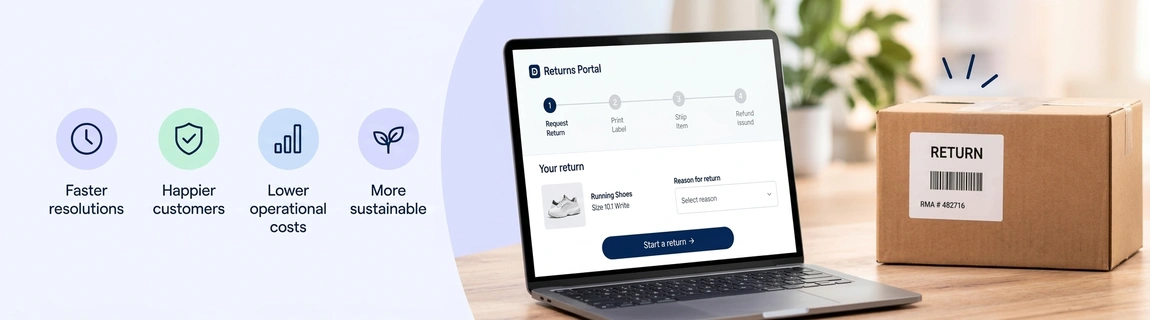
Returns are often treated as an unavoidable cost of doing business online. But for well-run eCommerce brands, they are also an opportunity to improve customer loyalty, reduce operational costs and gather valuable product insights.
A dedicated returns portal, supported by a clear Return Merchandise Authorization (RMA) process, turns what can be a frustrating and labour-intensive experience into a structured part of the customer journey.
What is a returns portal?
A returns portal is an online, self-service destination where customers can request a return, exchange or refund. Instead of contacting customer support and waiting for instructions, the customer can typically:
- Find their order using an order number and email address
- Select the item they want to return
- Choose a reason for the return
- Request a refund, exchange or store credit
- Generate a return label or QR code
- Track the progress of the return
Behind the portal, an RMA process assigns a unique reference to the return and guides it through approval, shipping, inspection, inventory and financial workflows.
The portal is the customer-facing experience. The RMA process is the operational framework that keeps everything controlled and traceable.
A better customer experience
The quality of a returns experience can influence whether a customer buys from a retailer again. When policies are unclear, instructions are difficult to find or refunds take too long, customers lose confidence in the brand.
A returns portal removes much of this uncertainty. It provides a consistent process, communicates what will happen next and gives customers greater visibility over the status of their request.
This convenience matters because the customer is already dealing with a disappointing outcome: the product may not fit, may not meet expectations or may have arrived damaged. A straightforward return cannot undo the original problem, but it can leave the customer feeling that the business responded fairly and professionally.
That experience can turn a potentially negative interaction into a reason to return.
Lower customer-service costs
Without a formal returns process, support teams spend significant time answering repetitive questions:
- Is my item eligible for return?
- Where should I send it?
- Has the return arrived?
- When will I receive my refund?
- Can I exchange it for another size?
A self-service portal answers many of these questions automatically. Eligibility rules can be applied at the beginning of the request, instructions can be generated immediately and status notifications can keep customers informed.
This reduces email volume and manual data entry, allowing service teams to focus on unusual or higher-value cases that genuinely require human judgement.
More accurate and efficient operations
Unstructured returns create work throughout the business. Warehouse staff receive parcels with incomplete information, support teams maintain separate spreadsheets and finance teams may issue refunds without a reliable connection to the returned product.
An RMA gives each return a unique record. When the parcel arrives, the warehouse can identify:
- The customer and original order
- The expected product and quantity
- The stated reason for return
- The requested resolution
- Whether the return was approved
- Any relevant deadlines or exceptions
This improves receiving accuracy and helps the business route products appropriately. Depending on their condition, returned goods may be restocked, refurbished, repaired, liquidated, recycled or written off.
A consistent RMA workflow also reduces the risk of issuing duplicate refunds, accepting ineligible returns or losing track of inventory.
Exchanges and store credit can protect revenue
A return does not always need to end in a refund. A well-designed portal can offer an exchange or store credit when appropriate.
For example, a customer returning clothing because of an incorrect size can be encouraged to select a replacement immediately. A customer who no longer wants a particular item may accept store credit, especially if it includes a small incentive.
These options preserve more revenue while still giving customers flexibility. They can also improve convenience: an instant exchange may be more attractive than waiting for a refund and then placing another order.
The key is to present alternatives without making refunds difficult. Retention works best when customers feel helped rather than obstructed.
Better data for product and business decisions
Returns provide a valuable source of customer feedback. A structured portal captures return reasons consistently instead of leaving them buried in support emails or free-text warehouse notes.
Over time, this data can reveal patterns such as:
- A garment consistently running smaller than expected
- A product being damaged by inadequate packaging
- Misleading photography or product descriptions
- Quality issues connected to a particular supplier
- High return rates from a specific campaign or sales channel
- Customers misunderstanding how a product should be used
These insights can inform changes to product design, sizing information, quality control, packaging, merchandising and marketing.
Reducing avoidable returns often creates more value than processing existing returns more cheaply.
Stronger policy enforcement and fraud controls
Returns policies can be difficult to enforce consistently when every request is handled manually. One customer may receive an exception while another receives a different answer for the same circumstances.
A returns portal can apply standard rules based on factors such as:
- Purchase date
- Product category
- Final-sale status
- Order location
- Warranty coverage
- Return history
- Condition requirements
Potentially suspicious or complex cases can be flagged for manual review, while ordinary requests move forward automatically.
This creates a useful balance: legitimate customers receive a fast experience, while the business retains control over high-risk returns.
A foundation for scalable growth
Manual processes may be manageable when a store receives only a small number of returns. As order volume grows, however, informal workflows become expensive and prone to error.
A portal and RMA system create repeatable processes that can scale across more orders, sales channels, warehouses and regions. Integration with the eCommerce platform, warehouse management system, shipping carriers, inventory records and payment provider can reduce handoffs even further.
The result is not simply faster returns. It is a more connected reverse-logistics operation.
Choosing the right approach
Not every business needs the most sophisticated returns platform available. The right solution depends on order volume, product type, return rate, operational complexity and customer expectations.
At a minimum, an effective system should provide:
- Clear eligibility rules
- A simple customer interface
- Unique return references
- Configurable refund, exchange and store-credit options
- Return shipping instructions
- Automated customer notifications
- Visibility for support and warehouse teams
- Consistent return-reason data
- Reporting on costs, recovery and outcomes
- Integration with core commerce and fulfilment systems
The process should also account for exceptions. Damaged goods, warranty claims, international returns and high-value products may require different workflows from ordinary change-of-mind returns.
Conclusion
A returns portal and RMA process should not be viewed only as administrative infrastructure. Together, they influence customer trust, operating efficiency, inventory accuracy and revenue retention.
The customer gains a faster, clearer and more convenient experience. The business gains automation, control and reliable data. Most importantly, returns become measurable and manageable rather than an disconnected cost hidden across customer service, warehousing and finance.
For eCommerce brands focused on sustainable growth, improving the returns experience can be just as important as improving checkout. The sale may happen at checkout, but loyalty is often earned by what happens when the purchase does not go to plan.