

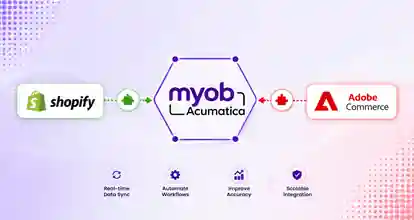
As Australian wholesalers, distributors and retailers modernise their operations, many are turning to MYOB Acumatica as the next generation of ERP technology. Selecting the right ERP is an important decision. However, the real value comes from ensuring your systems work together seamlessly.
A well-designed MYOB Acumatica integration connects your ERP and eCommerce platform into a single ecosystem, improving data accuracy, reducing manual processes and enabling your business to scale with confidence. Whether you’re implementing MYOB Acumatica for the first time, transitioning from MYOB EXO, or looking to improve an existing integration, this guide explores everything you need to know.
What Is a MYOB Acumatica Integration?
A MYOB Acumatica integration enables information to move automatically between your ERP and your eCommerce platform.
Rather than maintaining multiple disconnected systems, integrations synchronise critical business data to ensure operational teams and customers are working with accurate information.
Common integration scenarios include:
- Products and product information
- Inventory availability
- Customer accounts
- Pricing and discounts
- Sales orders
- Credit terms
- Shipping information
- Order status updates
The result is a connected technology ecosystem that supports growth without increasing administration.
Why Businesses Are Choosing MYOB Acumatica
Many organisations evaluating their future ERP strategy are attracted to MYOB Acumatica because of its modern architecture and flexibility.
Common reasons for adopting MYOB Acumatica include:
- Cloud-native deployment.
- Reduced reliance on on-premise infrastructure.
- Modern API capabilities.
- Flexible workflows.
- Improved accessibility for distributed teams.
- Support for business growth and scalability.
- Ongoing product investment and innovation.
For organisations currently operating on legacy ERP environments, MYOB Acumatica often provides an opportunity to modernise without compromising operational capability.
What Can Be Integrated with MYOB Acumatica?
Every implementation is different, but several integration requirements appear consistently across wholesale, retail and B2B environments.
Product Synchronisation
Ensure customers always have access to accurate product information.
This may include:
- Product names and descriptions
- SKUs
- Categories
- Attributes
- Images
- Product status
- Custom fields
Automating product updates improves consistency and reduces maintenance effort.
Inventory Synchronisation
Inventory accuracy is critical to maintaining customer trust.
Integrations commonly support:
- Available stock quantities
- Multi-warehouse inventory
- Backorder visibility
- Reserved inventory
- Safety stock thresholds
- Scheduled or near real-time updates
The right approach depends on your operational requirements and transaction volumes.
Customer Synchronisation
Customer information often exists across multiple systems.
Synchronisation can include:
- Customer accounts
- Contact information
- Billing addresses
- Delivery addresses
- Customer groups
- Trading terms
Maintaining a single source of truth reduces duplication and administrative overhead.
Pricing and Discounts
If you’re a wholesaler or manufacturer, you’ll know that B2B pricing structures can quickly become complex.
MYOB Acumatica integrations can support:
- Customer-specific pricing
- Trade pricing
- Contract pricing
- Promotional pricing
- Volume discounts
- Special pricing agreements
Ensuring pricing accuracy improves both customer confidence and operational efficiency.
Order Integration
Once an order is placed online, it should move seamlessly into fulfilment workflows.
Order integrations commonly include:
- Sales order creation
- Purchase order references
- Shipping instructions
- Tax calculations
- Payment status
- Order comments
- Fulfilment updates
This enables warehouse and finance teams to continue working within familiar operational processes.
B2B FunctionalityFor wholesalers and distributors, integration requirements often extend beyond simple transactions.
MYOB Acumatica integrations can support:
- Company accounts
- Credit terms
- Purchase order capture
- Approval workflows
- Account restrictions
- Self-service ordering experiences
These capabilities help create customer experiences that reflect how businesses actually trade.
Shopify and MYOB Acumatica Integration
Shopify has evolved into a powerful platform capable of supporting both B2C and B2B commerce.
When integrated with MYOB Acumatica, businesses can create seamless customer experiences while maintaining operational control.
Common Shopify integration scenarios include:
- Product synchronisation
- Inventory updates
- Customer account creation
- Order exports
- Trade pricing
- Multi-location inventory visibility
- B2B purchasing experiences
For growing organisations, the combination of Shopify and MYOB Acumatica offers flexibility without sacrificing scalability.
Adobe Commerce and MYOB Acumatica Integration
Adobe Commerce is often selected by organisations with more sophisticated requirements.
MYOB Acumatica integrations can support advanced Adobe Commerce capabilities such as:
- Shared catalogues
- Customer-specific pricing
- Company accounts
- Quote workflows
- Multiple customer groups
- Multi-source inventory
- ERP-driven catalogues
- Complex B2B experiences
This makes Adobe Commerce particularly well suited to businesses operating large-scale B2B environments.
Does MYOB Acumatica Have an API?
Yes.
One of MYOB Acumatica’s strengths is its modern API framework, which enables third-party systems to exchange information efficiently.
This supports the synchronisation of products, customers, orders and other operational data.
However, successful integrations involve more than simply connecting systems.
Businesses should also consider:
- Data ownership.
- Field mapping.
- Validation rules.
- Error handling.
- Security requirements.
- Monitoring and support.
- Long-term scalability.
The objective is not just to exchange data, but to support the way your business operates.
Migrating from MYOB EXO to MYOB Acumatica
For many Australian businesses, MYOB Acumatica represents a natural progression from MYOB EXO.
One of the biggest misconceptions during this transition is assuming everything must be rebuilt.
In reality, successful migrations often focus on preserving the customer experience while modernising operational systems.
Key considerations include:
- Documenting existing integrations.
- Understanding business processes and dependencies.
- Mapping data flows between systems.
- Reviewing pricing and customer structures.
- Thorough integration testing.
- Training operational teams.
- Monitoring closely after launch.
Importantly:
Replacing your ERP does not necessarily mean replacing your website.
Many organisations retain their Shopify or Adobe Commerce investment while adapting integrations to support their new ERP environment.
Common MYOB Acumatica Integration Challenges
Every integration project presents unique requirements.
Common challenges include:
Historical Customisations
Legacy processes often influence future requirements.
Data Quality
Incomplete or inconsistent data can impact migration outcomes.
Pricing Complexity
Customer-specific pricing structures require careful planning.
Multiple Warehouses
Inventory logic becomes increasingly sophisticated across locations.
B2B Account Structures
Approval processes, credit terms and purchasing rules must be accommodated.
Third-Party Systems
Freight providers, payment gateways, marketplaces and warehouse systems may also require consideration.
Addressing these areas early helps reduce project risk.
Choosing the Right Integration Approach
There is no single integration model suitable for every organisation.
Depending on requirements, businesses may consider:
Direct Integrations
Suitable for simpler environments where systems exchange information directly.
Middleware Solutions
Useful when multiple systems require orchestration and transformation.
Hybrid Architectures
Combining approaches to balance flexibility, scalability and operational requirements.
The right approach depends on your current environment and future objectives.
Why the Right Integration Partner Matters
Integrating MYOB Acumatica is about more than technical connectivity.
It requires an understanding of how customers buy, how teams operate and how information flows across the business.
Poorly designed integrations can result in:
- Incorrect pricing.
- Oversold inventory.
- Delayed fulfilment.
- Manual intervention.
- Frustrated customers.
- Reduced confidence in business systems.
A successful integration should remove friction and enable your organisation to operate more efficiently as it grows.
Frequently Asked Questions
Yes. Shopify can integrate with MYOB Acumatica to synchronise products, inventory, customers and orders while supporting both B2C and B2B requirements.
Yes. Adobe Commerce supports sophisticated MYOB Acumatica integrations, including customer-specific pricing, company accounts and advanced B2B workflows.
Yes. MYOB Acumatica provides modern API capabilities that support the exchange of operational data between systems.
Many MYOB EXO customers are evaluating MYOB Acumatica as part of their long-term ERP strategy due to its cloud-native architecture and ongoing investment.
Not necessarily. Many organisations retain their existing Shopify or Adobe Commerce platform and adapt integrations to support their new ERP environment.
Timelines vary depending on complexity, customisations and the number of systems involved. A discovery phase is typically the best way to understand requirements and identify potential risks.
A successful MYOB Acumatica integration should do more than automate data exchange. It should improve visibility, streamline operations and provide the foundation your business needs to grow with confidence.