
If you’re planning a new eCommerce project, one of the first questions you’ll ask is:
“How much will it cost to integrate our ERP?”
The honest answer is that it depends.
ERP integrations range from relatively straightforward inventory synchronisation through to highly complex, business-critical platforms that support customer-specific pricing, multiple warehouses, manufacturing workflows and real-time order processing.
Understanding what drives the cost of an ERP integration will help you budget accurately, avoid unnecessary customisation and build a solution that scales with your business.
In this guide, we’ll explore the factors that influence ERP integration costs, typical project budgets and where businesses can save money without compromising functionality.
Why ERP Integration Matters
Your ERP is the operational heart of your business.
It manages:
- Products
- Inventory
- Customers
- Pricing
- Purchasing
- Warehousing
- Manufacturing
- Finance
- Orders
Your eCommerce platform should not replace these functions.
Instead, it should provide customers with an intuitive buying experience while your ERP remains the system of record.
A well-designed integration ensures information flows seamlessly between both systems, eliminating manual processes and reducing errors.
What Impacts ERP Integration Costs?
The software itself is rarely the biggest cost.
Complexity is.
Several factors determine how much an integration will cost.
1. Which ERP Do You Use?
Every ERP is different.
Some offer modern REST APIs.
Others rely on older web services or database integrations.
Some already have mature middleware available.
Examples include:
- SAP Business One
- Microsoft Dynamics 365 Business Central
- NetSuite
- MYOB Acumatica
- Pronto Xi
- Infor M3
- SAP S/4HANA
- Cin7
- Odoo
An ERP with mature APIs and good documentation generally requires less custom development than older or heavily customised systems.
2. The Number of Integration Points
Many businesses initially think they only need products and orders synchronised.
In reality, modern commerce platforms often exchange far more information.
Common integration points include:
- Products
- Categories
- Inventory
- Customers
- Customer groups
- Customer-specific pricing
- Orders
- Shipments
- Tracking numbers
- Returns
- Credit limits
- Payment terms
- Tax rules
- Warehouses
- Purchase orders
- Gift cards
The more business processes involved, the greater the integration effort.
3. Real-Time vs Scheduled Synchronisation
Not every piece of information needs to update instantly.
Some businesses synchronise:
- Inventory every five minutes
- Products hourly
- Customers overnight
Others require:
- Real-time pricing
- Live inventory
- Immediate order creation
- Instant shipment updates
Real-time integrations generally require more sophisticated architecture and additional testing.
4. B2B Complexity
B2B projects almost always require more integration than B2C websites.
Examples include:
- Customer-specific pricing
- Multiple buyers per company
- Approval workflows
- Purchase order numbers
- Payment on account
- Credit limits
- Multiple delivery addresses
- Contract pricing
- Customer catalogues
These capabilities significantly increase integration complexity but also deliver substantial operational efficiencies.
5. Product Data Quality
Many ERP systems contain product information designed for internal operations rather than online selling.
Common issues include:
- Missing descriptions
- Low-quality images
- Inconsistent attributes
- Poor category structures
- Duplicate products
- Missing SEO information
Cleaning product data is often one of the largest hidden costs in an eCommerce project.
Fortunately, it also delivers one of the highest long-term returns.
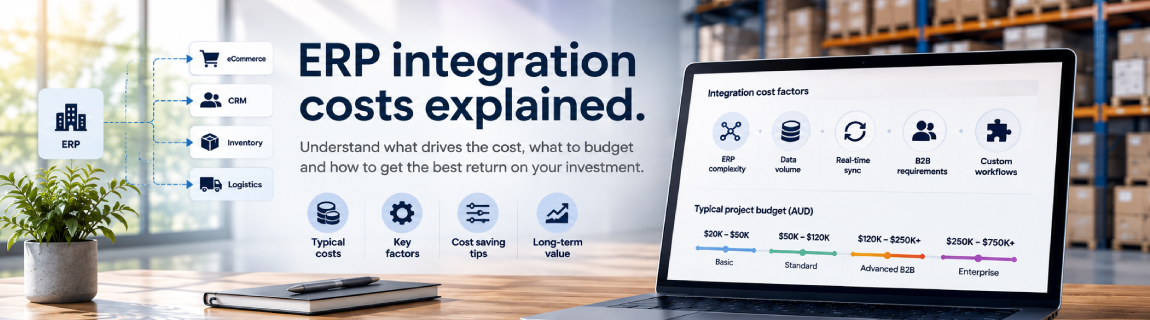
Typical ERP Integration Cost Ranges
Every project is different, but the following provides a general guide.
| Project Type | Typical Budget (AUD) |
|---|---|
| Basic inventory and order integration | $20,000–$50,000 |
| Standard ERP integration | $50,000–$120,000 |
| Advanced multi-system integration | $120,000–$250,000+ |
| Enterprise multi-system integration | $250,000+ |
These figures typically include integration development but not the full cost of the eCommerce implementation.
Projects involving multiple warehouses, international operations or highly customised workflows can exceed these ranges.
Shopify vs Adobe Commerce Integration Costs
Both platforms integrate successfully with leading ERP systems.
The difference lies less in integration capability and more in business requirements.
Shopify
Typically suits organisations seeking:
- Lower infrastructure costs
- Faster deployment
- SaaS architecture
- Lower ongoing maintenance
- Native B2B functionality
Shopify integrations are often simpler because much of the platform infrastructure is managed automatically.
Adobe Commerce
Adobe Commerce becomes attractive when businesses require:
- Highly customised purchasing journeys
- Large catalogues
- Complex pricing structures
- Multiple websites
- Advanced merchandising
- Extensive B2B workflows
The ERP integration itself may not be significantly more expensive, but overall project complexity is often higher.
Middleware vs Direct Integration
Another major cost consideration is architecture.
Direct Integration
Advantages:
- Fewer moving parts
- Lower licensing costs
- Simpler architecture
Disadvantages:
- Less flexible
- Harder to scale
- More tightly coupled
Middleware
Examples include:
- Boomi
- MuleSoft
- Celigo
- Patchworks
- Jitterbit
Advantages:
- Easier maintenance
- Better monitoring
- Improved scalability
- Reusable integrations
Disadvantages:
- Additional licensing
- More infrastructure
- Higher initial investment
For larger organisations, middleware often delivers a lower total cost of ownership over time.
Hidden Costs Businesses Often Miss
Many ERP integration budgets underestimate the work required outside development.
Common hidden costs include:
- Product data cleansing
- User acceptance testing
- Internal stakeholder workshops
- Documentation
- Change management
- Training
- API licensing
- Infrastructure
- Security reviews
- Performance optimisation
Planning for these activities early helps avoid unexpected budget increases later.
Can AI Reduce Integration Costs?
Increasingly, yes.
Modern development tools can accelerate:
- API development
- Testing
- Documentation
- Data mapping
- Code generation
- Error handling
However, AI cannot replace solution architecture.
The most important decisions—such as defining business rules, designing workflows and ensuring data integrity—still require experienced architects and integration specialists.
AI should be viewed as a productivity tool rather than a substitute for integration expertise.
How to Reduce ERP Integration Costs
There are several practical ways to reduce project costs without sacrificing long-term quality.
Invest in Discovery
The more clearly your requirements are defined, the fewer surprises you’ll encounter during delivery.
Improve Product Data First
Well-structured product data significantly reduces implementation effort.
Challenge Existing Processes
Not every legacy workflow should be replicated.
Many businesses discover opportunities to simplify operations during a replatform.
Use Native Platform Features
Modern commerce platforms provide sophisticated functionality out of the box.
Leveraging standard features instead of custom development usually reduces both implementation costs and future maintenance.
Think Beyond Launch
Design your integration to support future growth, additional sales channels and evolving customer expectations.
Building for scalability often delivers a lower total cost of ownership than solving only today’s requirements.
Choosing the Right Integration Partner
Selecting the right implementation partner is often more important than selecting the technology itself.
Look for a partner that understands:
- Your ERP
- Your eCommerce platform
- Your industry
- B2B and B2C workflows
- Integration architecture
- Long-term support
The cheapest quote isn’t always the least expensive project.
Poor architecture, inadequate testing and excessive customisation frequently lead to significantly higher maintenance costs over time.
Final Thoughts
ERP integration is one of the most valuable investments you can make in your eCommerce platform. When designed correctly, it eliminates manual processes, improves data accuracy, enhances the customer experience and provides a scalable foundation for future growth.
While project costs vary considerably depending on your ERP, business processes and integration requirements, focusing solely on the upfront budget can be misleading. The real objective should be building an integration that reduces operational costs, supports future expansion and delivers a measurable return on investment.
Whether you’re integrating Shopify, Adobe Commerce or another leading eCommerce platform, taking the time to plan the right architecture will almost always save time, money and complexity in the years ahead