
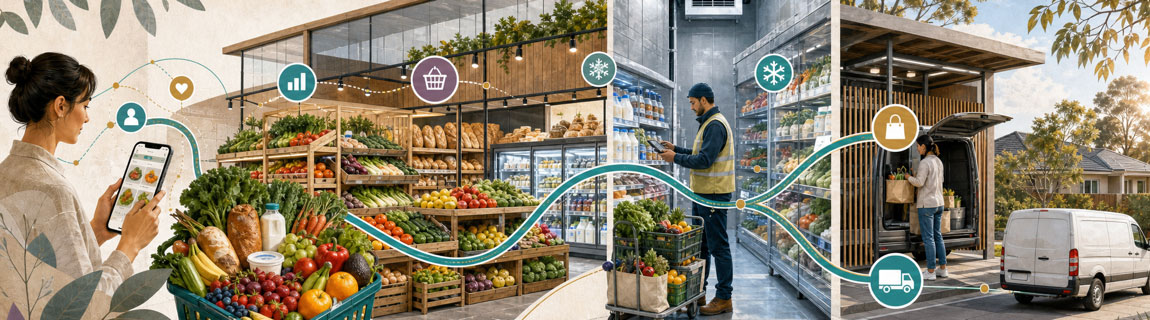
FMCG ecommerce presents retailers with an unusual commercial challenge.
Customers purchase frequently, but individual items are often inexpensive. Product ranges are large, availability changes quickly, promotions influence demand and fulfilment can consume a substantial share of the basket’s margin.
Growing online sales is therefore not enough.
An FMCG retailer can increase digital revenue while weakening its financial position through excessive discounting, substitution failures, inefficient picking, low-margin baskets and expensive delivery promises.
The objective must be profitable digital growth: increasing customer frequency and share of wallet while improving availability, basket contribution, operational efficiency and inventory productivity.
Online FMCG is growing rapidly—but the economics remain difficult
Australian consumers spent $14 billion online on food and grocery products in 2025, an increase of 15% year on year. Despite that growth, online transactions represented only 9.6% of total category spending, indicating significant room for further digital adoption.
Major Australian retailers are already experiencing substantial growth.
Coles reported 27% ecommerce sales growth during the first half of FY2026, alongside improved online satisfaction and supermarket EBIT growth of 14.6%.
Woolworths reported 23.8% ecommerce growth in the third quarter of FY2026. Ecommerce penetration reached 16.6% of Australian Food sales, while pickup represented 41.8% of ecommerce revenue.
These figures confirm that digital grocery and FMCG are becoming material parts of retail performance.
They do not, however, remove the central challenge: every additional order must still create sufficient contribution after promotions, picking, substitutions, packaging, payment and fulfilment.
FMCG ecommerce must be managed as a profit system
A successful ecommerce strategy connects customer experience with the retailer’s financial model.
| Ecommerce capability | Financial effect |
|---|---|
| Better product discovery | Higher conversion and category participation |
| Improved availability | More captured demand and fewer substitutions |
| Smarter basket building | Higher order value and gross profit |
| Personalised promotions | Reduced discount leakage |
| Faster repeat ordering | Greater frequency and customer retention |
| Better fulfilment choices | Lower cost-to-serve |
| Accurate delivery promises | Fewer cancellations and service contacts |
| Improved demand signals | Better inventory productivity |
| Retail media integration | Additional high-margin revenue |
| Stronger loyalty integration | Increased customer lifetime value |
This framework changes how the roadmap should be prioritised.
Instead of asking which features customers might appreciate, retailers should identify where the current digital journey is leaking revenue, margin or operating cost.
1. Compete for the whole basket—not individual products
FMCG customers rarely visit an ecommerce site to buy one isolated product.
They are assembling a basket around a household need, routine purchase, occasion or mission:
- The weekly grocery shop
- School lunches
- A dinner occasion
- Household cleaning
- Baby care
- Pet supplies
- Health and personal care
- Entertaining
- Replenishment of everyday essentials
The ecommerce experience should help customers complete that mission.
A retailer that focuses only on individual product conversion may improve the sale of one item while missing the larger basket opportunity.
Better basket-building capabilities include:
- Frequently purchased-together recommendations
- Meal or occasion-based collections
- Replenishment suggestions
- Previously purchased products
- Saved lists
- Household favourites
- Compatible pack-size alternatives
- Threshold progress
- Forgotten-item prompts
- Relevant substitutions
- Category-completion recommendations
The commercial measure should be contribution per order, not simply average order value.
Adding a low-margin or heavily discounted item may increase basket value without improving profit. Recommendations should therefore account for product relevance, margin, availability and the likelihood of incremental purchase.
2. Treat availability as a conversion and loyalty metric
In FMCG, availability is part of the product.
A product page can be accurate, attractive and easy to use, but it cannot convert if the product is unavailable at the customer’s fulfilment location.
The impact extends beyond the lost item.
An unavailable staple may cause the customer to move the entire basket to another retailer. Repeated availability failures can also reduce trust in future delivery and collection promises.
Retailers should measure more than the percentage of products technically in stock. They need to understand:
- Availability for products customers actually seek
- Availability by store and fulfilment location
- Lost demand from unavailable items
- Basket abandonment associated with stockouts
- Substitution acceptance
- Substitution profitability
- Products frequently removed after a location is selected
- Availability during promotions
- The accuracy of the online stock promise
A useful commercial metric is demand-weighted availability: the likelihood that a customer can purchase the products they are most likely to want.
Improving this measure can increase revenue without increasing traffic or promotional spending.
3. Make substitutions commercially intelligent
Substitution is one of the defining experiences of online FMCG.
A poor substitute can damage customer trust. Refusing to substitute anything can reduce order value and availability. Substituting solely according to product similarity may create an unacceptable price, dietary or brand outcome.
A good substitution system must account for:
- Product type
- Pack size
- Unit price
- Brand preference
- Dietary requirements
- Allergens
- Customer history
- Promotion status
- Margin
- Availability
- Customer-defined preferences
The system should also know when not to substitute.
A customer may accept another brand of paper towel but reject an alternative infant formula, prescription-adjacent product or ingredient required for a specific recipe.
Retailers should evaluate substitutions through:
- Acceptance rate
- Gross profit retained
- Refund rate
- Service enquiries
- Customer satisfaction
- Future purchase behaviour
- Picker compliance
- Time required to select an alternative
The objective is not to maximise the number of substitutions. It is to preserve the commercial value of the basket without weakening trust.
4. Improve the economics of digital promotions
FMCG retail is promotion-intensive.
Digital channels make promotions easier to target, test and measure. They can also increase margin leakage when offers are shown to customers who would have purchased anyway.
An effective promotion strategy should distinguish between:
- Acquiring a new customer
- Encouraging category trial
- Increasing purchase frequency
- Growing basket size
- Preventing churn
- Switching customers to a strategic product
- Clearing inventory
- Responding to competitor activity
- Rewarding loyalty
The promotion should be judged against the incremental behaviour it creates, not the revenue attached to redeemed transactions.
This requires a reliable control group and a view of customer behaviour beyond the promoted item.
A discounted product may appear successful while simply shifting the timing of a purchase or cannibalising a full-price alternative. Conversely, a low-margin promotional item may create a profitable basket when it attracts additional categories.
The relevant measures include:
- Incremental revenue
- Incremental gross profit
- Basket contribution
- Category expansion
- Purchase frequency
- Customer retention
- Cannibalisation
- Supplier funding
- Cost of fulfilment
- Post-promotion behaviour
Personalisation is valuable when it reduces unnecessary discounting and directs investment towards customers whose behaviour can genuinely be changed.
5. Design product discovery around shopping behaviour
FMCG discovery is different from discretionary retail.
Customers may search for a brand, a generic product, a dietary requirement, an occasion or a benefit. They may also expect to locate previously purchased products with minimal effort.
Search and navigation should understand:
- Brand and product names
- Pack sizes
- Common abbreviations
- Dietary and allergen requirements
- Flavours and variants
- Product benefits
- Category relationships
- Customer purchase history
- Promotional status
- Local availability
A customer searching for “gluten-free lunchbox snacks” is expressing a need that spans multiple product categories. A customer searching for a specific detergent may care about brand, load count, fragrance and unit price.
The strongest discovery systems combine product information, customer context and commercial logic.
They should make it easier to:
- Repurchase familiar items
- Compare unit prices
- Identify suitable alternatives
- Complete a shopping mission
- Discover relevant products
- Avoid unavailable products
- Understand promotional value
Retailers should monitor zero-result searches, query refinements, search exits, conversion after search and gross profit per search session.
Search data should also feed merchandising and range decisions. It provides a direct view of customer demand that was not satisfied by the current assortment or availability.
6. Win the digital shelf
In a physical store, shelf position influences visibility and purchase.
The same principle applies online, but the digital shelf is more dynamic. Product position can change according to search terms, customer history, availability, promotion, retail-media commitments and retailer priorities.
This creates a valuable commercial asset—but also a governance challenge.
Digital shelf decisions should balance:
- Customer relevance
- Product availability
- Gross margin
- Strategic brands
- Private-label objectives
- Promotional commitments
- Supplier funding
- New-product discovery
- Customer preferences
- Retail-media agreements
If ranking is driven solely by commercial payments, customer trust and conversion can decline. If it ignores commercial value entirely, the retailer may underuse a high-margin asset.
Sponsored placements should be clearly identified, relevant to the customer’s query and evaluated for incrementality.
Organic ranking logic should remain accountable to customer outcomes as well as retailer economics.
7. Use retail media without weakening the customer experience
FMCG retailers possess valuable first-party data and frequent customer interactions. This makes retail media an attractive source of high-margin revenue.
The opportunity extends across:
- Sponsored search
- Category placements
- Display advertising
- Personalised offers
- Off-site media
- Supplier-funded sampling
- Closed-loop campaign measurement
Retail media can materially improve the economics of ecommerce because media revenue does not carry the same fulfilment costs as product sales.
However, poorly integrated advertising can reduce product discovery, slow the site and create irrelevant customer experiences.
Retailers should evaluate the combined economics:
Retail-media revenue + incremental product margin − cannibalisation − experience impact − operating cost
A sponsored product that displaces a more relevant item may generate media income while lowering conversion or basket value. Measurement needs to capture the complete commercial effect.
The most valuable proposition for suppliers is not impressions alone. It is credible evidence that media investment created incremental sales, category growth or new customers.
8. Make repeat purchasing exceptionally easy
FMCG is naturally suited to retention because many products are purchased repeatedly.
Yet ecommerce journeys often require loyal customers to rediscover the same products every time.
Useful repeat-purchase capabilities include:
- Previous-order access
- One-click basket rebuilding
- Favourites
- Household lists
- Replenishment reminders
- Predictive recommendations
- Subscription or scheduled ordering
- Contextual alternatives when products are unavailable
The objective is not to automate the entire basket without customer involvement. It is to reduce the repetitive work involved in routine shopping.
Frequency should be evaluated alongside profitability.
A customer who orders more often in smaller baskets may increase revenue while raising fulfilment cost. Retailers should understand how repeat-order features affect basket contribution, order cadence, delivery utilisation and lifetime value.
The best retention model may encourage customers to consolidate some purchases while making urgent or convenience missions easier to complete profitably.
9. Segment fulfilment by mission and economics
Not every FMCG order needs the same fulfilment proposition.
A large planned grocery order, an urgent dinner purchase and a recurring pet-food delivery have different customer expectations and cost structures.
Retailers may need to support:
- Scheduled home delivery
- Same-day delivery
- Rapid delivery
- Click & Collect
- Store-based picking
- Centralised fulfilment
- Third-party delivery
- Supplier-direct delivery
- Subscription fulfilment
The strategic mistake is offering every service to every customer at a uniform price.
Fulfilment should account for:
- Basket value
- Gross margin
- Product temperature
- Weight and volume
- Delivery distance
- Customer value
- Time-window capacity
- Picking location
- Order urgency
- Membership status
Australia Post reports that 23% of online food purchases were sent through same-day or next-day delivery in 2025. At the same time, the average online food-and-grocery basket declined slightly to $104.55.
This makes fulfilment contribution especially important. Faster delivery may improve conversion, but the retailer must determine whether the incremental gross profit exceeds the additional picking and delivery cost.
10. Improve picking productivity without degrading quality
Picking is one of the largest variable costs in online FMCG.
Product location, store congestion, substitutions, age-sensitive stock and temperature requirements can all affect productivity.
A commercially effective picking model should consider:
- Pick path
- Product adjacency
- Batch size
- Store layout
- Order priority
- Substitution rules
- Freshness requirements
- Weight and fragility
- Temperature zones
- Handover timing
- Customer promise
Optimising only for items picked per hour can create problems elsewhere.
A faster picker may choose poorer fresh products, make less suitable substitutions or create packing errors. The resulting refunds, service contacts and customer attrition may cost more than the labour saved.
Retailers should measure:
- Cost per picked order
- Items picked per hour
- Order accuracy
- Substitution acceptance
- Freshness complaints
- Refunds
- Handover readiness
- Delivery-promise compliance
- Repeat purchase
Automation can create significant value, but it should be assessed as part of the complete order economics rather than through labour savings alone.
11. Connect loyalty data to operational decisions
FMCG loyalty programs can provide a detailed view of customer behaviour across categories, channels and time.
Their value is not limited to targeted marketing.
Connected loyalty data can help retailers understand:
- Customer lifetime value
- Category participation
- Churn risk
- Promotion sensitivity
- Channel preference
- Fulfilment preference
- Brand loyalty
- Replenishment cycles
- Household missions
- The relationship between store and online activity
This information should inform commercial and operational decisions.
A high-value customer encountering repeated substitutions may deserve different intervention from a promotion-driven occasional shopper. A customer who frequently collects orders may respond differently to fulfilment offers than someone who relies on delivery.
The challenge is to use this data transparently and responsibly. Personalisation should make shopping more useful, not make pricing or recommendations feel arbitrary.
12. Use ecommerce demand to improve inventory productivity
Sales history records what customers purchased. Digital behaviour also reveals what they attempted to purchase.
Searches, product views, unavailable-item interactions, abandoned baskets and rejected substitutions can improve demand planning when connected with transaction data.
Retailers can use these signals to identify:
- Demand hidden by stockouts
- Local range gaps
- Products receiving attention but failing to convert
- Promotion-driven demand changes
- Emerging dietary or category interests
- Substitute relationships
- Pack-size preferences
- Regional variation
- Products at risk of excess inventory
This can improve working capital by aligning inventory more closely with observable demand.
The greatest value comes when ecommerce, category management and supply-chain teams work from the same evidence. Digital insights should influence ranging, replenishment and supplier conversations—not remain confined to the ecommerce team.
13. Prepare product data for AI-mediated shopping
AI is beginning to change how customers discover, compare and select FMCG products.
Australia Post reports that 32% of Australians already use AI for shopping advice. FMCG products are particularly suited to assisted discovery because customers often have dietary, budget, household or occasion-based requirements.
For an AI assistant to recommend a product reliably, it needs accurate information about:
- Ingredients
- Allergens
- Dietary suitability
- Pack size
- Unit price
- Availability
- Promotions
- Nutritional information
- Brand
- Product benefits
- Delivery eligibility
This reinforces the importance of structured product information.
Retailers should not begin with a customer-facing AI assistant if the underlying product, inventory and promotion data is unreliable. Doing so merely creates a more conversational way to provide incorrect information.
The near-term opportunity is using AI to improve product classification, attribute extraction, search understanding, customer-service support and merchandising analysis—within defined controls.
14. Prioritise ecommerce investment through financial value
A mature FMCG ecommerce backlog may contain hundreds of potential improvements.
Without a shared commercial model, prioritisation can become driven by stakeholder seniority, competitor imitation or platform convenience.
Every material initiative should connect to a measurable financial outcome:
- Incremental revenue
- Gross-margin improvement
- Media revenue
- Reduced cost-to-serve
- Working-capital improvement
- Customer lifetime value
- Risk reduction
A practical model is:
Eligible demand × expected behavioural change × contribution per transaction − implementation and operating cost
For example, a retailer with $2 billion in digital sales would generate $10 million in additional revenue from a sustained 0.5% improvement. Whether that creates value depends on the incremental margin, fulfilment cost, cannibalisation and investment required.
This is not intended to create artificial certainty. It forces teams to state their assumptions and define success before implementation.
The most useful measures may include:
- Gross profit per digital visit
- Basket contribution
- Conversion by fulfilment type
- Demand-weighted availability
- Substitution acceptance
- Promotion incrementality
- Repeat-order frequency
- Digital share of customer spend
- Picking cost per order
- Delivery contribution
- Retail-media incrementality
- Customer-service cost per order
- Inventory turn
- Customer lifetime value
These measures give ecommerce investment a credible place within broader capital allocation.
The operating model matters as much as the platform
FMCG ecommerce spans merchandising, marketing, loyalty, stores, supply chain, technology, finance, media and customer service.
The platform cannot create profitable growth if these functions optimise competing outcomes.
Common questions include:
- Who owns basket contribution?
- Who controls digital shelf ranking?
- How are retail-media commitments governed?
- Who owns substitution quality?
- How is store-picking cost recognised?
- Which team funds delivery incentives?
- How are promotion results measured?
- Who owns product-data accuracy?
- How does online demand influence range and replenishment?
- Which metric takes priority when revenue and margin conflict?
These are commercial operating-model questions, not simply technology decisions.
An effective ecommerce strategy defines the customer promise, the financial model and the ownership required to deliver both.
What an industry-leading FMCG roadmap looks like
A credible roadmap should progress through five stages.
1. Establish the true economics
Measure revenue, gross profit, fulfilment contribution, media income, cost-to-serve and customer lifetime value.
2. Identify value leakage
Quantify the effect of unavailable products, failed searches, poor substitutions, ineffective promotions and unprofitable fulfilment.
3. Strengthen the data foundation
Connect product, inventory, promotion, customer and operational data around reliable definitions.
4. Optimise priority customer missions
Improve the journeys with the greatest revenue, frequency and contribution potential.
5. Scale intelligent decision-making
Use connected data to improve personalisation, ranging, replenishment, promotions, media and fulfilment across the business.
AI and automation become more useful in the final stage. Before that, they often amplify inconsistent information and unresolved commercial rules.
Profitable FMCG ecommerce is a coordination advantage
FMCG retailers already possess valuable assets:
- High purchase frequency
- Extensive product ranges
- Store and fulfilment networks
- Loyalty data
- Supplier relationships
- Established brands
- Customer trust
- Retail-media potential
The opportunity is to coordinate those assets more effectively.
That means improving the availability customers experience, building more profitable baskets, directing promotions towards incremental behaviour and matching each order with an economically appropriate fulfilment method.
For an ecommerce agency working in FMCG, interface quality should be the minimum standard—not the final measure of success.
The work should demonstrate how digital investment can:
- Capture more customer demand
- Increase profitable share of wallet
- Protect promotional margin
- Reduce fulfilment and service costs
- Improve inventory productivity
- Create new retail-media revenue
- Strengthen customer lifetime value
That is the difference between improving an ecommerce website and materially improving the retailer’s financial position.